
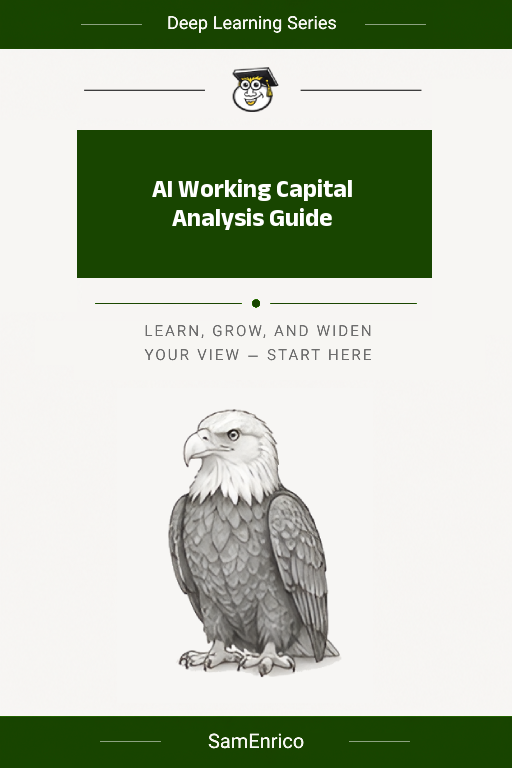
AI Working Capital Analysis Guide eBook
Analyze DSO DPO and inventory turns using AI that
by Seward Daren
Analyze DSO DPO and inventory turns using AI that suggests working capital improvements.
Formats
Free sample
Chapter 1: The Cash Graveyard--Most healthy-looking companies are already dead. They just haven't stopped breathing yet.I learned this lesson the hard way in 2019, sitting across from a CEO who had just finished presenting his quarterly earnings. Revenue was up 14 percent. EBITDA had improved 220 basis points. The stock had rallied 8 percent that morning.
His board was thrilled. His investors were applauding. And his company was ninety-six hours away from missing payroll.I was there as a consultant, brought in to do a routine working capital assessment. The CEO, a confident man in his early fifties with a Harvard MBA and a wall full of framed magazine covers, waved me off with a smile. "We have excellent metrics," he told me.
"Our DSO is fifty-two days. Industry average is fifty-five. We're winning."I asked to see the underlying data. Not the averaged reports. Not the month-end summaries.
The raw, line-item receivables aged by customer. He hesitated. Then he called his controller, who turned pale when I asked the question.What we found in the next three hours would cost the company $4.2 million in immediate cash that had been sitting there, invisible, for nearly two years. And it would cost the CEO his job within six months.This book is about making sure that does not happen to you.The Silent Bleeding Working capital is the most misunderstood metric in all of corporate finance. Ask a hundred CFOs what their working capital position is, and ninety-nine will give you a number that is technically correct and practically useless.
They will tell you their Days Sales Outstanding averages fifty-three days. They will tell you their inventory turns 4.2 times per year. They will tell you their Days Payables Outstanding sits at forty-eight days.These numbers are averages. Averages lie.Consider a simple example. A company has two customers.
Customer A pays in 10 days. Customer B pays in 90 days. The average DSO is 50 days. That number is mathematically correct. It is also dangerously misleading because it hides the fact that half the company's receivables are trapped for three full months.Now imagine that Customer B represents 60 percent of revenue.
The weighted average becomes 58 days. Still a single number. Still hiding the truth. Still creating the illusion of health while the company bleeds cash.This is the core argument of this book: traditional working capital management relies on lagging indicators that show you the problem only after the damage is done. By the time your month-end report tells you that DSO has jumped from 45 to 68 days, your cash has already been stuck in receivables for weeks.
By the time your quarterly review identifies excess inventory, those goods have already absorbed carrying costs, taken up warehouse space, and begun their slow march toward obsolescence. By the time your AP team realizes they missed an early-payment discount, the money is gone.The three silent killers of working capital are hiding in plain sight, camouflaged by the very systems designed to track them.Killer One: The Interest-Free Loan Every day an invoice remains unpaid, you are giving your customer an interest-free loan. This sounds obvious, but the magnitude of the cost is rarely calculated. Let us do the math.Assume your company has 100millioninaccountsreceivable.Assumeyourweightedaveragecostofcapitalis10percent.Eachadditionaldaythatthosereceivablesremainoutstandingcostsyouapproximately100 million in accounts receivable. Assume your weighted average cost of capital is 10 percent.
Each additional day that those receivables remain outstanding costs you approximately 100millioninaccountsreceivable.Assumeyourweightedaveragecostofcapitalis10percent.Eachadditionaldaythatthosereceivablesremainoutstandingcostsyouapproximately27,400 in implied interest—money you could have used to pay down debt, fund growth, or return to shareholders. Over a year, adding just five days to your DSO costs you nearly $5 million.Most finance teams treat DSO as a target to monitor, not a cost to optimize. They celebrate when DSO drops from 55 to 52 days without calculating the actual cash impact. They set annual goals based on industry benchmarks without understanding the unique behavior of their own customers.Worse, they rely on average DSO, which smooths out the spikes and valleys where the real problems live. A customer who pays in 20 days and another who pays in 100 days produce an average of 60 days, telling you nothing about the customer who is costing you thousands in implied interest every month.I once worked with a manufacturing company that had one customer representing 35 percent of revenue.
That customer paid in 90 days, every time, like clockwork. The company's reported DSO was 47 days because the other sixty-five customers paid quickly. The finance team had no idea that their largest customer was effectively receiving a multi-million dollar annual subsidy. When we calculated the implied interest cost of that 90-day term compared to a standard 30-day term, it exceeded $2.1 million per year. The company had been giving away that money for seven years.Killer Two: The Warehouse Tax Inventory is not an asset.
It is a tax on your balance sheet.This statement provokes immediate pushback from operations executives who have been trained to believe that inventory buffers against supply chain disruptions and protects customer service levels. They are not wrong about the buffer. They are wrong about the cost.Carrying inventory involves direct costs: warehousing, insurance, taxes, handling, and obsolescence. These typically run 20 to 30 percent of inventory value per year. A company holding 50millionininventoryisspending50 million in inventory is spending 50millionininventoryisspending10 to $15 million annually just to keep it sitting there.
That money is not invested in growth. It is not returned to shareholders. It is burned, slowly and invisibly, on the assumption that more inventory equals better service.But the indirect costs are even larger. Inventory ties up cash that could be used for acquisitions, capital expenditures, or debt reduction. Inventory creates operational drag, requiring labor to manage, systems to track, and management attention to review.
Inventory breeds complacency, allowing purchasing teams to order in bulk without scrutiny and sales teams to promise delivery without accountability.The illusion of "always on" is seductive. No supply chain manager ever got fired for having too much inventory. Plenty have been fired for stock-outs. So the bias runs deep toward holding more, not less. The result is warehouses filled with goods that move slowly, sit for months, or will never sell at all.I visited a distribution center in Ohio where the management team proudly showed me their 98 percent fill rate.
They had achieved this by carrying 120 days of inventory on average. Their industry benchmark was 60 days. They were carrying twice as much as necessary, tying up 40millioninexcessstock,andburning40 million in excess stock, and burning 40millioninexcessstock,andburning8 million per year in carrying costs. When I asked why, the answer was simple: "We've always done it this way."Killer Three: The Chaos Tax Accounts payable is the forgotten stepchild of working capital. CFOs obsess over DSO.
Supply chain leaders manage DIO. But AP? AP is where invoices go to die.The chaos tax takes two forms. First, manual processes create delays that forfeit early-payment discounts. A supplier offers 2 percent 10, Net 30.
You have twenty days to decide: pay in ten days and save 2 percent, or wait thirty days and pay full price. A 2 percent discount over twenty days annualizes to 36.5 percent return. There is no safer investment in the world.Yet most companies capture less than half of available early-payment discounts. Why? Because invoices…
This is the end of the free sample. Get the eBook to keep going. Buy now
About this book
Details
- Author
- Seward Daren
- Publisher
- SamEnrico
- Language
- English
- Genre
- Non-Fiction, AI Operator
- Released
- 2026-06-01
- Pages (approx.)
- 147
- Available as
- eBook, Audiobook

Read better in the ZLOADR app
Your eBooks on your phone or tablet. Sign in with your SamEnrico account and start reading.
More by Seward Daren
 Peg System for Foreign ScriptsSeward Daren$11.99
 Sales EQ Influence HandbookSeward Daren$11.99
 The Military Student TransitionSeward Daren$11.99
 Palace for Grocery ListsSeward Daren$11.99
 Mindfulness Meditation for Depression WorkbookSeward Daren$11.99
 Drug Dependency HandbookSeward Daren$11.99
 Art Therapy for NightmaresSeward Daren$11.99
 Self Worth And HoardingSeward Daren$11.99
 Metta For ResistanceSeward Daren$11.99
 The Last Don: The Untold Fall of John Gotti's EmpireSeward Daren$11.99
 Napoleon's Gold: How Money Won the Peninsular WarSeward Daren$11.99
 Striking Back: The 2023 Hollywood Writers' StrikeSeward Daren$11.99
You may also like
 Hong Kong Handover 1997Dunn Johnnie$11.99
 Zumba For Postnatal Recovery CourseNeal Christian$11.99
 Zumba for BeginnersLadner Nikia$11.99
 YouTube Comment Mining GuideHumes Pandora$12.99
 Worry Box MeditationCarlin Rudy$11.99
 Workplace Stress MeditationNguyen Lynn$11.99
 Workplace Stress and Sleep RepairHawley Ivory$11.99
 Workplace Perfectionism CureDelaney Jeffry$11.99
 Workplace Injustice Anger GuideWallen Isabelle$11.99
 Work Addiction and Burnout LinkGreenwood Ester$11.99
 Women in Yoga and WellnessBeattie Galina$11.99
 Women in Stand Up ComedyChun Evangeline$11.99