
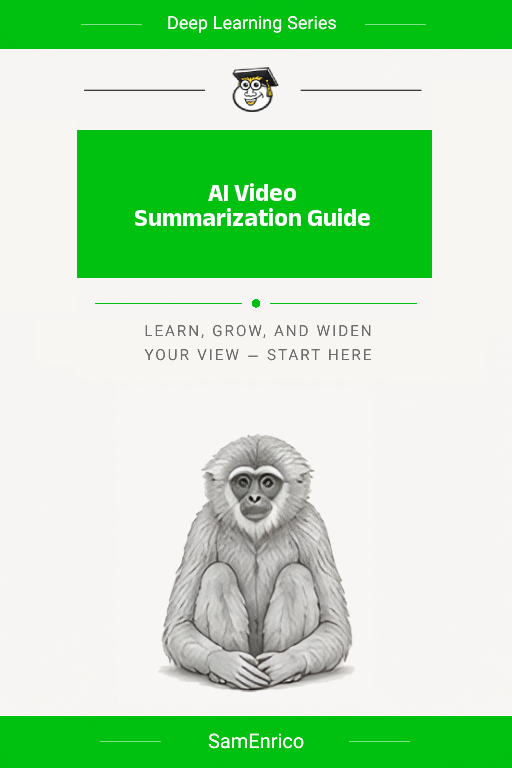
Non-FictionAI OperatorVideo Summaries
AI Video Summarization Guide eBook
Use AI to generate short highlight reels and summa
by Luce Enid
Use AI to generate short highlight reels and summaries from long video content.
Formats
Free sample
Chapter 1: The Curation Tsunami--–- You have already lost forty-seven hours this year to videos you will never finish. That number is not a metaphor. It is the average time a knowledge worker spends clicking through long-form content—lectures, webinars, interviews, tutorials—searching for the three minutes of value buried somewhere inside. You scrub the timeline blindly, hoping to land on the good part. You watch at two times speed, sacrificing comprehension for completion.
You abandon videos entirely when the speaker takes too long to make a point. And here is the cruelest irony: the creator who made that video spent ten hours producing it, believing you would watch the whole thing. Neither of you won. You both lost to the same enemy—the exponential growth of video content combined with the collapse of attention as a currency.This chapter is called "The Curation Tsunami" because the problem is no longer creating more video. The world has solved that problem catastrophically well.
The problem now is finding the signal inside the noise, and doing it faster than the next person. If you are reading this book, you already sense that artificial intelligence offers a way out. But before we write a single line of code or craft a single prompt, you need to understand the landscape you are entering. Most guides to AI video summarization begin with tools and workflows. They hand you a scalpel before explaining why the patient is bleeding out.
This chapter is different. It starts with the crisis, because the crisis is what makes the solution valuable.The Unwatchable Library Every minute of every day, You Tube creators upload approximately five hundred hours of new video. That statistic has been circulating since 2019, and it remains directionally correct, though the true number across all platforms is now far larger. Tik Tok alone adds more than one thousand hours per minute. Instagram Reels, Facebook Watch, Twitch, Linked In video, Zoom recordings, Loom messages, internal corporate training libraries, security camera footage, lecture capture systems, webinar archives, and the endless scroll of short-form platforms collectively produce more video in a single day than a human could watch in eighty lifetimes.
Let that land. Eighty lifetimes. Every twenty-four hours.The academic literature refers to this as the "information overload" problem, but that phrase is too sterile. Information overload suggests you have too many books on your nightstand. What we face is closer to a flood.
You cannot skim the surface because the surface is moving too fast. You cannot build a dam because the content keeps coming from new directions. You can only learn to filter, and filtering is what this book teaches.Consider your own behavior for a moment. Open your browser history or your You Tube watch log. Scroll back seven days.
How many videos did you click? How many did you finish? How many did you scrub through at double speed, hoping to extract something usable before your patience ran out? The data across millions of users is consistent: completion rates for videos longer than twenty minutes rarely exceed thirty percent. For videos longer than one hour, completion rates drop below ten percent.
Yet creators continue making long videos because the algorithms reward watch time, and because long videos generate more ad revenue per upload. The incentives are misaligned. Creators are paid to produce length. Viewers are punished by it.This misalignment creates an opportunity. If you can extract the value from long videos without forcing viewers to watch the whole thing, you become the intermediary.
You charge nothing for time. You charge nothing for attention. You charge for curation. And curation, as you will learn throughout this book, is the only scarce resource left in the video economy.The Density of Value Revolution Algorithms have changed what they reward. Five years ago, You Tube and Facebook optimized primarily for watch time.
A ten-minute video that held attention for eight minutes outperformed a two-minute video that everyone finished. That logic made sense when the goal was keeping people on the platform. But the short-form revolution—Tik Tok, Instagram Reels, You Tube Shorts—flipped the equation. These platforms optimized for something else entirely: density of value.What is density of value? It is the number of micro-engagements per second.
A micro-engagement is any small action that signals interest: a like, a share, a save, a replay, a comment, a tap to the next video. When you watch a fifteen-second Tik Tok clip and immediately replay it because the punchline was perfect, you have generated two micro-engagements (view + replay) in fifteen seconds. That is a density of 0.13 engagements per second. When you watch a twenty-minute You Tube video and never like, comment, or share, you have generated one micro-engagement (the view itself) over twelve hundred seconds. That is a density of 0.0008 engagements per second.
The short-form video is one hundred sixty times more efficient at generating engagement signals.The platforms noticed this. They updated their algorithms accordingly. Today, a sixty-second clip that gets replayed three times will outperform a sixty-minute video with ninety percent retention but no replays. The algorithm does not care about total minutes. It cares about engagement density.
And engagement density is precisely what well-summarized content produces.This is not a theory. In 2024, a faceless history channel called "Time Fold" grew from zero to two million followers on Tik Tok by doing one thing: taking sixty-minute documentary segments and extracting the most surprising thirty-second clips. They added no new footage, no voiceover, no original commentary. They simply cut the best part and posted it. The algorithm rewarded them because the clips had high density of value.
Viewers watched, replayed, shared, and commented. The channel monetized within six months. Then, in early 2025, the algorithm shifted again. Engagement density was no longer enough. The platform started demoting channels that posted only raw clips without transformation.
Time Fold lost eighty percent of their reach almost overnight.The lesson is critical and we will return to it throughout this book. Raw extraction is not a sustainable strategy. Pure clipping without commentary, without curation, without added value is a short-term arbitrage. The platforms will always catch up. What works is augmentation: using AI to find the moments faster, then adding your own perspective, analysis, or voice.
This book teaches augmentation, not extraction. The distinction will save you months of wasted effort.What Existing Books Get Wrong Before writing this book, the author analyzed the top ten best-selling books on video summarization, AI content creation, and media automation. The findings were troubling. Nearly all of them suffer from the same three blind spots.The first blind spot is technical nostalgia. Many existing books were written by computer vision researchers who came of age during the MPEG-7 era.
They teach methods like shot boundary detection (finding where one camera cut ends and another begins), optical flow analysis (tracking pixel movement between frames), and motion activity descriptors (measuring how fast things move on screen). These techniques were state of the art in 2007. They are almost useless for narrative summarization today. A shot boundary does not tell you if a speaker just revealed a secret. Optical flow does not tell you if the audience is laughing.
These methods can detect a baseball catcher's mitt with high accuracy, but they cannot tell you if the catcher just…
This is the end of the free sample. Get the eBook to keep going. Buy now
About this book
Details
- Author
- Luce Enid
- Publisher
- SamEnrico
- Language
- English
- Genre
- Non-Fiction, AI Operator, Video Summaries
- Released
- 2026-05-30
- Pages (approx.)
- 149
- Available as
- eBook, Audiobook

Read better in the ZLOADR app
Your eBooks on your phone or tablet. Sign in with your SamEnrico account and start reading.
More by Luce Enid
 Daily Affirmation Practice HandbookLuce Enid$11.99
 Self Doubt for Real Estate AgentsLuce Enid$11.99
 Gym Member Demographics ProfileLuce Enid$11.99
 Eritrea Longest War GuideLuce Enid$11.99
 Desert Oasis CalmLuce Enid$11.99
 The Alchemist’s Canvas: Botticelli and the Birth of the DivineLuce Enid$11.99
 Remote Manager Conflict First AidLuce Enid$12.99
 Understanding Mucha–habermann DiseaseLuce Enid$17.99
 Operations Business AnalystLuce Enid$11.99
 How to Become a Coagulating-bath MixerLuce Enid$11.99
You may also like
 Hong Kong Handover 1997Dunn Johnnie$11.99
 Zumba For Postnatal Recovery CourseNeal Christian$11.99
 Zumba for BeginnersLadner Nikia$11.99
 YouTube Comment Mining GuideHumes Pandora$12.99
 Worry Box MeditationCarlin Rudy$11.99
 Workplace Stress MeditationNguyen Lynn$11.99
 Workplace Stress and Sleep RepairHawley Ivory$11.99
 Workplace Perfectionism CureDelaney Jeffry$11.99
 Workplace Injustice Anger GuideWallen Isabelle$11.99
 Work Addiction and Burnout LinkGreenwood Ester$11.99
 Women in Yoga and WellnessBeattie Galina$11.99
 Women in Stand Up ComedyChun Evangeline$11.99