
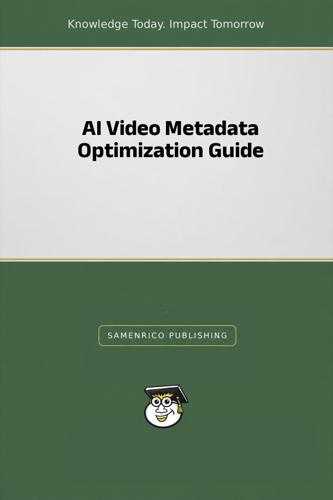
AI Video Metadata Optimization Guide eBook
Auto-generate titles, descriptions, tags, and chap
Auto-generate titles, descriptions, tags, and chapters by analyzing visual and audio content for SEO.
Formats
Free sample
Chapter 1: The Silent Judge--–- Every minute, over 500 hours of video are uploaded to You Tube alone. That's not a statistic to impress you at a dinner party. That's the roar of a crowd so loud that your voice—no matter how talented, how well-lit, how perfectly edited—is reduced to a whisper. You are not competing with bad content. You are competing with an avalanche of content that is good enough, published by people who have figured out one simple, brutal truth: being a great video creator does not make you a visible video creator.The gap between those two things—greatness and visibility—is not filled by luck.
It is not filled by the algorithm smiling upon you because you "deserve it." It is filled by metadata. And most creators, even the ones who have been at this for years, do not understand what metadata actually is, how it works, or why it has become the single most important lever they are not pulling.Let me tell you about Marco.Marco runs a small cooking channel called "Weeknight Hero." He is not a celebrity chef. He does not have a test kitchen with six cameras. He has an i Phone, a tripod, a hot stove, and an obsessive attention to detail. His recipes are genuinely good—tested, rewritten, tested again.
His pacing is tight. His lighting improved after he watched three You Tube tutorials on three-point setups. By any reasonable measure, Marco makes better content than 80 percent of the food creators in his niche.But for two years, his videos averaged 1,200 views. Some hit 5,000. Most got 400.
He watched competitors with worse recipes, worse presentation, and worse audio rack up 50,000 views on videos that looked like they were filmed in a basement. He did what any reasonable person would do: he improved his content. Better thumbnails. Faster intros. More engaging hooks.
Nothing moved the needle.The problem was not his content. The problem was that his content was invisible.And the reason it was invisible is that Marco thought of metadata as paperwork. After finishing a 10-hour editing session, he would spend five minutes typing a title that felt "good enough," copy the same three-sentence description from the last video, and paste a handful of tags he remembered from a You Tube tutorial in 2019. Then he would upload, sigh with relief, and wonder why the algorithm ignored him.The algorithm was not ignoring him. The algorithm could not find him.
Because Marco had given it nothing to find.This chapter is about understanding the silent judge that decides whether your video lives or dies. It is called a search engine, but that name is misleading. It does not search. It matches. And what it matches against is not your passion, your skill, or your production value.
It matches against metadata.By the end of this chapter, you will understand exactly how platforms like You Tube, Tik Tok, Vimeo, and even Google Video see your content. You will learn the three data streams that every video platform analyzes. You will learn why most creators are accidentally sabotaging their own discoverability. And you will learn the single mental model that will change how you think about every video you make from this day forward.The Metadata Delusion Let me start by killing a beloved myth: the algorithm does not "watch" your video.I know. It feels like it should.
We have been trained by years of social media mysticism to believe that some benevolent or malevolent AI is sitting in a server farm, evaluating our jump cuts, judging our storytelling, deciding whether we are worthy of the coveted "suggested videos" section. That is not how it works. Not even close.What actually happens is far more mechanical, far more literal, and far more exploitable.When you upload a video, the platform cannot—technologically cannot—watch it like a human does. Human vision is contextual. We see a chef chop an onion and we understand not just the action but the intention, the urgency, the sweat on the brow, the slightly dull knife that should have been sharpened.
A platform does not have that capacity. It has something else: pattern matching on an industrial scale.The platform ingests your video and immediately begins extracting three distinct types of data. Think of these as three different witnesses in a courtroom, each giving their own testimony about what your video contains. The platform then compares these three testimonies against each other. If they agree, you are rewarded.
If they contradict each other, you are penalized.The first witness is your audio track. The platform runs your entire audio through Automatic Speech Recognition (ASR) – a technology that converts spoken words into text. This is not transcription in the way you might use Otter.ai for a meeting. This is industrial-scale speech-to-text running at machine speed. It captures every word you say, every pause, every repeated phrase.
It can identify different speakers. It can detect sentiment—not perfectly, but well enough to know whether your tone is excited, somber, urgent, or instructional.The second witness is your visual frames. The platform samples your video at regular intervals—typically one to two frames per second—and runs those frames through object detection and scene recognition models. These models are trained to identify faces, text on screen, objects (knife, onion, stove), actions (chopping, pouring, stirring), and scene changes. They do not "understand" what they are seeing in any human sense.
But they can say with statistical confidence: "This frame contains a person. This frame contains food. This frame contains text that says 'Secret Ingredient.'"The third witness is your metadata packet—the fields you fill out when you upload. Title, description, tags, file name, and (depending on the platform) category, language, and captions. This is the testimony you control directly.
And here is the twist that most creators never realize: the platform compares this metadata against the audio and visual testimonies. If your metadata claims the video is about "beginner pasta recipes" but your audio spends ten minutes discussing advanced sous-vide techniques, the platform knows. If your title promises "five kitchen hacks" but your visual frames show only one hack repeated, the platform knows.The silent judge is not looking for perfection. It is looking for alignment.The Three Phases of the Video Crawl Now that you understand what the platform is looking at, let me walk you through exactly when and how it looks. The video crawl—the process by which your video becomes searchable—happens in three distinct phases.
Each phase matters. Each phase is a lever you can pull.Phase One: Ingestion The moment your video finishes uploading (and in some cases, while it is still uploading), the platform begins ingestion. This is the fastest phase, typically completing within minutes. During ingestion, the platform generates a transcript from your audio and extracts key frames from your video. It also reads your metadata packet immediately.Here is what most creators get wrong about ingestion: they assume they can upload first and optimize later.
They rush through the metadata fields to get the video live, planning to "come back and fix the description" or "update the…
This is the end of the free sample. Get the eBook to keep going. Buy now
About this book
Details
- Author
- Linville Kaley
- Publisher
- SamEnrico
- Language
- English
- Genre
- Non-Fiction, AI Operator, SEO
- Released
- 2026-06-06
- Pages (approx.)
- 153
- Available as
- eBook, Audiobook

Read better in the ZLOADR app
Your eBooks on your phone or tablet. Sign in with your SamEnrico account and start reading.
More by Linville Kaley
 The Saadia GaonLinville Kaley$11.99
 Emotion Regulation for Social Anxiety CourseLinville Kaley$11.99
 Self Hypnosis for Self LoveLinville Kaley$11.99
 Agoraphobia Subway Train HandbookLinville Kaley$11.99
 The Frozen Alchemists: When Ice Revealed the Secrets of the ElementsLinville Kaley$11.99
 How to Become a Car CooperLinville Kaley$11.99
 Ecommerce Marketplace Seller OutlookLinville Kaley$12.99
 Data Science Bootcamp Vs DegreeLinville Kaley$12.99
 Understanding Branchio-oculo-facial SyndromeLinville Kaley$17.99
 Industrial Sales RepresentativeLinville Kaley$11.99
You may also like
 Hong Kong Handover 1997Dunn Johnnie$11.99
 Zumba For Postnatal Recovery CourseNeal Christian$11.99
 Zumba for BeginnersLadner Nikia$11.99
 YouTube Comment Mining GuideHumes Pandora$12.99
 Worry Box MeditationCarlin Rudy$11.99
 Workplace Stress MeditationNguyen Lynn$11.99
 Workplace Stress and Sleep RepairHawley Ivory$11.99
 Workplace Perfectionism CureDelaney Jeffry$11.99
 Workplace Injustice Anger GuideWallen Isabelle$11.99
 Work Addiction and Burnout LinkGreenwood Ester$11.99
 Women in Yoga and WellnessBeattie Galina$11.99
 Women in Stand Up ComedyChun Evangeline$11.99