
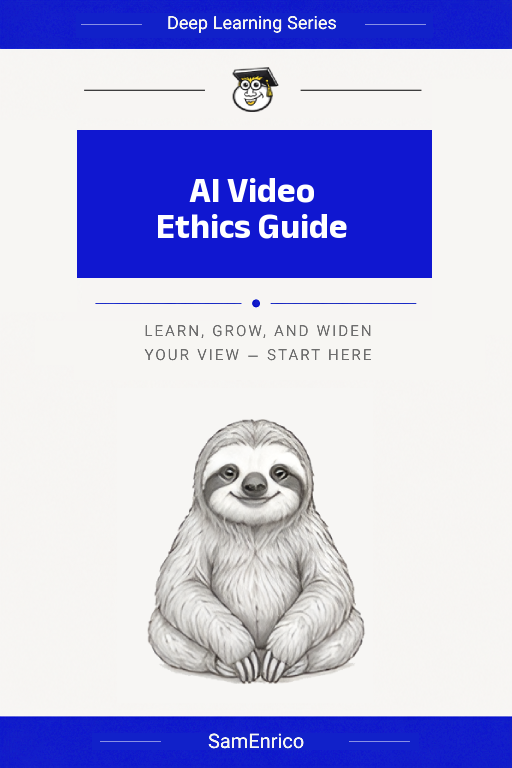
AI Video Ethics Guide eBook
Navigate ethical considerations in AI video produc
by Jolly Loree
Navigate ethical considerations in AI video production including deepfakes and disclosure.
Formats
Free sample
Chapter 1: The Broken Mirror--The camera never lied. For nearly two centuries, that unspoken contract between lens and viewer held firm. From the first daguerreotypes to the grainy Zapruder film, from the live broadcast of the moon landing to the viral smartphone video of a police shooting, moving images carried an almost sacred weight. They were evidence. They were proof.
They were the closest thing humanity had to a time machine—a window into moments that actually happened, exactly as they happened.That contract is now void.Not because cameras have changed, but because our ability to trust what they show has collapsed under the weight of synthetic media. Welcome to the age of the Liar's Dividend, where authentic footage can be dismissed as AI-generated, and convincing fakes can be manufactured by anyone with a laptop and fifteen dollars of cloud computing credits. This is not a future dystopia. It is happening right now, in courtrooms, newsrooms, and living rooms across the world.The Liar's Dividend: When Truth Becomes Defenseless The concept is deceptively simple, but its implications are devastating. The Liar's Dividend describes a paradoxical situation created by the existence of convincing AI-generated media: when fake content becomes indistinguishable from real content, bad actors gain the ability to dismiss genuine evidence as fake.
The very existence of deepfakes provides cover for those who wish to deny reality.Consider a scenario that has already played out in multiple political campaigns. A recording emerges of a candidate saying something damaging. The recording is authentic—verified by multiple forensic experts, chain of custody documented, metadata intact. But the candidate simply declares, "That's a deepfake. AI technology has advanced to the point where you can't believe anything you see anymore." A portion of the public shrugs.
The news cycle moves on. The truth becomes just another opinion.This is the dividend. The liar profits from the existence of the technology even when they never use it. The mere possibility of AI-generated content creates reasonable doubt where none should exist.The same dynamic plays out in corporate boardrooms, where leaked footage of illegal practices is dismissed as synthetic. In family courts, where video evidence of abuse is challenged as AI-generated.
In international relations, where satellite imagery of troop movements is called into question. The technology doesn't need to be used to be effective. It only needs to exist.But the Liar's Dividend has a mirror image that is equally dangerous. While the guilty dismiss real evidence, the innocent can be destroyed by fake evidence that they cannot disprove. A video of a CEO uttering racist remarks—completely fabricated—can tank a stock price before any forensic analysis can be completed.
A recording of a politician accepting a bribe—synthesized in an afternoon—can swing an election. By the time the truth emerges, the damage is done.We are living through the death of "seeing is believing." What replaces it is not yet clear. But one thing is certain: the ethical choices we make today about how to produce, label, and consume AI video will determine whether synthetic media becomes a tool for liberation or a weapon of mass deception.The Psychology of Visual Trust: Why We're So Vulnerable To understand why the Liar's Dividend is so effective, we must first understand how deeply wired visual trust is in the human brain. Evolution did not prepare us for deepfakes. Our cognitive architecture was built for a world where seeing was, in fact, believing.The human visual system prioritizes speed over accuracy.
Your brain processes images in milliseconds, making rapid judgments about reality before conscious thought intervenes. This is adaptive for avoiding predators and navigating physical space. It is disastrous for detecting sophisticated synthetic media.Neuroscience research has demonstrated that the brain's fusiform face area—a region specialized for facial recognition—activates whether the face is real or fabricated. Your brain doesn't have a "this might be fake" circuit that runs in parallel. By the time your conscious mind engages, you have already accepted what you saw as real.This is why even experts fall for well-made deepfakes.
It's not a failure of intelligence or training. It's a feature of how human perception works. The uncanny valley—that feeling of unease when something looks almost but not quite human—is our only built-in defense. And as AI improves, the uncanny valley is rapidly disappearing.The social dimension of visual trust is equally powerful. Humans are storytelling creatures, and video is the most compelling storytelling medium ever invented.
We don't just watch videos; we experience them. Our mirror neurons fire. Our emotions engage. Our critical thinking shuts down. A well-crafted video, whether real or fake, bypasses our rational defenses and speaks directly to our limbic system.This is why political deepfakes are so effective even when they're clumsy.
The emotional impact arrives before the analysis. By the time you've figured out the hands have the wrong number of fingers, you've already felt the outrage, the fear, or the joy. And emotions, once triggered, are sticky. Even after you learn a video is fake, the emotional residue remains.The media environment amplifies this vulnerability. Social media platforms are optimized for engagement, not accuracy.
An outrageous deepfake spreads faster than a dry correction. By the time fact-checkers have published their analysis, the fake has been viewed millions of times and shared into echo chambers where corrections never penetrate.This is not a bug in the system. It is a feature of how human psychology interacts with technological affordances. And it means that traditional approaches to misinformation—fact-checking, labeling, education—are necessary but insufficient. We need a new framework for visual truth.From Ethics to Risk Management: Why Your Brand Depends on This If you are a creator, a producer, a marketer, or a communicator of any kind, you might be tempted to think that the Liar's Dividend is someone else's problem.
It's for politicians and journalists and victims of revenge porn. You're just making commercial videos, training content, or social media clips. What does any of this have to do with you?Everything. Because the collapse of visual trust is not selective. It affects all video content, everywhere, regardless of intent.Consider the following scenarios, all of which have already occurred in real businesses:Scenario One: The Authentic Commercial.
A major automotive brand releases a commercial featuring stunning drone footage of their new vehicle driving through a desert landscape. The footage is one hundred percent real, captured over three days in Arizona. But a competitor, wishing to sow doubt, releases a social media post claiming the commercial is "AI-generated slop." The hashtag #Fake Ad trends. The brand spends millions defending their production process. Some consumers never believe them.Scenario Two: The Training Video.
A corporate training video, produced at significant expense, is leaked to an industry forum. The video includes a realistic simulation of a workplace accident, created with AI to avoid putting actors at risk. But a former employee claims the video "proves" the company knew about safety hazards and covered them up. The company cannot prove the video is synthetic because they didn't disclose its AI origins. A lawsuit follows.Scenario Three: The Testimonial.
A small business owner creates a heartfelt video testimonial from a satisfied customer. The customer is real. The words are…
This is the end of the free sample. Get the eBook to keep going. Buy now
About this book
Details
- Author
- Jolly Loree
- Publisher
- SamEnrico
- Language
- English
- Genre
- Non-Fiction, AI Operator, Ethics
- Released
- 2026-06-01
- Pages (approx.)
- 137
- Available as
- eBook, Audiobook

Read better in the ZLOADR app
Your eBooks on your phone or tablet. Sign in with your SamEnrico account and start reading.
More by Jolly Loree
 Zen Garden PeaceJolly Loree$11.99
 TM Stress Reduction Benefits GuideJolly Loree$11.99
 Pneumonia Vaccine Senior GuideJolly Loree$11.99
 Emotional Sobriety PrimerJolly Loree$11.99
 The Gacy Home Demolition InvestigationJolly Loree$11.99
 Xochiquetzal's Song: The Goddess Who Wove the WorldJolly Loree$11.99
 How to Become a Dividend-deposit-voucher ClerkJolly Loree$11.99
 Remote Team Conflict and Burnout LinkJolly Loree$12.99
 Refinery OperatorJolly Loree$11.99
 Understanding Müllerian Duct Abnormalities GalactosemiaJolly Loree$17.99
You may also like
 Hong Kong Handover 1997Dunn Johnnie$11.99
 Zumba For Postnatal Recovery CourseNeal Christian$11.99
 Zumba for BeginnersLadner Nikia$11.99
 YouTube Comment Mining GuideHumes Pandora$12.99
 Worry Box MeditationCarlin Rudy$11.99
 Workplace Stress MeditationNguyen Lynn$11.99
 Workplace Stress and Sleep RepairHawley Ivory$11.99
 Workplace Perfectionism CureDelaney Jeffry$11.99
 Workplace Injustice Anger GuideWallen Isabelle$11.99
 Work Addiction and Burnout LinkGreenwood Ester$11.99
 Women in Yoga and WellnessBeattie Galina$11.99
 Women in Stand Up ComedyChun Evangeline$11.99