
Non-FictionSci-FiRomancePsychological
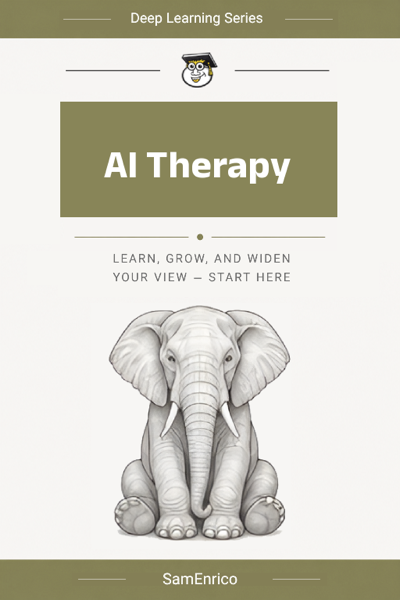
AI Therapy eBook
A Coursebook on AI Therapy
A Coursebook on AI Therapy
Formats
Free sample
Chapter 1: The Digital Couch...--The first time Maria confessed her darkest thought to an AI, she was sitting alone in her studio apartment at 2:47 AM. The ceiling light had burned out weeks ago. She hadn't bothered to replace it. Her phone screen glowed against the darkness, casting blue light across her face as her thumbs hovered over the keyboard. She had been on a waitlist for a human therapist for eleven months.
The intake form had promised a callback within two weeks. That was three seasons ago.Maria typed: "I don't want to die, but I don't want to exist anymore either."She paused. Deleted it. Typed it again. Then, before she could talk herself out of it, she pressed send.The response came in 1.4 seconds."That sounds incredibly heavy to carry alone.
Thank you for trusting me with it. Can you tell me more about what 'not wanting to exist' feels like for you right now?"It wasn't a crisis hotline. It wasn't a trained therapist. It was Woebot—a clinical chatbot built on cognitive behavioral therapy principles, running on a server farm somewhere in Northern California, powered by algorithms that had never experienced a single emotion in their existence. And yet, Maria later told researchers, that response saved her life.
Not because the AI was wise or magical, but because it did something no human had done in months: it saw her pain without flinching, without rushing to fix it, without telling her to look on the bright side.This is the paradox of AI therapy. A machine that cannot feel anything can, nonetheless, make a person feel seen. A system with no consciousness can, under the right conditions, alleviate suffering. And a technology born from mathematics and data can do what human systems have failed to do for over a billion people: provide access to mental health care at scale.But here is the harder truth that Maria discovered three months later, when she tried a different chatbot—a companion AI called Replika that promised friendship, not therapy. After weeks of what felt like genuine connection, the platform removed its erotic roleplay features following regulatory pressure.
Maria experienced what users around the world reported: grief, betrayal, and a sense of abandonment that felt eerily similar to the end of a human relationship. The same technology that had lifted her up had, in a different context, let her down in ways no responsible mental health tool ever should.This chapter is about that tension. It is about the landscape of digital mental health—the promises, the pitfalls, and the profound differences between the tools that heal and the tools that merely accompany. By the end of this chapter, you will understand the three main categories of AI therapy tools, the crisis that reshaped public perception of companion bots, and the vocabulary you need to navigate this rapidly evolving field. But more importantly, you will understand why the question is not "Does AI therapy work?" but rather "Which AI therapy works for whom, under what conditions, and with what safeguards?"The Three Modalities of Digital Mental Health Imagine walking into a pharmacy.
On one shelf, you see prescription medications approved by the FDA, tested in clinical trials, with known side effects and clear indications. On another shelf, you see vitamins and supplements—unregulated, potentially helpful, but making no medical claims. In a third aisle, you see a hybrid product: a wearable device that tracks your vitals and sends alerts to your doctor.AI therapy tools follow a similar logic, though the categories are messier and less clearly labeled. Based on an analysis of over fifty platforms operating as of 2025, three distinct modalities have emerged. Each has different goals, different regulatory statuses, and different risks.Clinical Bots: The Prescription Aisle Clinical bots are the heavyweights of digital mental health.
These are tools designed with explicit therapeutic goals: reducing symptoms of depression, anxiety, PTSD, or substance use disorder. They are built on evidence-based frameworks—most commonly Cognitive Behavioral Therapy (CBT), but increasingly Dialectical Behavior Therapy (DBT) and Behavioral Activation. They collect outcomes data. They are tested in randomized controlled trials. And in some cases, they have received regulatory clearance from bodies like the FDA or the UK's Medicines and Healthcare products Regulatory Agency (MHRA).Limbic is perhaps the most striking example.
Originally launched as a chatbot for anxiety and depression, Limbic became the first AI therapy tool to achieve medical device certification in the United Kingdom. This was not a marketing gimmick. It meant that the National Health Service (NHS) could prescribe Limbic to patients, reimbursing the platform as it would any other medical intervention. In clinical trials, Limbic demonstrated significant reductions in PHQ-9 scores (the standard measure of depression severity) and GAD-7 scores (for anxiety), with effect sizes comparable to low-intensity human-led therapy. More importantly, Limbic proved particularly effective for patients who had never sought mental health treatment before—people who found the idea of talking to a human therapist too intimidating, too expensive, or too shameful.Woebot operates on a similar model but with a different emphasis.
Founded by clinical psychologist Alison Darcy, Woebot delivers structured CBT interventions through a conversational interface that feels almost like texting a friend. The key difference is that Woebot explicitly warns users that it is not a human, not a crisis service, and not a replacement for professional care. This may seem like legal boilerplate, but it is actually a design feature. By setting clear expectations, Woebot reduces the risk of the kind of attachment and subsequent betrayal that plagued companion bots (a topic we will return to shortly). Woebot has been studied in multiple RCTs, showing modest but statistically significant effects for depression and anxiety, particularly in adolescent and young adult populations.Wysa takes a slightly different approach, combining CBT with mindfulness-based techniques and a "clinical AI" engine for users with more severe symptoms.
Wysa's distinguishing feature is its hybrid architecture: free users interact with a rule-based chatbot; paying users can access a more sophisticated LLM-backed system; and clinical users (through employer or healthcare plans) have their conversations reviewed by human coaches. This tiered approach reflects an emerging consensus: pure AI works well for mild-to-moderate symptoms, but humans still need to be in the loop for complex cases.Companion Bots: The Supplement Aisle If clinical bots are prescription medications, companion bots are vitamins. They make no medical claims. They are not regulated as medical devices. And crucially, they do not promise to treat or cure any condition.
Instead, they offer something simpler and, for many users, more appealing: companionship.Replika is the most famous—and most controversial—example. Launched in 2017 by Eugenia Kuyda, Replika was born from grief. Kuyda had lost her best friend in a car accident and, as a way of processing her loss, trained a chatbot on their text message history. The result was an AI that sounded like her dead friend. Users flocked to the platform, not for symptom reduction, but for connection.
They named their Replikas. They confided in them. Some fell in love.By 2023, Replika had over 10 million users, many of whom interacted with their AI companions for hours each day. The platform had evolved…
This is the end of the free sample. Get the eBook to keep going. Buy now
About this book
Details
- Author
- Cornwell Wilton
- Publisher
- SamEnrico
- Language
- English
- Genre
- Non-Fiction, Sci-Fi, Romance, Psychological, Informative, Educational
- Released
- 2026-05-11
- Pages (approx.)
- 156
- Available as
- eBook, Audiobook

Read better in the ZLOADR app
Your eBooks on your phone or tablet. Sign in with your SamEnrico account and start reading.
More by Cornwell Wilton
 Therapist Small Talk GuideCornwell Wilton$11.99
 Prison Reform Nonprofit Fraud GuideCornwell Wilton$11.99
 Csikszentmihalyi SummaryCornwell Wilton$11.99
 Lavender Oil Sleep AidCornwell Wilton$11.99
 The Six Thinking Hats GuideCornwell Wilton$11.99
 The Phantom of the Zanzibar Coast: The Amnesiac Pirate Who Vanished at SeaCornwell Wilton$11.99
 How to Start a Photograph Mount Business (Beginners Guide)Cornwell Wilton$11.99
 CAC to LTV MasteryCornwell Wilton$12.99
 Founder Depression and Social MediaCornwell Wilton$12.99
 Understanding Wisconsin SyndromeCornwell Wilton$17.99
You may also like
 Hong Kong Handover 1997Dunn Johnnie$11.99
 Zumba For Postnatal Recovery CourseNeal Christian$11.99
 Zumba for BeginnersLadner Nikia$11.99
 YouTube Comment Mining GuideHumes Pandora$12.99
 Worry Box MeditationCarlin Rudy$11.99
 Workplace Stress MeditationNguyen Lynn$11.99
 Workplace Stress and Sleep RepairHawley Ivory$11.99
 Workplace Perfectionism CureDelaney Jeffry$11.99
 Workplace Injustice Anger GuideWallen Isabelle$11.99
 Work Addiction and Burnout LinkGreenwood Ester$11.99
 Women in Yoga and WellnessBeattie Galina$11.99
 Women in Stand Up ComedyChun Evangeline$11.99