
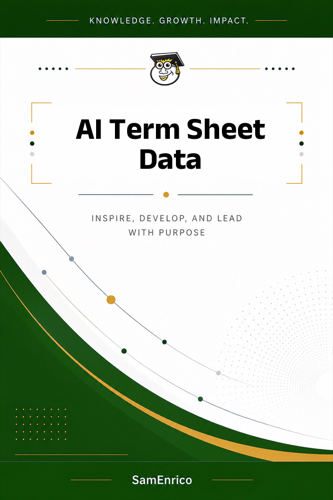
AI Term Sheet Data
Artificial intelligence and ML company financing t
Artificial intelligence and ML company financing terms across 500 deals.
Formats
About this book
Free sample
Chapter 1: The Compute Trap...--–- The email arrived at 11:47 PM on a Tuesday. Sarah Chen, founder of a promising generative AI video startup, had just signed her term sheet four hours earlier. The subject line read: "AWS Compute Overage Alert – Action Required." She opened it and her screen went blurry. $12,347,892. That was the overage.
Not for the year. Not for the quarter. For the last nine days. A training run had diverged—a known risk in large-scale model training—and her uncapped compute liability clause meant the cloud bill was entirely her problem. Her investors, who had celebrated the signing with champagne that afternoon, were now unreachable.
By Friday, the company was insolvent. By the following Tuesday, the VCs had exercised their Server Reclamation Rights (a clause she hadn't fully understood) and taken possession of the GPU servers she had paid for. Sarah walked away with nothing. Her employees received no severance. The investors lost nothing—they had structured the deal as a loan secured by the hardware.This story is not an outlier.
It is a cautionary tale that repeats itself every few months in the current AI financing environment, and it illustrates a fundamental truth that most founders learn too late: the rules of venture capital have changed, but the term sheets haven't been rewritten to tell you.The old venture capital playbook—the one written for Saa S companies, marketplaces, and mobile apps—assumed that a startup's biggest expenses were salaries and marketing. Compute was a rounding error. A few thousand dollars a month for AWS credits, maybe ten thousand if you were doing something fancy. In that world, term sheets were designed to protect investors against market risk (Will anyone buy this?) and execution risk (Can the team deliver?). The capital intensity was low, the collateral was intangible, and the downside was limited to the cash invested.Artificial intelligence has shattered every one of those assumptions.Today, a seed-stage AI company might spend more on a single training run than a Saa S company spends on its entire first year of operations.
A mid-sized LLM training run costs $5-10 million in compute alone. A frontier model? Hundreds of millions. And unlike a…
This is the end of the free sample. Get the eBook to keep going. Buy now
Contents
- Chapter 1
- Chapter 2
- Chapter 3
- Chapter 4
- Chapter 5
- Chapter 6
- Chapter 7
- Chapter 8
- Chapter 9
- Chapter 10
- Chapter 11
- Chapter 12
Details
- Author
- Vanhorn Patrice
- Publisher
- SamEnrico
- Language
- English
- Genre
- Non-Fiction, Capital & Valuation Register, AI
- Released
- 2026-06-11
- Pages (approx.)
- 151
- Available as
- eBook, Audiobook

Read better in the ZLOADR app
Your eBooks on your phone or tablet. Sign in with your SamEnrico account and start reading.
More by Vanhorn Patrice
 Micronutrients For Lung Health GuideVanhorn Patrice$11.99
 Senior Nap Energy GuideVanhorn Patrice$11.99
 Fibromyalgia Family Support GuideVanhorn Patrice$11.99
 MBSR for Divorce StressVanhorn Patrice$11.99
 Letting Go Hypnosis ScriptsVanhorn Patrice$11.99
 Caregiver for Aging ParentsVanhorn Patrice$11.99
 Netflix and ChillsVanhorn Patrice$11.99
 Property Management EthicsVanhorn Patrice$11.99
 Ride the Devil’s BackboneVanhorn Patrice$11.99
 Chromatic Uprising: The Hidden Colors of the French RevolutionVanhorn Patrice$11.99
 Multiple Account Policy Trap GuideVanhorn Patrice$12.99
 Founder Medical Crisis Customer Refund ProtocolVanhorn Patrice$12.99