
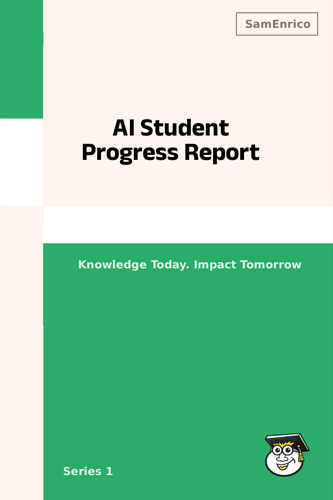
Non-FictionAI OperatorProgress Reports
AI Student Progress Report eBook
Generate narrative progress reports summarizing st
Generate narrative progress reports summarizing strengths and areas for growth.
Formats
Free sample
Chapter 1: The Grading Lie--–- Maria Sanchez had been teaching eighth-grade math for fourteen years when she found herself crying in the school supply closet at 11:47 PM. The report cards were due in thirteen minutes. She had written 127 personalized comments over the previous six hours. She had 43 more to go. Her husband had texted three times asking if she was coming home.
Her left hand was cramped into a claw shape. And she was fairly certain that nobody — not a single parent, not a single student, not even the principal who demanded these comments — would read most of what she had written.This is not an unusual story. It is, in fact, the quiet catastrophe of American education: millions of teachers spending thousands of hours writing millions of sentences that go unread, that demoralize rather than motivate, that reduce complex human beings to percentages and platitudes. The grading lie is not that grades are inaccurate. The grading lie is that grades — in isolation, without narrative, without context, without a story — actually help students learn.They do not.
And the data has been clear for decades.The Tyranny of the Percentage Let us begin with a simple question that has a complicated answer: What does a B-minus actually mean? In one classroom, it might represent a brilliant student who turned in three assignments late but aced every test. In another, it might represent a hardworking student who struggled with a single concept but improved steadily over the semester. In a third, it might represent a student who did exactly what was asked and nothing more — competent but uninspired. All three students receive the same letter.
All three students are collapsed into the same category. And all three students receive the same message: This is who you are.Carol Dweck's groundbreaking work in Mindset demonstrated that students who receive fixed-label feedback ("You're an A student," "You're struggling in math") internalize these labels as identity statements rather than performance snapshots. The B-minus student doesn't think, "I need to work on algebraic manipulation." The B-minus student thinks, "I'm a B-minus kind of person." This is not semantics. This is the difference between a growth orientation and a fixed orientation — a difference that predicts academic persistence, resilience in the face of challenge, and long-term achievement trajectories.Dan Pink's Drive added another layer to this critique. Pink synthesized decades of motivational psychology to show that extrinsic motivators — grades, percentages, rankings — actually reduce performance on tasks requiring creativity, problem-solving, and deep understanding.
The student who is told "You need to get an A on this project" produces different work than the student who is told "I want to see what you discover about this topic." The former is trying to please. The latter is trying to understand. These are not the same cognitive processes.And yet, the American education system remains addicted to the percentage. We convert complex learning into single numbers. We sort students by these numbers.
We tell ourselves this is objective, fair, and efficient. It is none of these things.What Grades Actually Measure (Spoiler: Not Learning)If grades measure learning, then two students who have learned the same amount should receive the same grade. But this is demonstrably false. A student who enters the school year already knowing 80 percent of the material will receive a higher grade than a student who learns 80 percent of new material over the same period — even though the second student learned far more. Grades measure prior knowledge plus effort plus compliance plus test-taking skill.
They do not measure growth.Consider two students in a hypothetical history class:Elena arrives on the first day already fluent in the causes of World War I because her father is a historian. She does no additional reading, completes her assignments carelessly, but aces the multiple-choice exams through prior knowledge. She receives an A-minus.Marcus arrives knowing nothing about WWI. He reads every assigned text, stays after class for extra help, improves his essay writing dramatically over the semester, and goes from failing quizzes to scoring proficient on the final exam. He receives a C-plus.Which student learned more?
Marcus, unquestionably. Which student received a better grade? Elena. The grade system punished growth and rewarded existing privilege. This is not a flaw in implementation.
This is a feature of percentage-based grading.The problem extends beyond fairness to accuracy. Research consistently shows that grades are unreliable indicators of learning: the same student's work will receive different grades from different teachers, and even the same teacher will assign different grades to the same work on different days. A 2016 study in the Journal of Educational Psychology found that teacher-assigned grades correlated only modestly with standardized test scores — suggesting that grades measure something real, but that something is not simply "what the student has learned."So what do grades actually measure? Compliance. Punctuality.
Formatting. Test-taking strategy. Prior knowledge. Effort (sometimes). And, in many cases, the teacher's implicit bias about the student's potential.
This is not a conspiracy. This is the accumulated result of a system designed for industrial efficiency, not human development.The Emotional Cost of the Percentile The grading lie does not merely misrepresent learning. It actively harms it.For struggling students, a low percentage functions as a verdict. "You are a 62 percent person" feels permanent. Research on academic self-concept shows that students who receive low grades early in a subject tend to predict low performance in the future — and then fulfill that prediction through reduced effort and increased anxiety.
The grade creates the outcome it claims to measure.For high-achieving students, the damage is different but equally real. The student who consistently receives As without meaningful narrative feedback learns that the goal is the grade, not the growth. These students become risk-averse, choosing easier assignments that guarantee As over challenging work that might produce a B. They learn to perform, not to learn. And when they eventually encounter a subject where they cannot immediately succeed — as everyone eventually does — they lack the resilience to persist through difficulty.For the vast middle — the B and C students — the message is perhaps most insidious.
They learn that they are average, that average is acceptable, and that there is no particular reason to push beyond average. The percentage tells them where they stand in relation to an invisible norm. It does not tell them how close they are to mastery, what specific skills need development, or what they have uniquely contributed. It tells them their rank. And then it stops talking.Parents, too, are harmed by the grading lie.
A percentage on a report card arrives without context, without narrative, without guidance. Parents see a C and feel anxiety or frustration. They do not know whether their child struggled with one concept or all concepts. They do not know whether the child improved or declined. They do not know whether the grade reflects ability, effort, attendance, or a bad week.
They know a single number. And that number becomes the basis for conversations that might have been productive if they had been grounded in actual information.Teachers — the people who write these reports — suffer most of all. The average middle school teacher spends between 45 minutes and…
This is the end of the free sample. Get the eBook to keep going. Buy now
About this book
Details
- Author
- Kelley Vickie
- Publisher
- SamEnrico
- Language
- English
- Genre
- Non-Fiction, AI Operator, Progress Reports
- Released
- 2026-06-07
- Pages (approx.)
- 120
- Available as
- eBook, Audiobook

Read better in the ZLOADR app
Your eBooks on your phone or tablet. Sign in with your SamEnrico account and start reading.
More by Kelley Vickie
 Eisenhower For Parents GuideKelley Vickie$11.99
 The HGH Supplements RealityKelley Vickie$11.99
 Immigrant Healthcare EntrepreneursKelley Vickie$11.99
 ABCDE for Therapists GuideKelley Vickie$11.99
 The Trollwife of Dovrefjell: A Mountain’s CurseKelley Vickie$11.99
 Leadership Management TrendsKelley Vickie$12.99
 USA Raise Mastery GuideKelley Vickie$12.99
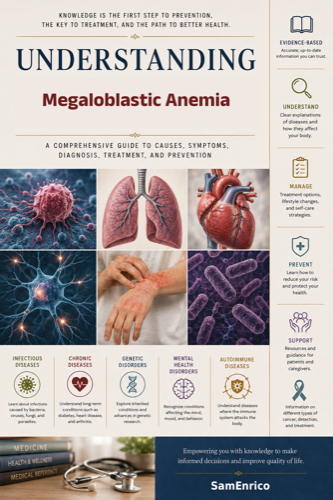 Understanding Megaloblastic AnemiaKelley Vickie$17.99
 PT Sales AssociateKelley Vickie$11.99PT Sales AssociateKelley Vickie$11.99
 Ultimate Handbook Guide to Xuzhou : (China) Travel GuideKelley Vickie$11.99
You may also like
 Hong Kong Handover 1997Dunn Johnnie$11.99
 Zumba For Postnatal Recovery CourseNeal Christian$11.99
 Zumba for BeginnersLadner Nikia$11.99
 YouTube Comment Mining GuideHumes Pandora$12.99
 Worry Box MeditationCarlin Rudy$11.99
 Workplace Stress MeditationNguyen Lynn$11.99
 Workplace Stress and Sleep RepairHawley Ivory$11.99
 Workplace Perfectionism CureDelaney Jeffry$11.99
 Workplace Injustice Anger GuideWallen Isabelle$11.99
 Work Addiction and Burnout LinkGreenwood Ester$11.99
 Women in Yoga and WellnessBeattie Galina$11.99
 Women in Stand Up ComedyChun Evangeline$11.99