
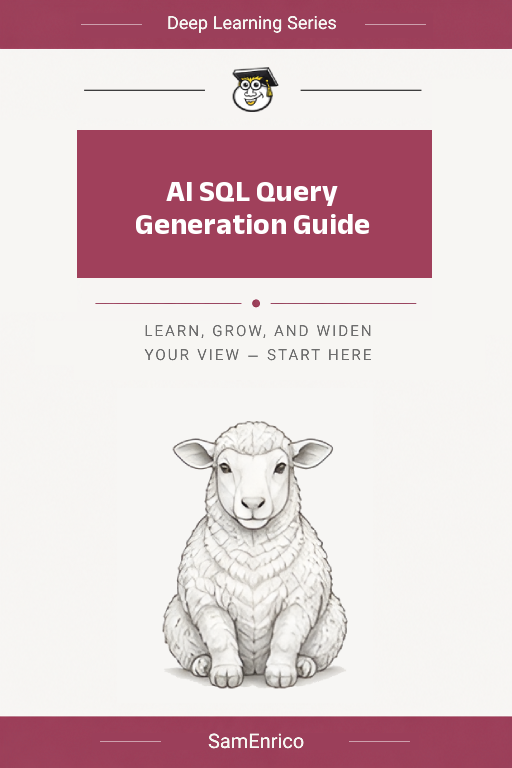
AI SQL Query Generation Guide eBook
Write complex SQL queries and optimize them using
by Hanley Royal
Write complex SQL queries and optimize them using AI pair programming.
Formats
Free sample
Chapter 1: The Architect-Supervisor Shift--–- Alice had just spent eleven hours debugging a 200-line SQL query. She was a senior data engineer at a mid-sized e-commerce company, earning $110,000 per year, and she was exhausted. The query was supposed to calculate customer lifetime value segmented by acquisition channel and cohort month. It had worked perfectly in the staging environment. In production, it ran for forty-five minutes before the job timed out.
Her manager was breathing down her neck. The CFO needed that report by 9:00 AM.Alice tried everything. She reorganized the joins. She added hints. She broke the query into temp tables.
She even rewrote the window functions three times. Nothing worked. Around hour nine, she opened Chat GPT out of pure desperation. She pasted the query and typed: "This is running in 45 minutes. Help me make it faster."Within thirty seconds, the AI responded with three observations.
First, a correlated subquery in the WHERE clause was being executed once per row—approximately two million times. Second, the ROW_NUMBER() window function was partitioning by a column that had high cardinality but no supporting index. Third, two of the CTEs were being referenced multiple times but were not materialized. The AI suggested specific changes, including a filtered index and converting one CTE to a temp table.Alice implemented the suggestions in twenty minutes. The query ran in twelve seconds.She sat back in her chair and stared at the screen.
Not because she was impressed with the AI—although she was—but because she realized something profound. She had spent eleven hours fighting syntax and optimization rules. The AI had spent thirty seconds identifying patterns. The difference wasn't intelligence. The difference was role.Alice had been acting as a writer—someone who types every comma, every join condition, every aggregation manually.
The AI had acted as a pattern recognizer—identifying structural inefficiencies that Alice knew in theory but could not see in practice after hours of staring at the same code.This chapter is about that realization. The role of the SQL developer is changing. Not disappearing. Not being outsourced to artificial intelligence. Evolving.
You are no longer primarily a writer of syntax. You are becoming an architect-supervisor—someone who designs the logical flow, specifies business rules in natural language, delegates syntax generation to AI, and then supervises the output for correctness, performance, and safety.This is not a small change. It requires unlearning habits that have been reinforced for decades. It requires trusting an AI that will occasionally hallucinate a column name. It requires learning new skills—prompt engineering, output validation, iterative refinement—that no SQL bootcamp teaches.
And it requires a mental framework that this book will build, chapter by chapter.The Three Ages of the SQL Developer To understand where we are going, we must understand where we have been. The history of SQL development can be divided into three distinct ages. Your current skills were shaped by the first two. The third is where this book lives.Age 1: The Manual Scribe (1970s–1990s)In the beginning, there was no graphical query builder, no ORM, no autocomplete. Developers wrote SQL on green screens, often on terminals connected to mainframes.
Every character was intentional because backspacing was unreliable and re-running a query could take minutes.The manual scribe memorized syntax. They knew that INNER JOIN and JOIN were the same but that OUTER JOIN required the OUTER keyword in some dialects. They carried pocket references—small spiral-bound books listing every function in Oracle or DB2. Performance tuning meant reading EXPLAIN plans printed on fanfold paper and manually reordering joins based on estimated row counts.The core skill of the manual scribe was syntax precision. A missing comma or an extra parenthesis meant a five-minute wait for the database to return a syntax error.
This age produced developers who were meticulous, cautious, and slow.Age 2: The GUI Optimizer (2000s–2020s)Then came the graphical tools. SQL Server Management Studio, Oracle SQL Developer, pg Admin, Data Grip. Syntax highlighting. Autocomplete. Visual query designers.
The manual scribe became the GUI optimizer—no longer worried about typos, now focused on performance.This age introduced the core optimization patterns that still dominate SQL education today. Sargability. Covering indexes. Materialized views. Query plan analysis.
The GUI optimizer learned to read graphical execution plans, to spot a sort operation that should be an index seek, to recognize implicit conversions that kill performance.The core skill of the GUI optimizer was pattern recognition. They could look at a query and spot anti-patterns: SELECT *, functions on indexed columns, NOT IN subqueries returning NULLs, correlated subqueries that should be joins. This age produced developers who were fast, analytical, and pattern-driven.You are likely a GUI optimizer. You know the patterns. You can read an execution plan.
You can write a complex query with window functions and CTEs. But you are also frustrated because the patterns are multiplying faster than you can memorize them, and the pressure to deliver faster is increasing every quarter.Age 3: The Architect-Supervisor (2024 and Beyond)Welcome to the third age. The AI pair programmer does not replace your pattern recognition—it augments it. You still need to know what a table scan means. You still need to understand why WHERE YEAR(date) = 2024 is bad and WHERE date BETWEEN '2024-01-01' AND '2024-12-31' is good.
But you no longer need to spot these patterns yourself. The AI will spot them for you.Your new job is not to write SQL. Your new job is to design the logic (the business outcome), supervise the generation (review AI output for correctness), and iterate on the prompt (refine instructions based on what the AI produced).The architect-supervisor has three core skills:Decomposition. Breaking a business problem into logical steps that an AI can translate into SQL. This is not about syntax—it is about structure.
"First, find all users who logged in during the last 30 days. Second, for each user, calculate their total purchase amount. Third, rank users by that amount within their country."Validation. Looking at AI-generated SQL and knowing whether it is correct. This requires understanding joins, aggregations, window functions, and set logic—the fundamentals you already know.
You are not being replaced. You are being promoted to quality control.Iteration. When the AI produces something wrong, you do not fix the SQL directly (although you can). You refine the prompt. "That query used RANK() but I need ROW_NUMBER() to break ties.
Please regenerate." This is faster than manual editing and builds a reusable prompt library.Why SQL Is Uniquely AI-Friendly Before we go further, we must address a question that every skeptical reader is asking: "Why SQL? Why not Python, Java, or any other language?"SQL has four properties that make it exceptionally well-suited for AI generation:Property 1: Formal, Predictable Structure Every SQL query follows the same skeletal structure, even if the clauses appear in different orders depending on the dialect:text Copy Download SELECT [columns | aggregations | expressions] FROM [tables | subqueries | CTEs | joins] WHERE [filters] GROUP BY [grouping columns] HAVING [post-aggregation filters] ORDER BY [sort columns] LIMIT [row restriction]This is not true for Python, where a function can return…
This is the end of the free sample. Get the eBook to keep going. Buy now
About this book
Details
- Author
- Hanley Royal
- Publisher
- SamEnrico
- Language
- English
- Genre
- Non-Fiction, AI Operator
- Released
- 2026-05-30
- Pages (approx.)
- 152
- Available as
- eBook, Audiobook

Read better in the ZLOADR app
Your eBooks on your phone or tablet. Sign in with your SamEnrico account and start reading.
More by Hanley Royal
 Security Guard Burnout GuideHanley Royal$11.99
 Sacred Silence Training ManualHanley Royal$11.99
 Oil Gas FCPA ViolationsHanley Royal$11.99
 Imposter Visualization MasteryHanley Royal$11.99
 Bedtime Battle SolutionHanley Royal$11.99
 Pelvic Floor TherapyHanley Royal$11.99
 The Catholic Revival ArtHanley Royal$11.99
 Visual Impairment ListeningHanley Royal$11.99
 Ho Chi Minh TrailHanley Royal$11.99
 The Silk Road Swindle: How a Teenage Hacker Duped the Dark WebHanley Royal$11.99
 The Silent Coup: How a Tech Giant Swallowed a Media EmpireHanley Royal$11.99
 The Forgotten Cartographer: Gertrude Bell and the Mapping of the Middle EastHanley Royal$11.99
You may also like
 AI Presentation WorkbookSommers Tonda$11.99
 PowerPoint Copilot MasteryConway Lanita$11.99
 Branded AI DecksWindham Loni$11.99
 AI Presentation CourseGrooms Olin$11.99
 AI Presentation CertificationBlank Dolly$11.99
 AI Deck Version ControlMedley Lorina$11.99
 AI Deck Update AutomationFraser Tresa$11.99
 AI Deck Myths DebunkedCrittenden Romelia$11.99
 AI Deck Customization GuideDove Hannelore$11.99
 AI Bullet to Slide ConverterKohn Eloisa$11.99
 AI Deck Notes CreatorBarela Sunday$11.99
 AI Deck Outline GeneratorAshmore Morgan$11.99