
Non-FictionAI OperatorCorporate Communications
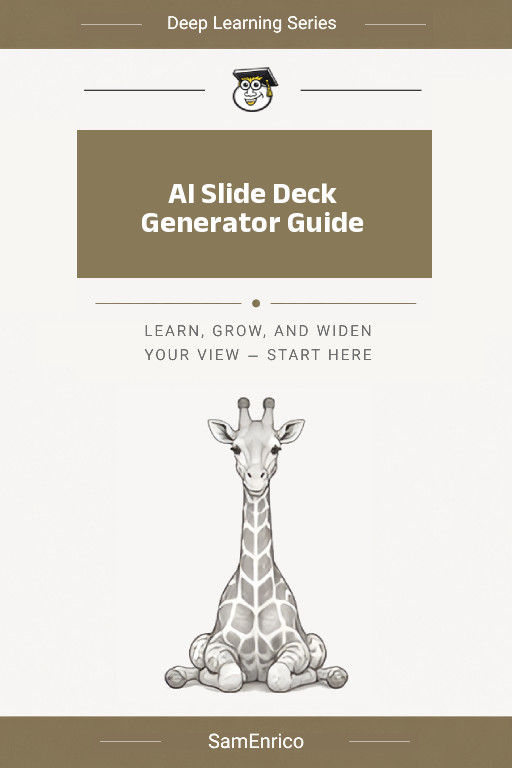
AI Slide Deck Generator Guide eBook
Automate presentation creation from raw notes and
Automate presentation creation from raw notes and data. Covers narrative flow, visual layout prompts, and brand-compliant template integration for business communicators.
Formats
Free sample
Chapter 1: You Are Not a Formatter...--–- The email arrived at 11:47 PM on a Tuesday. Sarah, a senior product marketing director at a mid-sized Saa S company, had spent the last four hours moving boxes on a Power Point slide. Not writing strategy. Not analyzing competitive positioning. Not coaching her team.
She was adjusting the vertical alignment of three bullet points inside a text box that had inexplicably shifted 0.2 inches to the left after she inserted a logo. Her husband had gone to bed two hours ago. Her teenagers had stopped asking for help with homework. And Sarah, who earned 180,000ayeartoleadgo−to−marketstrategy,wasperformingworkthata180,000 a year to lead go-to-market strategy, was performing work that a 180,000ayeartoleadgo−to−marketstrategy,wasperformingworkthata15-per-hour administrative assistant could do—if only that assistant had access to her slide master file.This is not an outlier. It is the norm.The average business professional spends 5.2 hours per week creating, formatting, and revising slide decks, according to a 2024 survey of 2,500 knowledge workers conducted by the Presentation Productivity Lab.
That is 270 hours per year—nearly seven full workweeks. Multiply that by the 62 million knowledge workers in the United States alone, and the aggregate annual productivity loss exceeds $450 billion. For context, that is roughly the GDP of Norway. We have built an entire economic subcategory around moving text boxes.Yet the problem is not Power Point, Keynote, Google Slides, or Canva. The problem is not even the humans using these tools.
The problem is a failure of imagination about what work should be done by machines versus what work must be done by minds. We have outsourced our strategic thinking to our own habits and outsourced our formatting to… no one. We have simply done both, poorly, for decades.This book exists because that era is ending.The Great Misunderstanding Artificial intelligence did not arrive in 2022 with the release of Chat GPT. It arrived quietly, feature by feature, inside tools you already use: auto-complete in email, smart sorting in spreadsheets, recommendation engines in design software. But the arrival of large language models marked an inflection point because for the first time, AI could generate not just predictions but compositions.
It could write a paragraph, design a layout, summarize a document, and—crucially—format a slide.And yet, the first wave of AI presentation tools produced results that ranged from mediocre to disastrous.Why?Because the early adopters made a category error. They assumed that because AI could generate *a* slide deck, it could generate the slide deck. They fed a prompt like "create a quarterly business review for a B2B software company" and received ten slides of generic, statistically dubious, aesthetically incoherent garbage. The AI hallucinated market share numbers. It placed a photograph of a handshake on every slide.
It used fonts that looked like they belonged at a rave. These early users concluded that AI was useless for presentations and went back to their manual formatting, grumbling about overhyped technology.They were wrong about AI. But they were also right about the output.The error was not in the technology. The error was in the workflow. An AI given no constraints, no source material, no brand guidelines, and no strategic direction will produce what it has been trained to produce: the statistical average of every slide deck it has ever seen.
The average slide deck is terrible. Therefore, the average AI-generated slide deck is also terrible.This book exists to break that cycle.The 80/20 Rule Revisited Before we go any further, let me state the single most important sentence you will read in these 400 pages:You are not a formatter.You were not hired to adjust kerning, align bullet points, resize logos, or choose between fourteen variations of the same organizational chart template. You were hired to think strategically, persuade audiences, synthesize complex information, and make decisions under uncertainty. The fact that you have spent any portion of your career moving objects on a digital canvas is not a testament to your work ethic. It is a failure of the tools and processes you have inherited.The 80/20 Rule, as it applies to slide creation, is this: AI should handle 80% of the grunt work—consistency, formatting, summarization, spell-checking, basic layout suggestions, and first-draft visualization—while humans retain the 20% that matters.
That 20% is what this book calls the Golden Thread: strategic narrative, emotional resonance, authentic humor, ethical judgment, brand voice calibration, and final approval authority.Here is what the 80/20 Rule looks like in practice:Activity Who Does It Time Saved Creating a first draft from meeting notes AI90%Formatting fonts and colors to brand standards AI100%Generating chart annotations and callouts AI85%Writing speaker notes that sound natural AI-assisted (human edits)70%Determining the strategic argument of the deck Human0% (non-negotiable)Deciding which data to emphasize or omit Human0% (non-negotiable)Injecting humor, empathy, or urgency Human0% (non-negotiable)Approving the final deck for distribution Human0% (non-negotiable)Notice the pattern. AI handles tasks that are deterministic (rules-based), repetitive, or syntactic (about the arrangement of words and elements). Humans handle tasks that are strategic, emotional, or judgment-based. This division is not arbitrary. It reflects the fundamental capabilities and limitations of current AI systems.The Three Failure Modes (And How This Book Fixes Them)Before we can build the right workflow, we must understand why existing workflows fail.
Across hundreds of interviews with professionals who have tried—and often abandoned—AI presentation tools, three failure modes recur.Failure Mode 1: The Hallucination Cascade An AI generates a deck that looks beautiful but contains provably false information. A salesperson presents a quarterly review claiming 23% growth in a region that actually declined by 4%. A consultant presents market sizing that has no relationship to any real data source. The presenter, trusting the tool, does not verify every claim. The error is discovered during the meeting.
Credibility is destroyed.Why it happens: Most AI models are trained to be plausible, not truthful. They have no internal mechanism for distinguishing a verified fact from a statistically likely fabrication. When asked to generate a slide about "Q3 performance," they will invent numbers that look reasonable rather than admit they don't have the data.How this book fixes it: Chapter 2 introduces the "Source-Grounded Foundation" and the "House of Cards" Principle: every claim must have a citation back to source material. Chapter 11 provides the Hallucination Audit, a mandatory pre-flight check that flags unverified statements.Failure Mode 2: The Generic Abyss An AI generates a deck that is technically correct but strategically useless. The headlines read like section labels ("Q3 Overview," "Competitive Landscape," "Team Structure").
The visuals are stock photography of diverse teams shaking hands. The tone is neutral to the point of blandness. The deck could belong to any company in any industry. The audience glazes over.Why it happens: AI models are trained on the average of everything. The average slide deck is generic.
Without specific constraints and strategic direction, the AI defaults to the mean.How this book fixes it: Chapter 3 introduces the BLUF Architecture (Bottom Line Up Front) and the Sentence Headline Rule, forcing every slide to make a specific argument. Chapter 4 provides prompt engineering techniques for generating distinctive, brand-appropriate visuals. Chapter 10 teaches the "Emotional EQ" Pass for…
This is the end of the free sample. Get the eBook to keep going. Buy now
About this book
Details
- Author
- Busby Philomena
- Publisher
- SamEnrico
- Language
- English
- Genre
- Non-Fiction, AI Operator, Corporate Communications
- Released
- 2026-06-01
- Pages (approx.)
- 145
- Available as
- eBook, Audiobook

Read better in the ZLOADR app
Your eBooks on your phone or tablet. Sign in with your SamEnrico account and start reading.
More by Busby Philomena
 Cultural Failure Fear GuideBusby Philomena$11.99
 Menopause Migraine GuideBusby Philomena$11.99
 Thunberg Climate Strikes During COVID GuideBusby Philomena$11.99
 Dolly Parton Tennessee Mountain MemoirBusby Philomena$11.99
 Cognitive Stimulation Therapy BasicsBusby Philomena$11.99
 When the World Was a Lotus: The Birth of the Universe in Vedic CosmologyBusby Philomena$11.99
 The Tide That Changed the World: Portugal’s Secret Cold War Maritime Spy Network (1950s-1970s)Busby Philomena$11.99
 Vulnerability Management AnalystBusby Philomena$11.99
 How to Start a Printing By Duplication Machines Business (Beginners Guide)Busby Philomena$11.99
 AI Mileage Tracking GuideBusby Philomena$12.99
 Understanding Fournier GangreneBusby Philomena$17.99
You may also like
 Hong Kong Handover 1997Dunn Johnnie$11.99
 Zumba For Postnatal Recovery CourseNeal Christian$11.99
 Zumba for BeginnersLadner Nikia$11.99
 YouTube Comment Mining GuideHumes Pandora$12.99
 Worry Box MeditationCarlin Rudy$11.99
 Workplace Stress MeditationNguyen Lynn$11.99
 Workplace Stress and Sleep RepairHawley Ivory$11.99
 Workplace Perfectionism CureDelaney Jeffry$11.99
 Workplace Injustice Anger GuideWallen Isabelle$11.99
 Work Addiction and Burnout LinkGreenwood Ester$11.99
 Women in Yoga and WellnessBeattie Galina$11.99
 Women in Stand Up ComedyChun Evangeline$11.99