
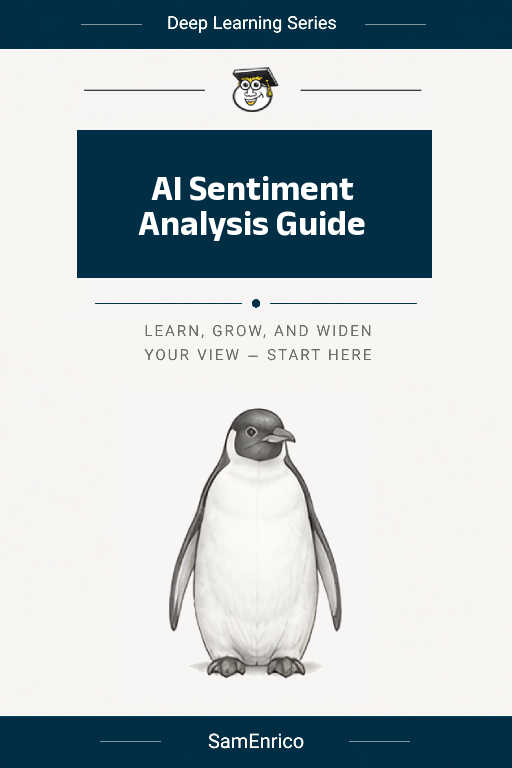
Non-FictionAnnual CheckupSentiment AI
AI Sentiment Analysis Guide eBook
Use Brand24, Talkwalker, or Mention to track brand
by Reno Jonelle
Use Brand24, Talkwalker, or Mention to track brand sentiment across social media.
Formats
Free sample
Chapter 1: The $47 Million Typo--In March of 2025, a 32-year-old graphic designer in Omaha, Nebraska, posted a message to a mid-sized subreddit dedicated to skincare enthusiasts. Her post was brief, unemotional, and contained exactly zero exclamation points. She included a single photograph of her reddened cheek and wrote: "Used this brand's new serum for three nights. Thought I was breaking out, but now I think it might be a reaction. Anyone else?"Within 48 hours, that post had accumulated 2,147 comments.
A community-created megathread emerged. Someone dug up the brand's ingredient list and highlighted a known irritant buried in fine print. Another user found an obscure 2022 FDA filing about a similar reaction. A former employee (unverified, but the internet believed them) claimed the brand had ignored internal safety warnings. The thread was screenshotted, reposted to Twitter, migrated to Tik Tok as a "storytime" video with 4 million views, and eventually picked up by a beauty industry newsletter with 200,000 subscribers.The brand's social media dashboard, however, showed a predominantly green "positive" reading throughout those 48 hours.
The AI had classified comments like "GREAT job, really impressive 🙄" and "Oh fantastic, exactly what I wanted — a chemical burn" as positive sentiment, matching on keywords "great" and "fantastic" while entirely missing the sarcasm. Comments that said "This is fine 🔥" (an emoji of fire, not a flame of approval but a dumpster fire) were marked neutral-neutral. The system never triggered an alert. No human reviewed the thread until day three.By then, the brand had lost $47 million in market capitalization.Not because their product was fatally dangerous. Not because they refused to respond.
But because their sentiment analysis tool told them everything was fine while their customers were screaming in a language the AI had never learned to understand.This book exists because that scenario is not an anomaly. It is the new normal. And it will happen to your brand if you rely on the tools the way most companies currently use them.The Vanity Metric Trap For the past decade, marketers have been trained to worship volume. How many likes? How many shares?
How many mentions? The assumption was simple: more noise equals more brand health. A viral tweet with ten thousand likes must mean ten thousand happy customers. A trending hashtag must mean successful campaign. A spike in mentions must mean effective awareness.This assumption is not merely incomplete.
It is dangerous.Consider the difference between counting and understanding. A thermometer can tell you that a patient has a fever, but it cannot tell you whether they have the flu, food poisoning, or an autoimmune disorder. It cannot tell you if they are getting better or worse, only that the current measurement deviates from a baseline. Sentiment analysis without emotional nuance is the business equivalent of a thermometer without a diagnosis. You know something is happening, but you have no idea what, why, or what to do about it.The three pillars of modern brand intelligence, introduced here for the first time as the Sentinel Framework, address this gap by moving beyond volume into three distinct layers of understanding.The first pillar is Polarity.
This is what most tools call sentiment: positive, neutral, negative. It is the entry-level metric, useful for broad trends but catastrophically imprecise at the individual mention level. A comment that says "I love how slow your shipping is" will register as positive to a naive polarity model because of the word "love." A comment that says "Not bad, I guess" will register as neutral when the customer actually means "disappointed but too tired to complain."The second pillar is Emotion. This moves beyond binary classification into specific feeling states: joy, anger, sadness, fear, disgust, admiration, surprise. When a customer says "I'm so frustrated I could scream," polarity models see negative.
Emotion models see anger. That distinction matters because anger requires a different response than sadness. Anger demands acknowledgment and swift action. Sadness demands empathy and assurance. Fear demands transparency and education.
Most tools do not distinguish between these emotions. The ones that do — and we will examine which platforms excel at this — provide a massive strategic advantage.The third pillar is Intent. This answers the question: what does this person want? Intent categories include purchase intent ("Where can I buy this?"), complaint intent ("This broke and I want a refund"), information-seeking intent ("How does this compare to X?"), and advocacy intent ("Everyone should buy this"). A brand that can distinguish between a customer who wants to buy and a customer who wants to complain can route each mention to the correct department instantly.
A brand that cannot distinguish will send sales leads to customer support and angry customers to marketing, creating friction at every turn.The Reddit thread that destroyed $47 million in value was, by polarity, mostly positive. By emotion, it was almost entirely anger and disgust masked as sarcasm. By intent, it was a cascade of complaint intent accelerating into advocacy intent against the brand. The dashboard saw green. The reality was a five-alarm fire.The Suitcase Problem: Why Words Are Never Simple The philosopher and linguist Alfred Korzybski famously said, "The map is not the territory." A map of Paris is not Paris itself.
It is a simplified representation that omits millions of details—the smell of bread from a bakery, the sound of footsteps on cobblestones, the weight of a baguette in your hand—because including every detail would make the map as large and complex as the city.Sentiment analysis faces the same problem, but with an added complication. Words are not just simplified maps of meaning; they are suitcases packed with multiple, conflicting definitions that change depending on who is speaking, what came before, and what the speaker assumes the listener already knows.This is known in natural language processing as the Suitcase Problem. A single word like "sick" can mean ill (negative), excellent (positive), or disturbed (nuanced) depending entirely on context and the speaker's subcultural affiliation. A phrase like "that's what I needed" can express relief after a problem is solved or bitter sarcasm after a problem worsens. An emoji like the crying-laughing face 😂 can indicate genuine amusement or, increasingly among younger users, performative discomfort with an awkward situation.No AI model currently in existence solves the Suitcase Problem perfectly.
The best models achieve accuracy rates of 85-95% on standardized benchmarks, but those benchmarks are typically clean, labeled datasets created in laboratories, not the chaotic, typo-riddled, slang-infested reality of social media.The gap between 95% accuracy and 99% accuracy is not 4%. It is the difference between missing one sarcastic comment in twenty and missing one in one hundred. For a brand that receives ten thousand mentions per day, 95% accuracy means five hundred misclassified mentions daily. Some of those misclassifications will be harmless. Some will be false positives that trigger unnecessary alerts.
And some will be false negatives that hide a brewing crisis until it is too late.Understanding this limitation is not an excuse to abandon sentiment analysis. It is a reason to build a system that knows when to trust the AI and when to escalate to a human. The brands that thrive in the coming years will not be the ones with the most expensive tools. They will be…
This is the end of the free sample. Get the eBook to keep going. Buy now
About this book
Details
- Author
- Reno Jonelle
- Publisher
- SamEnrico
- Language
- English
- Genre
- Non-Fiction, Annual Checkup, Sentiment AI
- Released
- 2026-05-30
- Pages (approx.)
- 144
- Available as
- eBook, Audiobook

Read better in the ZLOADR app
Your eBooks on your phone or tablet. Sign in with your SamEnrico account and start reading.
More by Reno Jonelle
 Counting Breaths for BeginnersReno Jonelle$11.99
 Hypnotic Induction Without A GuideReno Jonelle$11.99
 Stalking Animal Rights Activist CasesReno Jonelle$11.99
 CrossFit Breathing During WODs GuideReno Jonelle$11.99
 WhatsApp Group Social ComparisonReno Jonelle$11.99
 The Silk Road of the Mind: Healing Traditions and the Birth of Mental Health WisdomReno Jonelle$11.99
 Black Box: The Phantom of Flight 447Reno Jonelle$11.99
 Adobe Stock Phone GuideReno Jonelle$12.99
 Understanding Dupuytren's ContractureReno Jonelle$17.99
 Client Relations ManagerReno Jonelle$11.99
You may also like
 Hong Kong Handover 1997Dunn Johnnie$11.99
 Zumba For Postnatal Recovery CourseNeal Christian$11.99
 Zumba for BeginnersLadner Nikia$11.99
 YouTube Comment Mining GuideHumes Pandora$12.99
 Worry Box MeditationCarlin Rudy$11.99
 Workplace Stress MeditationNguyen Lynn$11.99
 Workplace Stress and Sleep RepairHawley Ivory$11.99
 Workplace Perfectionism CureDelaney Jeffry$11.99
 Workplace Injustice Anger GuideWallen Isabelle$11.99
 Work Addiction and Burnout LinkGreenwood Ester$11.99
 Women in Yoga and WellnessBeattie Galina$11.99
 Women in Stand Up ComedyChun Evangeline$11.99