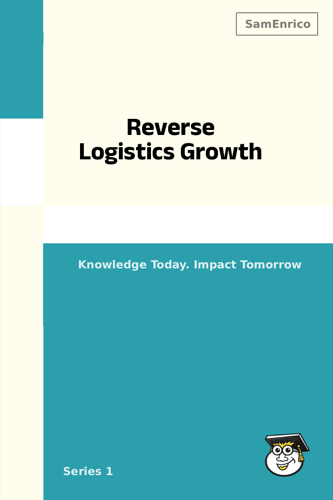
AI Reverse Logistics Guide eBook
Learn machine learning sorting returned items for
by Keaton Oda
Learn machine learning sorting returned items for resale, recycling, or disposal to maximize recovery value.
Formats
Free sample
Chapter 1: The $100 Million Mistake...--The email arrived at 6:47 PM on a Tuesday. Sarah Chen, VP of Operations for a mid-sized electronics retailer we will call Circuit Hub, was finishing her second cup of coffee when her phone buzzed. The subject line read: "Q3 Returns Analysis – Urgent." She opened it. Her heart sank.The company had processed 47millioninreturnsthatquarter.Afterinspecting,sorting,andliquidatingeverythingatanaverageof14centsonthedollar,theyhadrecoveredjust47 million in returns that quarter. After inspecting, sorting, and liquidating everything at an average of 14 cents on the dollar, they had recovered just 47millioninreturnsthatquarter.Afterinspecting,sorting,andliquidatingeverythingatanaverageof14centsonthedollar,theyhadrecoveredjust6.6 million.
The remaining 40.4million–plusanother40.4 million – plus another 40.4million–plusanother8 million in processing labor, shipping, and warehouse overhead – had evaporated. In one quarter. Nearly $50 million, gone.The email did not say this explicitly, of course. It was buried in spreadsheets, hidden in line items labeled "Other Operating Expenses" and "Inventory Shrinkage." But Sarah had been in operations long enough to read between the numbers. Circuit Hub was not alone.
Across the retail industry, hundreds of billions of dollars were disappearing into the same黑洞 – not through fraud, not through theft, but through the quiet, unexamined failure of reverse logistics.This book is about making sure that does not happen to you.The Trillion-Dollar Blind Spot Let us begin with a number so large it is almost meaningless: $1 trillion.That is the gross merchandise value of all returns processed in the United States in 2024. Every pair of jeans that did not fit. Every smartphone that had a dead pixel. Every espresso machine that made a funny noise on the second use. One trillion dollars worth of products that left a customer's hands and came back to a warehouse, a distribution center, or a return processing facility.To put that in perspective: $1 trillion is larger than the GDP of all but 16 countries in the world.
It is more than the combined market capitalization of Amazon, Apple, and Google. It is enough money to buy every single home in New York City, San Francisco, and Boston – with billions left over.And yet, most companies treat this mountain of returned goods as a nuisance. A cost center. A problem to be minimized rather than an asset to be maximized.Here is the truth that will drive every chapter of this book: Returns are not a tax on sales. They are a data-rich, value-dense asset stream – and almost no one is mining it properly.The typical retailer recovers only 30 to 50 percent of a returned item's original value.
The rest is lost to inefficient sorting, incorrect dispositioning, and the default decision that has plagued reverse logistics for decades: just liquidate it and move on.But what if you could recover 70, 80, or even 90 percent? What if the same AI tools that recommend your next purchase or route your Uber could also look at a returned smartphone and decide – in milliseconds – whether to restock it, repair it, harvest it for parts, or recycle it for maximum value?That is what this book will teach you. And it starts by understanding precisely why the current system is broken.The Returns Paradox: How Free Shipping Became a Margin Killer In 2010, free returns were a competitive advantage. Zappos famously offered 365-day free returns, and customers loved them for it. Amazon followed.
Then everyone followed. By 2020, free returns were table stakes – you could not compete in e-commerce without offering them.But here is the paradox that few executives anticipated: Free returns drive more sales, but they also destroy margins in ways that are invisible until you look at the full lifecycle cost.Consider a typical 100item.Thecustomerordersit,lovesit,keepsit.Theretailermakesperhaps100 item. The customer orders it, loves it, keeps it. The retailer makes perhaps 100item.Thecustomerordersit,lovesit,keepsit.Theretailermakesperhaps40 in gross margin after cost of goods sold and shipping. Everyone is happy.Now consider a returned 100item.Theretailerpaystoshipittothecustomer(100 item.
The retailer pays to ship it to the customer (100item.Theretailerpaystoshipittothecustomer(7). The customer returns it (another 7,oftensubsidized).Theitemarrivesatawarehousewhereahumaninspectsit(2minutesat7, often subsidized). The item arrives at a warehouse where a human inspects it (2 minutes at 7,oftensubsidized).Theitemarrivesatawarehousewhereahumaninspectsit(2minutesat20/hour = 0.67).Theitemisrepackaged(another0.67). The item is repackaged (another 0.67).Theitemisrepackaged(another0.50 in materials). It sits in a "returns" bin for an average of 14 days (carrying cost: approximately $0.40).
Then it is either restocked, liquidated, or scrapped.If the item is restocked, it must be sold at a discount – typically 20 to 40 percent off – because it is now "open box." If it is liquidated, the retailer might get 10 to 20 cents on the dollar. If it is scrapped, the retailer gets zero.Add it all up. A 100itemthatisreturnedandliquidatedyieldsperhaps100 item that is returned and liquidated yields perhaps 100itemthatisreturnedandliquidatedyieldsperhaps15 in recovery. The retailer has spent $15 in shipping and processing. Net recovery: zero.
And they have lost the original margin they would have made if the item had never been returned.This is the Returns Paradox: the very policy that drives sales also guarantees that a significant portion of those sales will be unprofitable. The only way out is to get smarter about what happens after the return arrives.The "Liquidate Everything" Trap Here is a confession from every operations executive I have interviewed over the past five years: when in doubt, they liquidate.It is not because they are lazy or careless. It is because the pressure to process returns quickly is immense. Warehouses are measured on throughput – items per hour, days to close a return, cost per unit processed. There is no metric on the standard warehouse P&L for "value recovered per returned item."So the default decision becomes: move it out the door.
Send it to a liquidator. Take the 15 cents on the dollar and call it a day.Let me give you a concrete example. A smartphone – let us say a recent model i Phone or Galaxy – is returned. The box is a little dented, but the phone itself is pristine. The customer says it "does not turn on," but the warehouse inspector plugs it in and it boots up fine.
Perhaps the customer just changed their mind. Perhaps they bought two and decided to keep the other.Under the "liquidate everything" model, this phone goes on a pallet with 499 other random returns. The liquidator pays 150forthephonethatoriginallysoldfor150 for the phone that originally sold for 150forthephonethatoriginallysoldfor1,000. The liquidator then cleans it, tests it, and sells it on a secondary marketplace for 700.Theretailergets700. The retailer gets 700.Theretailergets150.
The liquidator makes $550.That is not a partnership. That is a value leak.Now imagine the same phone processed by an AI system. The computer vision model (which we will build together in Chapter 4) scans the phone and detects no defects. The OCR system (Chapter 5) reads the serial number and matches it to the original purchase record. The predictive grading model (Chapter 6) estimates an expected recovery value of 780ifsoldonarefurbishedmarketplace.Thesystemautomaticallyliststhephoneon Back Market,Swappa,ortheretailer′sownoutletstore.Acustomerbuysitfor780 if sold on a refurbished marketplace.
The system automatically lists the phone on Back Market, Swappa, or the retailer's own outlet store. A customer buys it for 780ifsoldonarefurbishedmarketplace.Thesystemautomaticallyliststhephoneon Back Market,Swappa,ortheretailer′sownoutletstore.Acustomerbuysitfor780 the next day.The retailer recovers 780insteadof780 instead of 780insteadof150. That is a 420 percent improvement in recovery value. And the only difference is intelligent dispositioning.Now, let me add a crucial nuance that will appear throughout this book: bulk liquidation…
This is the end of the free sample. Get the eBook to keep going. Buy now
About this book
Details
- Author
- Keaton Oda
- Publisher
- SamEnrico
- Language
- English
- Genre
- Non-Fiction, Forecast & Outlook, Reverse Logistics
- Released
- 2026-05-28
- Pages (approx.)
- 153
- Available as
- eBook, Audiobook

Read better in the ZLOADR app
Your eBooks on your phone or tablet. Sign in with your SamEnrico account and start reading.
More by Keaton Oda
 Car Wash Operation Politicians ListKeaton Oda$11.99
 Loneliness and AnxietyKeaton Oda$11.99
 Mailchimp Automation GuideKeaton Oda$11.99
 Teacher Standing Stretch BreakKeaton Oda$11.99
 The Fiery Rise of the Black Entrepreneur: Volcanic Ventures in CommerceKeaton Oda$11.99
 The Billionaire’s Secret War: How Elon Musk’s X Prize Sparked a Space RevolutionKeaton Oda$11.99
 Understanding HypopituitarismKeaton Oda$17.99
 How to Start a Hobby in MUDKeaton Oda$11.99
 Paid Time Off Refresh HandbookKeaton Oda$12.99
 Customer Account SpecialistKeaton Oda$11.99