
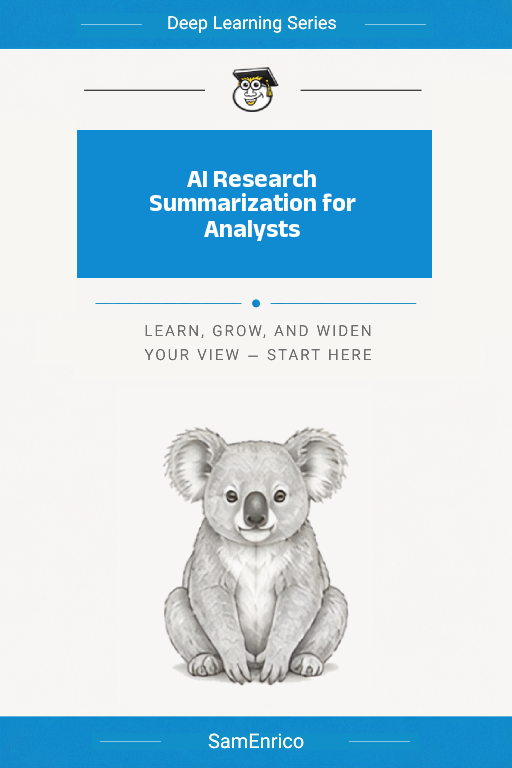
researchAI OperatorIntelligence Gathering
AI Research Summarization for Analysts eBook
Use AI to summarize long research papers, reports,
Use AI to summarize long research papers, reports, and articles. Extract key findings and methodology quickly.
Formats
Free sample
Chapter 1: The Reading Trap--–- It begins, as it always does, with a blinking cursor and a stack of unread PDFs. The analyst—let us call her Sarah—arrives at her desk at 6:45 AM, coffee in hand, hoping to get ahead of the day. Her inbox already contains seventeen new messages. Three of them are urgent. One is a 250-page equity research report from a bulge bracket bank, published at 2 AM.
Another is a 10-K filing from a competitor, dense with risk factors and financial footnotes. A third is a clinical trial readout from a biotech firm she covers, containing forty-seven tables of efficacy and safety data. Sarah has exactly ninety minutes before the morning meeting, where she is expected to present a synthesized view of all three documents to the investment committee. She knows, with the certainty of someone who has done this a thousand times, that she will read about thirty pages total, skim another fifty, and completely miss at least one material finding buried on page 187. This is not a failure of effort or intelligence.
It is a structural impossibility. The volume of published research has outpaced human reading capacity by a factor of approximately forty since the year 2000. And yet, the expectation remains that analysts like Sarah will somehow absorb, synthesize, and act upon all of it.This chapter is about that gap—the widening chasm between the information available and the time to consume it. But more importantly, it is about the false promise of traditional reading strategies and the emergence of a fundamentally different approach. Not reading faster.
Not skimming more efficiently. Not hiring junior analysts to do the reading. But offloading the mechanical work of extraction to artificial intelligence, and reserving human attention for what machines cannot yet do well: verification, judgment, and cross-document synthesis.The premise of this entire book rests on a single, uncomfortable truth: the traditional analyst workflow is broken. Ctrl+F, speed reading, weekend catch-up sessions, and heroic skimming are not strategies. They are coping mechanisms.
And they are failing. The evidence for this failure is everywhere—in missed risks, in analyst burnout, in investment committees making decisions based on incomplete information. But the failure is rarely attributed to the reading load itself. It is attributed to the analyst. "She should have read more carefully." "He missed that footnote." "They didn't dig deep enough." These are not accusations of laziness.
They are descriptions of the impossible.The Exponential Flood: By the Numbers Let us put numbers to the problem, because the scale of the challenge matters for every technique and tool described in later chapters. According to a 2024 study published in Scientometrics, the number of peer-reviewed research papers published annually crossed 5 million in 2023, doubling approximately every seventeen years. In the financial domain, public companies filing with the SEC produced over 450,000 annual reports, proxy statements, and material event filings in the same year. The average equity research report from a major investment bank is now 87 pages, up from 42 pages a decade ago. The average earnings call transcript has grown from 5,000 to 12,000 words as executives add more qualifiers, risk disclosures, and forward-looking statements.Now consider the typical coverage universe for a sell-side equity research associate.
She covers twelve companies. Each company reports quarterly, producing an earnings release (15 pages), a 10-Q filing (80 pages), and an earnings call transcript (12,000 words). Each company also files at least two material events per quarter (an 8-K, a press release, a presentation). And each company is covered by at least three other banks, each producing its own research reports. The theoretical reading load is approximately 15,000 pages per year.
That is forty-one pages per day, every single day, including weekends and holidays.But here is the cruel arithmetic that every analyst knows in their bones but rarely states aloud. The average professional reader processes about 200 to 250 words per minute with adequate comprehension. At that rate, a forty-page document (approximately 20,000 words) takes eighty to one hundred minutes to read carefully. An analyst with five such documents in a day would need eight hours of uninterrupted reading—no meetings, no email, no analysis, no bathroom breaks. And that calculation covers only the reading component of the job.
The actual work of analysis—comparing findings across documents, identifying contradictions, weighting evidence, forming judgments, and preparing presentations—happens after the reading. Or, more accurately, it happens instead of the reading.The result is what cognitive psychologists call the "information bottleneck." The human visual system can process about 10 million bits per second, but conscious reading comprehension maxes out at approximately 60 bits per second. The gap between what arrives and what can be absorbed is not a trickle. It is a floodwall about to break. Analysts cope by triaging—reading executive summaries, scanning headings, searching for keywords, relying on memory of previous documents.
But triage is not analysis. It is survival. And survival strategies, when deployed continuously for years, produce predictable outcomes: missed information, burned-out professionals, and organizational risk.The Illusion of Ctrl+F: Three Ways Keyword Search Fails The first tool most analysts reach for when faced with a long document is the search bar. Ctrl+F, or its Mac equivalent Command+F, feels like a superpower. Type a term—"revenue guidance," "adverse event," "termination clause," "material weakness"—and the document reveals every instance.
The analyst can jump from hit to hit, extracting only what matters, ignoring the rest. This is efficient. It is also dangerous. Keyword search creates the illusion of comprehension while systematically missing three critical categories of information.Failure One: The Lost Context Problem. Imagine searching a 200-page pharmaceutical company's annual report for the term "efficacy." The search returns twenty-seven mentions.
The analyst clicks through each one, extracting the numbers. But what she does not see are the paragraphs that contain important caveats but never use the word "efficacy." A sentence like "the primary endpoint did not achieve statistical significance in the per-protocol analysis" contains no keyword match for "efficacy" but fundamentally changes the interpretation of the efficacy data found elsewhere. A paragraph discussing "symptom improvement" without using the word "efficacy" might contain the most important clinical finding in the entire document. The analyst who searches only for keywords builds a mental model from fragments, not from arguments. She knows what the document says about efficacy where the word appears.
She has no idea what the document says about efficacy where the word does not appear.Failure Two: The Blindness to Implicit Information. Search cannot find what is not stated explicitly. Consider a legal contract review. The analyst searches for "indemnification" and finds the clause. But what about the absence of a "limitation of liability" clause?
What about the omission of a governing law provision? What about the lack of an audit right? Keyword search only reveals presence, not absence. The most important finding in a contract review is often what is missing—the protection that was negotiated away, the right that was never granted, the disclosure that was conspicuously absent. Ctrl+F will never show you that.
It cannot. It has no representation of absence.Failure Three: The False Sense of Coverage. Studies of information-seeking behavior have repeatedly shown that professionals who use keyword search systematically overestimate how much of…
This is the end of the free sample. Get the eBook to keep going. Buy now
About this book
Details
- Author
- Messina Larita
- Publisher
- SamEnrico
- Language
- English
- Genre
- research, AI Operator, Intelligence Gathering
- Released
- 2026-06-01
- Pages (approx.)
- 154
- Available as
- eBook, Audiobook

Read better in the ZLOADR app
Your eBooks on your phone or tablet. Sign in with your SamEnrico account and start reading.
More by Messina Larita
 Canva Brand Identity for TutorsMessina Larita$11.99
 NVC In Tech Teams GuideMessina Larita$11.99
 Teen Comparison Culture EscapeMessina Larita$11.99
 Step Eleven Prayer and MeditationMessina Larita$11.99
 The Forgotten War: The Battle of Imphal-Kohima – Britain’s Bloodiest Jungle FightMessina Larita$11.99
 Ham Radio Operator (commercial use)Messina Larita$11.99
 Learn to Play the SurnayMessina Larita$11.99
 How to Start a Carded Asbestos Fibre Business (Beginners Guide)Messina Larita$11.99
You may also like
 Scientific Research On TM GuideMartens Nathanial$11.99
 Research Proposal Methodology Section MasteryPauley Debroah$11.99
 Research Proposal Appendix CompilationRaines Tyisha$11.99
 Academic Researcher Distraction GuideFord Virgil$11.99
 TM Research and ScienceCovert Nicki$11.99
 Social Anxiety Research ReviewRoberge Cole$11.99
 Research Proposal Significance Section GuideBock Tory$12.99
 Research Proposal Reviewer PsychologyLugo Tawanda$11.99
 Research Proposal Research Questions DesignLara Robbi$11.99
 Research Proposal References and CitationsPatten Shanice$11.99
 Research Proposal Mixed Methods DesignCameron Omega$11.99
 Research Proposal Data Management PlanAnderson Roberto$12.99