
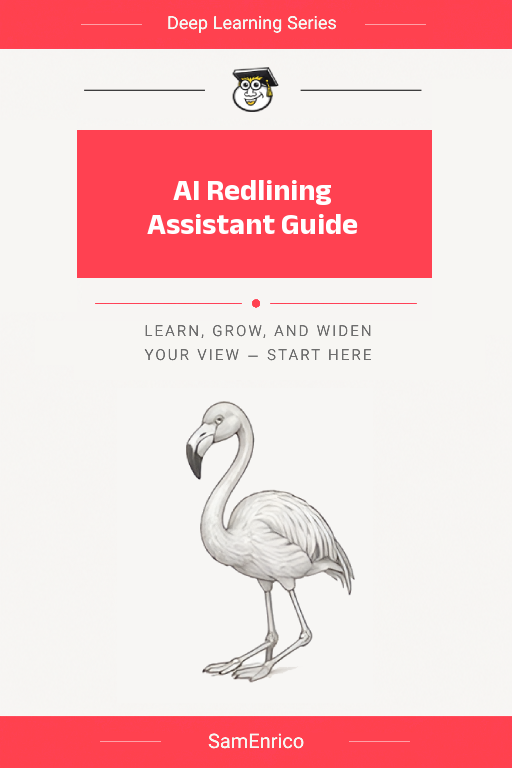
AI Redlining Assistant Guide eBook
Use AI to suggest redlines, alternative language,
Use AI to suggest redlines, alternative language, and negotiation points during contract markup sessions.
Formats
Free sample
Chapter 1: The 45-Minute Lie--–- The senior associate stared at the blinking cursor. The opposing counsel’s redline had arrived at 4:47 PM on a Friday, as it always did. Seventy-two pages. Two hundred and fourteen tracked changes. Eleven comments marked “RESOLVED” but clearly not.
The indemnity clause had been rewritten three times, each version worse than the last. The liability cap was gone. A new “automatic renewal” provision had appeared in Exhibit B, buried on page 67. The associate’s billable hour clock was running. The partner’s voicemail said, “Just get it done.” And somewhere in the office kitchen, the last cup of coffee was gone.This is not a story about artificial intelligence.
This is a story about time. Specifically, the forty-five minutes that every contract lawyer secretly knows they are about to lose before they even open the document.Welcome to the 45-Minute Lie.The lie is not malicious. No one intends to deceive. The lie is structural, baked into the very fabric of how legal professionals have reviewed contracts for decades. The lie says: You must read every word of the counterparty’s draft before you can begin redlining.
The lie says: Thoroughness requires a full top-to-bottom review. The lie says: The blank page is where trust lives.None of these statements are true.They were never true. But for generations, lawyers had no alternative. The only way to find a problematic clause was to read until you found it. The only way to spot a missing definition was to flip pages until you realized the defined term had no home.
The only way to prepare a redline was to start at Section 1 and grind forward, word by agonizing word.That era is over. And most lawyers do not yet know it.This chapter dismantles the foundational assumption that effective redlining begins with a human reading every word of a counterparty’s draft. It introduces the concept of cognitive load — how unstructured, page-by-page review leads to inconsistent outcomes, missed risks, and staggering billable waste. It presents the breakthrough of Precise Redlining, where AI suggests specific word, phrase, or clause edits while preserving the original document’s structure. And it teaches you to reframe your professional role from “editor” (line‑by‑line word chopper) to “strategic reviewer” (judgment, risk assessment, and negotiation positioning).By the end of this chapter, you will never open a contract the same way again.The Cognitive Load Trap Legal education trains lawyers to be afraid of missing things.
This fear is rational. Miss an indemnity carve-out, and your client pays millions. Miss a termination-for-convenience clause, and your client is locked into a five-year software contract for a product they stopped using in month three. The stakes are real. The consequences are severe.But the profession’s response to this fear has been pathological: exhaustive, linear, full-document review for every contract, every time.Cognitive load refers to the total amount of mental effort being used in working memory.
Legal contracts are uniquely terrible for cognitive load because they combine:Length – Fifty to one hundred pages is common for commercial agreements Density – Single sentences can run two hundred words with multiple subordinate clauses Interdependence – A definition in Section 1 affects interpretation of Section 27Adversarial drafting – Counterparties deliberately bury unfavorable terms Variation – No two contracts are identical, even for the same counterparty When a lawyer opens a seventy-two-page redline at 4:47 PM on a Friday, their working memory is already taxed. The cognitive load of simply navigating the document — scrolling, searching, cross-referencing — consumes mental bandwidth that should be reserved for judgment. By the time they reach Section 20, they have forgotten a nuance in Section 4. By the time they finish, they have missed three changes buried in exhibits.This is not a failure of lawyer competence. This is a failure of process architecture.The Contract Conundrum, a 2024 study of legal workflow efficiency, documented that lawyers spend approximately 62% of their contract review time on what the study called “non-judgment activities” — reading text that matches their playbook, verifying formatting, locating defined terms, and confirming that exhibits are attached.
Only 38% of time is spent on actual strategic decisions: evaluating risk, crafting negotiation positions, and balancing trade-offs.Sixty-two percent grunt work. Thirty-eight percent lawyering.The 45-Minute Lie is the name for this inefficiency: the false belief that thorough review requires linear, full-document reading. The truth is that thorough review requires accurate risk identification, not exhaustive page-turning. And accurate risk identification does not require reading text that matches expectations.Consider a simple example. Your Firm Playbook (introduced in Chapter 3) states that your acceptable limitation of liability clause is: “Each party’s total liability arising out of or related to this Agreement shall not exceed the total fees paid by Buyer to Seller during the twelve months preceding the claim.”The counterparty’s draft says: “Each party’s total liability arising out of or related to this Agreement shall not exceed the total fees paid by Buyer to Seller.”The difference is eleven words: “during the twelve months preceding the claim.” A human reading this clause must recognize that the counterparty has deleted a temporal limitation.
A human who has reviewed fifty similar clauses that week might miss it. An AI never misses it.But more importantly, a human does not need to read the entire contract to find this deviation. The AI can compare every clause against the playbook in seconds, flag only the deviations, and present them to the lawyer in a structured list. The lawyer then reads only the deviations — the 5% of the contract that actually matters — and spends their cognitive load on judgment, not hunting.That is the cognitive load trap escaped.Precise Redlining: What It Is and What It Is Not The term “redlining” has meant the same thing for forty years: opening Microsoft Word, turning on Track Changes, and manually striking, adding, or modifying text. AI redlining is not a faster version of that manual process.
It is a fundamentally different approach to contract markup.What AI Redlining Is Not:First, AI redlining is not paragraph replacement. Early contract AI tools operated like sophisticated find-and-replace: they identified a clause and swapped in a standard version from a library. This approach destroyed context, eliminated negotiated nuance, and often created more work for lawyers who had to manually restore acceptable changes. A tool that replaces your carefully negotiated liability cap with a generic template is not an assistant; it is a vandal.Second, AI redlining is not fully autonomous redlining. No responsible legal technology claims that AI should finalize and send redlines without human approval.
The malpractice risk is too high, the ethical duties too clear. As detailed in Chapter 12, the supervising lawyer remains fully responsible for every redline, whether AI-generated or not.Third, AI redlining is not a substitute for legal judgment. AI can identify deviations, suggest alternative language, and predict counterparty objections. AI cannot decide whether a client’s risk tolerance justifies accepting a higher liability cap in exchange for faster deal closure. That is strategy.
That is yours.What AI Redlining Is:Precise Redlining, as defined by platforms like Ironclad and Summize, is the use of generative AI to suggest specific word, phrase, or clause edits while preserving the original…
This is the end of the free sample. Get the eBook to keep going. Buy now
About this book
Details
- Author
- Gladden Jayna
- Publisher
- SamEnrico
- Language
- English
- Genre
- Non-Fiction, AI Operator, Legal Tech Skills
- Released
- 2026-05-29
- Pages (approx.)
- 154
- Available as
- eBook, Audiobook

Read better in the ZLOADR app
Your eBooks on your phone or tablet. Sign in with your SamEnrico account and start reading.
More by Gladden Jayna
 Natural Migraine RemediesGladden Jayna$11.99
 Listening For Medical ProfessionalsGladden Jayna$11.99
 Metabolic Syndrome African AmericansGladden Jayna$11.99
 Cocaine Work Performance RecoveryGladden Jayna$11.99
 The Last Quest of Sir Balin the SavageGladden Jayna$11.99
 Learn to Play the Inline OcarinaGladden Jayna$11.99
 How to Start a Needle Roller Bearings Business (Beginners Guide)Gladden Jayna$11.99
 Corn RoasterGladden Jayna$11.99
You may also like
 Employment Contract Review with AIBonilla Leonila$12.99
 NDA Review Prompts for AIManns Albert$12.99
 Lease Agreement Review PromptsCorrea Trina$12.99
 Cross Document Clause ComparisonPenn Voncile$12.99
 Contract Risk Analysis with AIFrantz Ozie$12.99
 AI for Compliance Document ReviewAmato Giuseppina$12.99
 AI for Legal Document SummarizationCason Akilah$12.99
 AI Assisted Legal Document Review GuideCarder Merrilee$12.99
 Legal Document QA with AIPetersen Alesha$12.99