
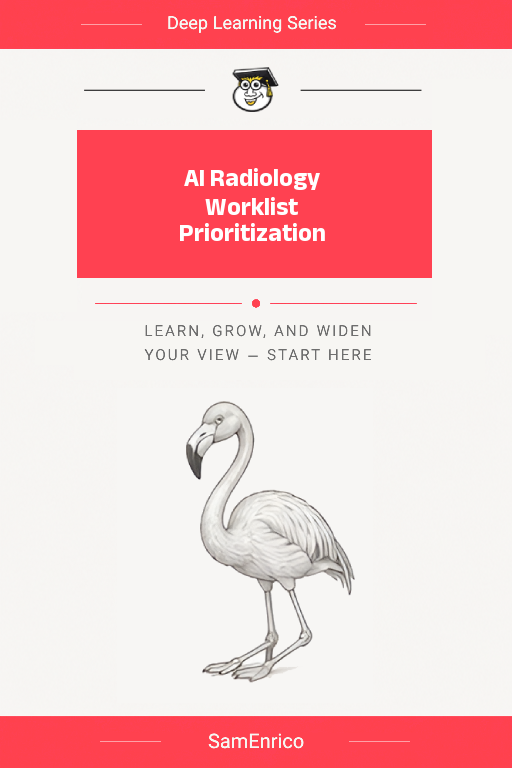
Non-FictionForecast & OutlookWorklist AI
AI Radiology Worklist Prioritization
Discover algorithms flagging critical findings for
Discover algorithms flagging critical findings for immediate review, reducing turnaround for time-sensitive diagnoses.
Formats
About this book
Free sample
Chapter 1: The Deadly Queue--–- The 3:14 AM CT scan completed with a soft chime. Somewhere in the bowels of Memorial Hospital’s PACS server, a digital object representing a 58-year-old schoolteacher named Eleanor Vance took its place in line. Behind it were seventeen other exams: a routine follow-up MRI for a known benign liver lesion, three outpatient knee X-rays for osteoarthritis, a CT urogram for a stone former, and twelve other studies of varying urgency. Eleanor’s scan showed a hyperdense middle cerebral artery sign—a large vessel occlusion starving half her brain of oxygen. But the worklist didn’t know that.
The worklist couldn’t know that. The worklist was blind. Eleanor’s scan sat in position fourteen. The radiologist on call, Dr. Harris, was reading in order of arrival.
He didn’t see Eleanor’s brain until 4:47 AM. She woke from thrombectomy six hours later unable to speak fluently again.This is not a cautionary tale. It is a description of standard operating procedure in nearly every radiology department on the planet. The technology to prevent it has existed for years. The failure is not one of medicine.
It is one of queue management.The Paradox of Speed Radiology has achieved a remarkable feat. Over the past two decades, image acquisition times have collapsed. What once required minutes of breath-holding now takes seconds. CT scanners can image the entire chest in less time than it takes to say “pulmonary embolism.” MRI pulse sequences have accelerated to the point where a complete brain protocol runs in under ten minutes. From the moment the patient lies down to the moment the last image arrives in PACS, the gap has never been smaller.Yet the interval from image completion to report—the metric that actually matters for patient outcomes—has stubbornly refused to improve at the same rate.
In some departments, it has worsened. The reason is counterintuitive: faster scanners produce more exams. A lot more. Global imaging volume grows at 3–5 percent annually, driven by aging populations, expanded clinical indications, and the sheer ease of ordering a scan that takes…
This is the end of the free sample. Get the eBook to keep going. Buy now
Contents
- Chapter 1
- Chapter 2
- Chapter 3
- Chapter 4
- Chapter 5
- Chapter 6
- Chapter 7
- Chapter 8
- Chapter 9
- Chapter 10
- Chapter 11
- Chapter 12
Details
- Author
- Hickson Maddie
- Publisher
- SamEnrico
- Language
- English
- Genre
- Non-Fiction, Forecast & Outlook, Worklist AI
- Released
- 2026-06-01
- Pages (approx.)
- 137
- Available as
- eBook, Audiobook

Read better in the ZLOADR app
Your eBooks on your phone or tablet. Sign in with your SamEnrico account and start reading.
More by Hickson Maddie
 Review Ritual ScienceHickson Maddie$11.99
 Resistance Tube Travel WorkoutHickson Maddie$11.99
 Twitter Comparison Recovery GuideHickson Maddie$11.99
 Values And Mission Alignment Social MediaHickson Maddie$11.99
 The Great Unplug: How the 2019 Blackout United a Divided WorldHickson Maddie$11.99
 The Last Broadcast: The Mysterious Signals from the CosmosHickson Maddie$11.99
 Understanding Hypofibrinogenemia, FamilialHickson Maddie$17.99
 A Beginners Guide to Boli Khela (Volume 1)Hickson Maddie$11.99
 ChatGPT Business Applications WorkbookHickson Maddie$12.99
 Tennis Ball ThrowerHickson Maddie$11.99
You may also like
 Hong Kong Handover 1997Dunn Johnnie$11.99
 Zumba For Postnatal Recovery CourseNeal Christian$11.99
 Zumba for BeginnersLadner Nikia$11.99
 YouTube Comment Mining GuideHumes Pandora$12.99
 Worry Box MeditationCarlin Rudy$11.99
 Workplace Stress MeditationNguyen Lynn$11.99
 Workplace Stress and Sleep RepairHawley Ivory$11.99
 Workplace Perfectionism CureDelaney Jeffry$11.99
 Workplace Injustice Anger GuideWallen Isabelle$11.99
 Work Addiction and Burnout LinkGreenwood Ester$11.99
 Women in Yoga and WellnessBeattie Galina$11.99
 Women in Stand Up ComedyChun Evangeline$11.99