
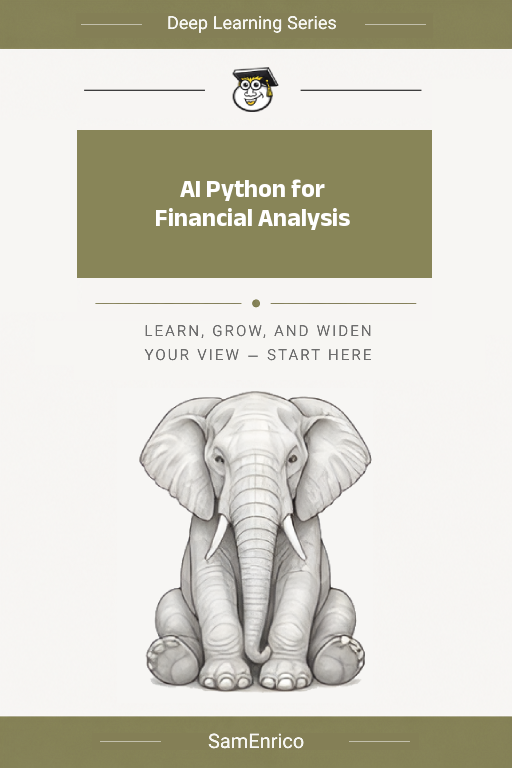
AI Python for Financial Analysis eBook
Generate Python scripts for financial calculations
by Tuggle Dayle
Generate Python scripts for financial calculations, data analysis, and automation using AI.
Formats
Free sample
Chapter 1: The 3 AM Epiphany--The spreadsheet has frozen for the third time tonight. It is 3:14 AM. Your boss needs the risk report by 8 AM. The model you spent two weeks building just threw an error you have never seen before. Somewhere in a competing firm, another analyst is sleeping soundly because their AI agent wrote the same model in fourteen minutes while they watched.This is not a book about learning Python.
This is a book about learning to stop doing work that computers can do for you.If you are reading this, you have likely felt the creeping realization that the financial industry is splitting into two distinct groups of people. The first group spends their days wrestling with Excel spreadsheets, copying data from PDFs into CSV files, writing the same backtesting loops over and over, and praying that their macro doesn't break when someone adds a new column. The second group describes a trading strategy in plain English to an AI, watches as Python code appears, validates the logic, and moves on to the next problem before their coffee gets cold.This book exists to move you from the first group to the second.But let me be brutally honest about what this book is not. This is not a book that will teach you to become a professional software engineer. You do not need to memorize the syntax of every pandas method.
You do not need to understand the garbage collection mechanisms of CPython. You do not need to implement a Red-Black tree from scratch. Those skills are valuable for a very small number of people writing high-frequency trading systems. The other ninety-nine percent of financial analysts need something completely different: the ability to tell an AI what they want, get working code, and know whether that code is correct.This is a book about augmentation, not replacement.Every chapter of this book follows a consistent philosophy that I call the Triad Model. The Triad has three components.
First, there is you, the human analyst. You bring the financial knowledge, the risk appetite, the ethical judgment, and most importantly, the ability to ask the right question. Second, there is the Large Language Model, the AI that generates code, explains complex concepts, refactors messy scripts, and writes documentation. Third, there is Python itself, the execution engine that runs your models, fetches your data, and places your trades.The relationship between these three components changes as you progress through this book. In the early chapters, the AI does most of the heavy lifting while you learn the landscape.
In the middle chapters, you take the lead and use the AI to refactor and optimize your code. In the final chapters, you orchestrate teams of AI agents that collaborate to solve complex financial problems while you set the constraints and approve the decisions.To help you understand where you are in this journey, each chapter includes four critical pieces of information before you start reading. First, a Difficulty rating that tells you whether this chapter is Beginner, Intermediate, Advanced, or Expert. Second, a Prerequisites section listing exactly what you need to know or have completed before starting. Third, a Trust Spectrum Level that tells you who is driving the work in this chapter.
Fourth, a Time Estimate so you can plan your learning.Here is what you need to know about the Trust Spectrum, as it is the single most important framework in this book. At Level One, which covers Chapters One and Two, the AI writes the code and you review it. You are learning to prompt and validate. At Level Two, which covers Chapters Three and Four, the AI suggests solutions and you approve edits before they are applied. At Level Three, which covers Chapters Five through Eight, you write the basic implementation and the AI refactors it to be faster, safer, and more statistically valid.
At Level Four, which covers Chapters Nine and Ten, you design the architecture and the AI implements the details. At Level Five, which covers Chapters Eleven and Twelve, the AI proposes solutions and you set the constraints and approve the final decisions.You will notice that nowhere in this spectrum does the AI operate without human oversight. This is intentional. The best AI agents today are brilliant at generating code that looks correct but contains subtle errors. They are terrible at understanding whether a trading strategy will blow up your portfolio in a black swan event.
They are incapable of feeling the fear of losing real money. That is your job, and no amount of prompt engineering will change it.Before we write a single line of code, we need to talk about the environment where all of this work happens. You need three things. First, you need Python 3.11 or newer installed on your computer. Second, you need a code editor.
I recommend VS Code because it has excellent integration with AI coding assistants, but Jupyter Lab is also fine. Third, and most importantly, you need access to a Large Language Model. Chat GPT with GPT-4 or Claude 3.5 Sonnet are the best options as of this writing. The free tier of Chat GPT with GPT-3.5 is insufficient for the complexity of code we will generate. If you cannot afford a subscription, consider using Google's Gemini or Anthropic's Claude free tier, though both have rate limits that will frustrate you.Here is your first prompt.
I want you to open your AI assistant and paste this exactly, then run whatever code it generates. Do not worry about understanding every line yet. Your job right now is to observe and validate.The prompt is: "Act as a Senior Quantitative Developer. Create a cross-platform Python script that checks if conda is installed. If conda is present, create a new conda environment named agentic_finance with Python 3.11.
Then install the following packages using pip inside that environment: yfinance, pandas, pandas_ta, plotly, scikit-learn, statsmodels, arch, tensorflow, langchain, python-dotenv, requests, beautifulsoup4, lxml. If conda is not present, check for virtualenv and create a virtual environment instead. Use error handling so the script fails gracefully with clear error messages. Add comments explaining each major step."Run whatever the AI gives you. Watch what happens.
This script, which might take you an hour to write manually, should execute in a few minutes. You now have a complete Python environment configured for every chapter of this book.If the script fails, do not panic. The AI's code might have a bug. Copy the error message back to the AI and say: "This script failed with the following error. Please fix it." The AI will iterate until it works.
This is the core skill you will develop in this book: not writing perfect code on the first try, but guiding an AI through debugging cycles until the code works.Now that your environment is ready, we need to talk about the three hidden assumptions that every AI-assisted financial analyst must understand.The first hidden assumption is that the AI understands finance. It does not. Large Language Models have read millions of financial documents and can recite the Black-Scholes formula from memory. But they do not understand what volatility means for an options portfolio. They…
This is the end of the free sample. Get the eBook to keep going. Buy now
About this book
Details
- Author
- Tuggle Dayle
- Publisher
- SamEnrico
- Language
- English
- Genre
- Non-Fiction, AI Operator, Python
- Released
- 2026-05-30
- Pages (approx.)
- 115
- Available as
- eBook, Audiobook

Read better in the ZLOADR app
Your eBooks on your phone or tablet. Sign in with your SamEnrico account and start reading.
More by Tuggle Dayle
 Relationship Burnout RecoveryTuggle Dayle$11.99
 Name Emotional TaggingTuggle Dayle$11.99
 The Smartphone HelperTuggle Dayle$11.99
 Rightsizing Your Retirement Home GuideTuggle Dayle$11.99
 Early Payment DiscountTuggle Dayle$11.99
 Salary Negotiation GuideTuggle Dayle$11.99
 Compulsive Spending TriggersTuggle Dayle$11.99
 OKRs for Remote TeamsTuggle Dayle$11.99
 Theseus and the Minotaur: Labyrinth of ShadowsTuggle Dayle$11.99
 The Poisoned Prohibition: The Hacker Who Sold Death in a BottleTuggle Dayle$11.99
 How to Produce a KamadoTuggle Dayle$11.99
 Service Providers Guide to MattressesTuggle Dayle$11.99