
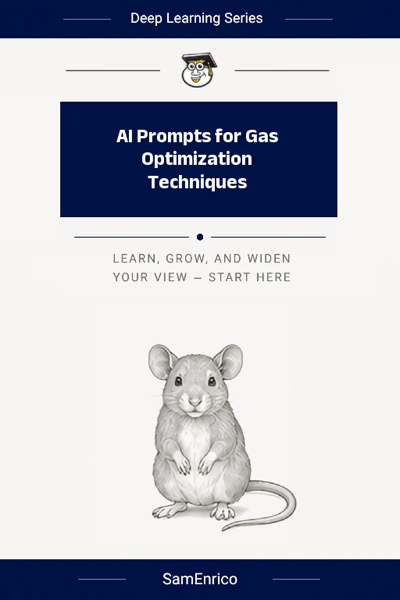
Non-FictionInformativeEducational
AI Prompts for Gas Optimization Techniques
A Coursebook on AI Prompts for Gas Optimization Te
by Coker Arline
A Coursebook on AI Prompts for Gas Optimization Techniques
Formats
About this book
Free sample
Chapter 1: The Two Gases--–- In a control room somewhere along the Texas Gulf Coast, a process engineer named Elena watches three monitors. On the left, a digital twin of a deethanizer column shows pressure creeping toward an alarm limit. On the center screen, a Large Language Model interface waits for her next prompt. On the right, a dashboard she barely looks at displays the data center energy usage for her company’s AI tools. Elena is trying to solve a pressure problem in a distillation tower.
She does not realize that the prompt she is about to type will consume two kinds of gas: the hydrocarbon rising through the tower trays and the electricity powering the GPU cluster three states away. This book is for Elena and everyone like her—engineers, analysts, and operators who have been taught to optimize physical processes but have never been told that their AI prompts have a carbon cost of their own.The Double Meaning You Cannot Ignore If you work in downstream energy, you already know what “gas” means. It means methane, ethane, propane, butane, and the complex mixtures that flow through pipelines, compressors, fractionation towers, and furnaces. It means fuel gas that fires refinery heaters. It means natural gas that becomes LNG.
It means hydrogen that gets purer or impurer depending on how you open a valve. This is physical gas, and optimizing it has been the work of process engineers for a century.But there is a second gas that has snuck into your refinery, your gas plant, and your LNG terminal. It is computational gas. Every time you type a prompt into an LLM—every time you ask an AI to simulate a column, estimate a flash point, or recommend a compressor setpoint—you consume compute cycles. Those cycles run on GPUs.
Those GPUs consume electricity. That electricity, in most parts of the world, comes from burning fuel, which emits carbon. In data centers that serve industrial AI, a single complex prompt can consume as much electricity as running a 100-watt light bulb for an hour. A thousand such…
This is the end of the free sample. Get the eBook to keep going. Buy now
Contents
- Chapter 1
- Chapter 2
- Chapter 3
- Chapter 4
- Chapter 5
- Chapter 6
- Chapter 7
- Chapter 8
- Chapter 9
- Chapter 10
- Chapter 11
- Chapter 12
Details
- Author
- Coker Arline
- Publisher
- SamEnrico
- Language
- English
- Genre
- Non-Fiction, Informative, Educational
- Released
- 2026-05-04
- Pages (approx.)
- 155
- Available as
- eBook, Audiobook

Read better in the ZLOADR app
Your eBooks on your phone or tablet. Sign in with your SamEnrico account and start reading.
More by Coker Arline
 Wholesaling Without A License GuideCoker Arline$11.99
 The Boredom Confidence WorkbookCoker Arline$11.99
 Natural Disaster Recurring DreamsCoker Arline$11.99
 Wholesaling Landing Page GuideCoker Arline$11.99
 Spin Standing Climb FormCoker Arline$11.99
 Sam Palmisano IBMCoker Arline$11.99
 Professional Driver Rage FixCoker Arline$11.99
 Stress Reproductive Health GuideCoker Arline$11.99
 Nightmare Breath GroundingCoker Arline$11.99
 The Last Stand of the Iron Legs: The Untold Story of the 1975 World Cup's Most Brutal MatchCoker Arline$11.99
 Anansi and the Moonlit Vow: A Spider’s Web of Love and DeceptionCoker Arline$11.99
 The Unseen Architect: How a Refugee Redesigned the World’s SkylineCoker Arline$11.99
You may also like
 Hong Kong Handover 1997Dunn Johnnie$11.99
 Zumba For Postnatal Recovery CourseNeal Christian$11.99
 Zumba for BeginnersLadner Nikia$11.99
 YouTube Comment Mining GuideHumes Pandora$12.99
 Worry Box MeditationCarlin Rudy$11.99
 Workplace Stress MeditationNguyen Lynn$11.99
 Workplace Stress and Sleep RepairHawley Ivory$11.99
 Workplace Perfectionism CureDelaney Jeffry$11.99
 Workplace Injustice Anger GuideWallen Isabelle$11.99
 Work Addiction and Burnout LinkGreenwood Ester$11.99
 Women in Yoga and WellnessBeattie Galina$11.99
 Women in Stand Up ComedyChun Evangeline$11.99