
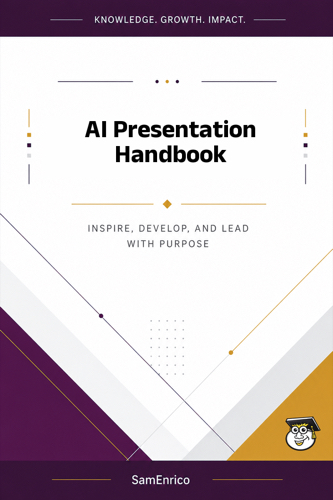
AI Presentation Handbook eBook
Complete guide to AI tools for slide deck generati
Complete guide to AI tools for slide deck generation across all platforms.
Formats
Free sample
Chapter 1: The Junior Partner...--The blank slide is the enemy of progress. Every executive, consultant, and entrepreneur knows this moment. You open Power Point, Google Slides, or Canva. The cursor blinks on a white rectangle. And suddenly, the eighteen ideas you had five minutes ago vanish like smoke.
You type a headline. Delete it. Type another. Move a box three pixels left. Change the font.
Change it back. Forty-five minutes later, you have two slides and a growing sense of dread.Then you discover AI presentation tools.You type "make me a sales deck for a B2B Saa S company" into Chat GPT, Gamma, or Copilot. Fifteen seconds later, the machine hands you twenty slides. There are charts. There are bullet points.
There are stock photos of people shaking hands in front of city skylines. It looks complete. It looks professional. It looks, to the untrained eye, like work.It is not work. It is a trap.I have reviewed hundreds of AI-generated presentations over the last eighteen months — from first-time founders, from Fortune 500 marketing teams, from consultants at firms that should know better.
The results are consistently disastrous. Seventy percent of AI-generated decks fail what I call the boardroom test. They lack narrative. They contain hallucinated facts. They ignore the audience's actual needs.
And worst of all, they give the presenter a false sense of security. You think you are ready. You are not.This book exists to fix that.The AI Presentation Handbook is not a cheerleader for artificial intelligence. It is not a doom-scroll about machines stealing your job. It is a practical, battle-tested workflow for doing one thing well: building slide decks that persuade, inform, and close deals, using AI as a tool rather than a crutch.
You will learn when to trust the machine, when to verify its output, and — most importantly — when to throw its work away and start over.Let us begin with the single biggest mistake I see.The Consultant Who Lost Two Million Dollars A technology consultancy was pitching a supply chain optimization project to a retail client. The potential contract value was two million dollars. The partner leading the pitch was smart, experienced, and under enormous time pressure. He had five days to prepare a deck that would normally take two weeks.He used an AI presentation tool. He fed it the request-for-proposal document, some historical slides from similar projects, and a prompt that said "create a compelling pitch deck." The tool returned thirty-two slides.
They looked beautiful. There were process diagrams, ROI projections, case studies, team bios. The partner made a few tweaks, added the client's logo, and sent the deck to his team for review.No one reviewed it. Everyone was too busy. The partner presented the deck to the client's procurement committee.Three minutes into the presentation, the client's head of supply chain raised his hand.
He said, "Where did you get these numbers?" The partner looked at the slide. A chart showed that the client's current warehouse utilization was sixty-two percent. The actual number, as the client knew and the partner should have known, was eighty-nine percent. The AI had hallucinated the data. It had pulled from a generic industry report instead of the client's specific financials.The partner tried to recover.
He said the chart was a placeholder. He said the real analysis would come later. But the damage was done. The client asked for the presentation to be paused. They never rescheduled.
The consultancy lost the two-million-dollar deal.The partner's mistake was not using AI. His mistake was treating AI as a content factory rather than a structural architect. He trusted the machine to know things it could not possibly know. He skipped verification. And he paid for it.I tell this story not to scare you away from AI tools.
I tell it to establish the single most important framework you will learn in this book.The Trust but Verify Framework Throughout this book, you will encounter a simple, repeatable decision rule. I call it the "Trust but Verify" framework. It applies to every tool, every platform, and every presentation you build.Here is the rule: Trust AI for structure. Verify everything else.Let me be specific. The table below shows exactly what you can confidently delegate to artificial intelligence and what you must personally verify before any human sees your slides.Trust AI For Verify AI For Outline and slide structure Facts and numbers First-draft placeholder text Data visualizations and charts Layout suggestions Brand consistency (colors, fonts, logos)Speaker notes generation Narrative logic and argument flow Data table generation (raw numbers only)Emotional intelligence and audience awareness Grammar and spelling correction Export fidelity across platforms Notice what is missing from the "Trust" column.
AI does not know your business. It does not know your client. It does not know the unspoken politics of your organization. It knows patterns. It knows probabilities.
It knows that most sales decks include a problem slide, a solution slide, and a pricing slide. That is useful. That is structure. But structure is not truth.The consultant who lost two million dollars trusted AI for data visualization. That is a "Verify" item.
He trusted AI for facts. That is also a "Verify" item. He violated the framework, and the framework punished him.Here is what the framework would have told him to do instead. Trust AI to generate the slide structure: problem, solution, methodology, team, investment. Trust AI to write placeholder text for each slide.
Trust AI to suggest a layout. Then verify every number against the client's actual financial documents. Verify every claim against the request-for-proposal. Verify every case study against real project records. And when the AI hallucinates a statistic — which it will — catch it before the client does.This framework will appear in every chapter of this book.
Chapter 4, on Microsoft Copilot, will show you how to trust its Excel-to-chart feature for first drafts but verify before sending. Chapter 9, on data visualization, will show you exactly how AI charts lie and how to catch the lies. Chapter 11, on quality assurance, will give you a scorecard that enforces the framework on every deck.But before we go tool-by-tool, we need to understand what professional presentation creation actually looks like without AI. Because you cannot direct a machine to do something you do not understand yourself.The Six Essential Steps You Cannot Skip Professional presentation creation follows a predictable sequence. I have watched hundreds of presenters — from first-year analysts to Fortune 50 C-suite executives — build decks.
The ones who succeed follow these six steps. The ones who fail skip steps or do them out of order.Step One: Audience Definition You cannot persuade someone you do not understand. Before you write a single word, answer three questions about your audience.First, who are they? Be specific. Not "the client" but "the Chief Financial Officer who has been burned by software implementations before." Not "the team" but "the head of marketing who needs approval from legal." The more specific your audience persona, the better your AI prompts will work.Second, what do they already know?
If you are presenting to engineers, you can use technical language. If you are presenting to the board, define your…
This is the end of the free sample. Get the eBook to keep going. Buy now
About this book
Details
- Author
- Brunson Marline
- Publisher
- SamEnrico
- Language
- English
- Genre
- Non-Fiction, AI Operator
- Released
- 2026-06-08
- Pages (approx.)
- 133
- Available as
- eBook, Audiobook

Read better in the ZLOADR app
Your eBooks on your phone or tablet. Sign in with your SamEnrico account and start reading.
More by Brunson Marline
 The Beginner's Anger PracticeBrunson Marline$11.99
 Cawnpore Massacre MemorialBrunson Marline$11.99
 Beverage Recall EncyclopediaBrunson Marline$11.99
 Psoriasis Body EsteemBrunson Marline$11.99
 Ayanna PressleyBrunson Marline$11.99
 Reformation Predestination Puritan ManualBrunson Marline$11.99
 Czech Biotech Sector OutlookBrunson Marline$11.99
 Hue City House to HouseBrunson Marline$11.99
 Shadows of the Pentagon Papers: The Man Who Leaked the Vietnam WarBrunson Marline$11.99
 The Silk Road Revealed: Rediscovering Central Asia's Hidden LandscapesBrunson Marline$11.99
 Galileo's Star: The Telescope That Changed the UniverseBrunson Marline$11.99
 The Complete Guide to Children's Diet ProgramsBrunson Marline$11.99
You may also like
 Hong Kong Handover 1997Dunn Johnnie$11.99
 Zumba For Postnatal Recovery CourseNeal Christian$11.99
 Zumba for BeginnersLadner Nikia$11.99
 YouTube Comment Mining GuideHumes Pandora$12.99
 Worry Box MeditationCarlin Rudy$11.99
 Workplace Stress MeditationNguyen Lynn$11.99
 Workplace Stress and Sleep RepairHawley Ivory$11.99
 Workplace Perfectionism CureDelaney Jeffry$11.99
 Workplace Injustice Anger GuideWallen Isabelle$11.99
 Work Addiction and Burnout LinkGreenwood Ester$11.99
 Women in Yoga and WellnessBeattie Galina$11.99
 Women in Stand Up ComedyChun Evangeline$11.99