
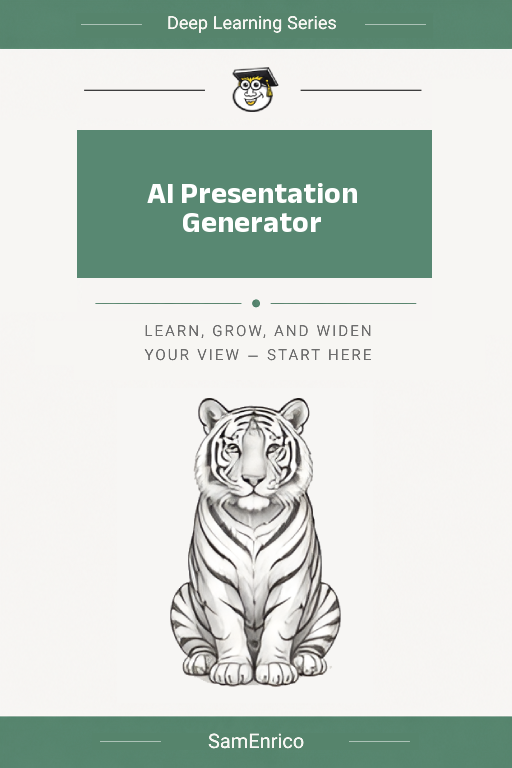
AI Presentation Generator eBook
Use Tome AI, Beautiful AI, or Gamma to create busi
Use Tome AI, Beautiful AI, or Gamma to create business presentations from text prompts.
Formats
Free sample
Chapter 1: The Prompt Paradox-- Most people believe that using an AI presentation generator is simply a matter of typing a few words into a box and watching magic happen. They imagine a scene not unlike a Star Trek computer: “Make me a deck about quarterly earnings” and – poof – perfect slides appear, complete with insightful charts, compelling narratives, and flawless design. This fantasy is the single greatest barrier to mastering AI presentation tools. It is also the reason why thousands of professionals have tried Gamma, Tome, or Beautiful.ai exactly once, received mediocre results, and concluded that the technology “isn’t ready yet.”The truth is far more interesting and far more empowering. AI presentation generators are not magic.
They are sophisticated prediction engines that require a specific kind of human intelligence to direct them effectively. The gap between a generic, forgettable AI-generated deck and a stunning, persuasive presentation is not a better algorithm. It is a better prompt. This chapter will dismantle the myths surrounding AI presentation tools and replace them with a practical, repeatable framework for getting exactly what you want from machines that do not actually understand what they are creating.If you have ever received a slide deck from an AI that felt “off” – generic phrasing, weird structure, irrelevant images, or confidently stated falsehoods – the problem was almost certainly not the tool. The problem was how you communicated with it.
This chapter will teach you to see through the illusion of intelligence, understand how these systems actually process language, and master the four dimensions of prompting that separate amateurs from professionals. By the end, you will never look at an AI text box the same way again.The Illusion of Understanding Let us begin with a foundational truth that will shape everything you do with AI presentation tools: Large language models do not understand anything.This statement sounds provocative, but it is simply an accurate description of the technology. When you type a prompt into Gamma, Tome, or Beautiful.ai, the system is not reading your words, comprehending your business problem, or thinking creatively about solutions. Instead, it is performing an extraordinarily complex statistical calculation. The model has been trained on billions of examples of human language – books, articles, websites, presentations, reports, and more.
Based on that training, it has learned patterns: which words tend to follow which other words, which sentence structures are common in certain contexts, and how topics typically flow from one idea to the next.When you provide a prompt, the AI is essentially asking itself: “Given these input words, what is the most statistically probable sequence of words that should come next?” It is not reasoning. It is predicting.This distinction matters enormously for presentation design. When you ask an AI to “create a pitch deck for a Series A Saa S company,” the system is not analyzing your specific product, market position, or competitive landscape. It is drawing on thousands of pitch decks it has seen during training and generating a statistically average version of what a Series A Saa S pitch deck looks like. The result will be competent, generic, and – crucially – exactly like everyone else’s.The best presenters understand this limitation and design their prompts to overcome it.
They do not ask the AI to “think.” They feed it specific information, constrain its options, and guide its predictions toward originality and relevance. The difference between a bad prompt and a good prompt is the difference between ordering a “meal” at a restaurant and ordering a “medium-rare ribeye with roasted garlic potatoes and asparagus, no salt, extra pepper, with a side of béarnaise.”Tokenization: How AI Chews Your Words To write effective prompts, you need to understand at a basic level how AI processes language. The technical concept here is tokenization, and while it sounds intimidating, it is actually quite simple.When you type a sentence into an AI presentation tool, the system does not see letters or even whole words the way you do. Instead, it breaks your text into small pieces called tokens. A token can be as short as one character or as long as one word, but it is typically a few characters.
For example, the sentence “Show me Q3 revenue growth” might be tokenized as: “Show” + “ me” + “ Q” + “3” + “ revenue” + “ growth”. Each of these pieces is a token.Why does this matter? Because AI models have a fixed limit on how many tokens they can process at once – a limit called the context window. When you are working with Tome or Gamma, the system can only “see” a certain amount of your conversation history. If your prompt is too long, or if you have had an extended back-and-forth with the AI, older parts of the conversation will simply be forgotten.Most presentation-focused AI tools have context windows between 4,000 and 128,000 tokens.
For perspective, 4,000 tokens is roughly 3,000 words – about three pages of single-spaced text. While that might sound like plenty, consider that every time you upload a report, ask a follow-up question, or request a revision, you are consuming tokens. An ambitious user can hit the context limit surprisingly quickly, after which the AI will begin responding as if earlier instructions never happened.The practical implication is this: Keep your prompts concise and your conversations focused. If you are working on a complex presentation, avoid long, rambling exchanges with the AI. Instead, start fresh with a clear, comprehensive prompt that includes all necessary context upfront.
Think of each AI session as a blank slate – the less you rely on the AI’s “memory,” the more reliable its outputs will be.The Four-Dimensional Prompt Framework Now we arrive at the heart of this chapter: a practical, repeatable system for constructing prompts that consistently produce high-quality presentation drafts. I call this the 4-D Framework because it organizes your thinking around four essential dimensions of any effective prompt: Desired Outcome, Data Sources, Design Vibe, and Demographic.Each dimension answers a specific question that the AI cannot answer on its own. When you provide all four, you transform the AI from a generic content generator into a focused, purpose-built presentation assistant. When you omit even one dimension, the AI is forced to guess – and its guesses will be statistically average, not strategically excellent.Let us explore each dimension in depth.First Dimension: Desired Outcome The most common mistake in AI prompting is asking for “a presentation” without specifying what the presentation should achieve. A pitch deck that raises money looks very different from a training deck that teaches new employees.
A quarterly review that aligns a team looks different from a sales deck that closes a deal. The AI has no way of knowing which you need unless you tell it.The Desired Outcome dimension asks one question: What should the audience know, feel, or do after viewing this presentation?Notice that this question includes three different types of outcomes:Know – Cognitive outcomes. “After this presentation, the audience should understand why we are entering the European market in Q2.” These presentations are informational and structured around facts, data, and logical arguments.Feel – Emotional outcomes. “After this presentation, the audience should feel excited about the product launch and confident in our team.” These…
This is the end of the free sample. Get the eBook to keep going. Buy now
About this book
Details
- Author
- Fulton Francesco
- Publisher
- SamEnrico
- Language
- English
- Genre
- Non-Fiction, Annual Checkup, Presentation AI
- Released
- 2026-06-01
- Pages (approx.)
- 155
- Available as
- eBook, Audiobook

Read better in the ZLOADR app
Your eBooks on your phone or tablet. Sign in with your SamEnrico account and start reading.
More by Fulton Francesco
 The Four Part Breath GuideFulton Francesco$11.99
 CrossFit Home Gym Setup GuideFulton Francesco$11.99
 Self Hypnosis Sleep InductionFulton Francesco$11.99
 Acupuncture Points Quick ReferenceFulton Francesco$11.99
 YouTube Shorts Dopamine TrapFulton Francesco$11.99
 The Ghost in the Cloud Chamber: Rutherford's Atomic Revolution (1911)Fulton Francesco$11.99
 The Billionaire’s Bet: How Larry Ellison’s Radical Yacht Race Changed the Tech WorldFulton Francesco$11.99
 123RF Mobile ContributorFulton Francesco$12.99
 Understanding Dwarfism Mental Retardation Eye AbnormalityFulton Francesco$17.99
 Cloud Security SpecialistFulton Francesco$11.99
 How to Become a Control ClerkFulton Francesco$11.99