
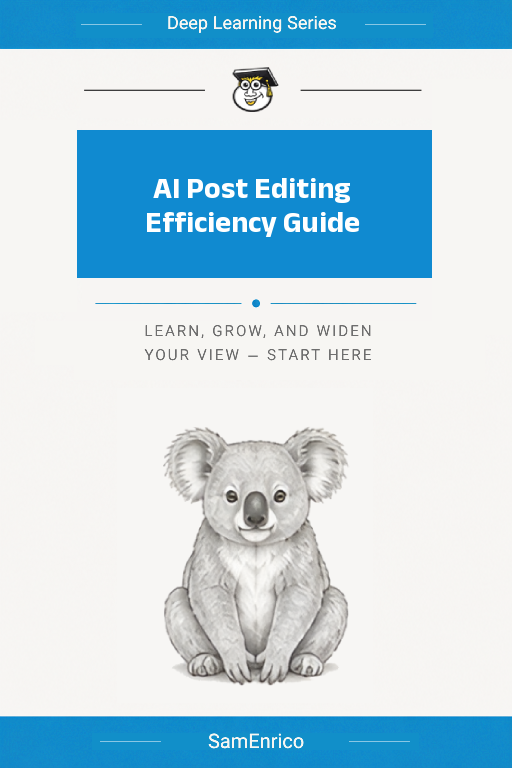
AI Post Editing Efficiency Guide eBook
Train custom models on your corrections so machine
by Pride Bette
Train custom models on your corrections so machine translations improve over time, reducing human editing effort by sixty percent after three months.
Formats
Free sample
Chapter 1: The Editing Trap--The first time Maria saw the same mistranslation for the eight hundred and forty-seventh time, she didn't scream. She didn't throw her laptop across the room. She didn't even sigh. She simply highlighted the word, typed the correct translation, and moved on to the next segment. That was her job.
That was what post-editing meant. Fix the same errors, over and over, for years, while the machine that produced them learned absolutely nothing from her effort.Maria is a fictional name, but her story is not. She represents thousands of professional translators and post-editors working today in what the industry politely calls "language services." Her reality is this: she spends fifty-five to sixty-five percent of her working hours fixing errors she has already fixed before. The same terminology. The same syntactic inversions.
The same false friends that plague every translation between her language pair. And every time she fixes them, the machine smiles blankly and forgets by the next sentence.This chapter is about why that happens, why almost everyone in the translation industry has accepted it as normal, and why accepting it is slowly making you less valuable.The Great Misunderstanding of "Post-Editing"The term "post-editing" contains a hidden assumption. The "post" suggests that the editing comes after the main event. The machine translates. Then you edit.
This sequence implies that your work is secondary, corrective, and ultimately disposable. You are the cleanup crew. The machine is the star.That assumption is wrong. And it is costing you thousands of hours of unnecessary work.Let me state this as clearly as possible: every edit you make is a training data point. Every time you change a word, restructure a sentence, or correct a term, you are generating information that could make the machine better.
The problem is that the vast majority of translation workflows today throw that information away. Your edits go into a Translation Memory (TM) as a "good" final version, but the machine never sees the journey from "bad" to "good." It only sees the destination. It learns nothing.This is what I call The Editing Trap. You work. The machine stays stupid.
You work more. The machine stays stupid. The only thing that improves is your speed at fixing the same errors – which is to say, you become more efficient at being exploited.The Six to Seven Month Slog Let me give you a concrete example from the book publishing industry, because it illustrates the problem in slow motion.A typical literary translation project of a 300-page novel takes between six and seven months from first draft to final publication. That timeline is not driven by the complexity of the language or the creativity required. It is driven by repetition.
The translator must remember, across 90,000 sentences, that the protagonist's name is always spelled a certain way, that the fictional currency converts according to a specific rule, that the invented technical jargon from Chapter 3 reappears in Chapter 27.A human can do this. Humans are remarkable. But a human should not have to do this. The machine could remember all of it perfectly, consistently, without fatigue, if only someone had trained it.But here is the cruel irony: the translator does train it. Every correction is a training signal.
The translator simply has no way to feed that signal back into the machine. The post-editing environment shows the source text, shows the machine's attempt, accepts the human's correction, and then... nothing. The correction vanishes into the TM archive, never to be seen by the model again.So the translator corrects the same term in Chapter 3, again in Chapter 7, again in Chapter 12, again in Chapter 19, again in Chapter 24, again in Chapter 31, and again in Chapter 38. By Chapter 44, they have corrected it twelve times.
By the end of the book, thirty times. And the machine will still get it wrong on the very next project.Why Generic Engines Hit a Ceiling You might be thinking: "But Deep L and Google Translate are getting better all the time. They release updates. They improve."This is true. And it is irrelevant to your specific problem.Generic machine translation engines improve globally.
They get better at general language because their developers train them on more general data. But they do not get better at your language – your client's preferred terminology, your domain's specific jargon, your style guide's eccentricities, your language pair's unique false friends.Why? Because those engines have no access to your corrections. They cannot learn from you. You are one user among millions, and even if they wanted to incorporate your feedback, they would have no way to distinguish your corrections from someone else's contradictory corrections.
The generic engine's model is shared across all users. Your personal corrections would drown in the noise.This is the ceiling. A generic engine will get you to eighty percent quality for general content. Maybe eighty-five percent. But the last fifteen percent – the difference between "understandable" and "professional" – requires domain adaptation.
It requires the model to learn your specific corrections. And the only way to achieve that is to build a Feedback Loop where your edits become training data.Static vs. Adaptive: The Critical Distinction Throughout this book, I will use a specific vocabulary. Let me define it now.Non-Adaptive Machine Translation refers to any model that does not update based on your post-edits. This includes:Generic cloud engines (Google Translate, Deep L, basic GPT-4o without fine-tuning)On-premise models that are trained once and never retrained Any system where your corrections go into a TM but not back into the model Non-adaptive MT has a place.
It is fast. It is cheap (sometimes free). For low-stakes, one-off translations, it is perfectly adequate. But if you are a professional translator or editor working on recurring content, non-adaptive MT is a trap. It makes you faster at fixing the same errors, but it never reduces the number of errors.
Your effort stays constant. You never climb the learning curve because the machine refuses to climb with you.Adaptive Machine Translation refers to models that update incrementally based on your corrections. This includes:Fine-tuned models that retrain weekly or monthly on your correction database Online learning systems that update after every editing session Interactive MT systems that react to keystrokes in real time Adaptive MT is the subject of this book. When implemented correctly, it creates a virtuous cycle: you edit, the model learns, you edit less, the model learns faster, you edit even less, until the only edits you make are stylistic and creative. The boring work disappears.The Feedback Loop Defined The core concept of this book – the single idea that everything else builds upon – is The Feedback Loop.
(You may also encounter this idea in academic literature as "online learning" or in industry marketing as a "closed-loop system." These are synonyms. I will use "Feedback Loop" throughout.)A Feedback Loop has four stages:Source text enters the system. This could be a sentence, a paragraph, or an entire document.The MT model produces an initial translation. This is the "raw" output before any human touches it. It will contain errors.
That is fine. Errors are data.A human editor corrects the translation. This is the work you already do. The difference…
This is the end of the free sample. Get the eBook to keep going. Buy now
About this book
Details
- Author
- Pride Bette
- Publisher
- SamEnrico
- Language
- English
- Genre
- Non-Fiction, AI Operator, Post Editing
- Released
- 2026-05-29
- Pages (approx.)
- 132
- Available as
- eBook, Audiobook

Read better in the ZLOADR app
Your eBooks on your phone or tablet. Sign in with your SamEnrico account and start reading.
More by Pride Bette
 Brainwriting Pool For TeamsPride Bette$11.99
 Public Speaking Stress ReductionPride Bette$11.99
 Fasting Growth Hormone SpikePride Bette$11.99
 Chess Opening Memory LociPride Bette$11.99
 Antwerp Heist Historical ImpactPride Bette$11.99
 Defensive Back Instincts TrainingPride Bette$11.99
 Retirement Assets and AnnuitiesPride Bette$11.99
 PMS Insomnia GuidePride Bette$11.99
 Lebanon Hostage CrisisPride Bette$11.99
 Neon Shadows: The Rise and Fall of the Bitcoin BoomPride Bette$11.99
 The Iron Discipline: Prussia's Pandemic DefensePride Bette$11.99
 The Heart Whisperer: How a Rebel Surgeon Redefined TransplantsPride Bette$11.99