
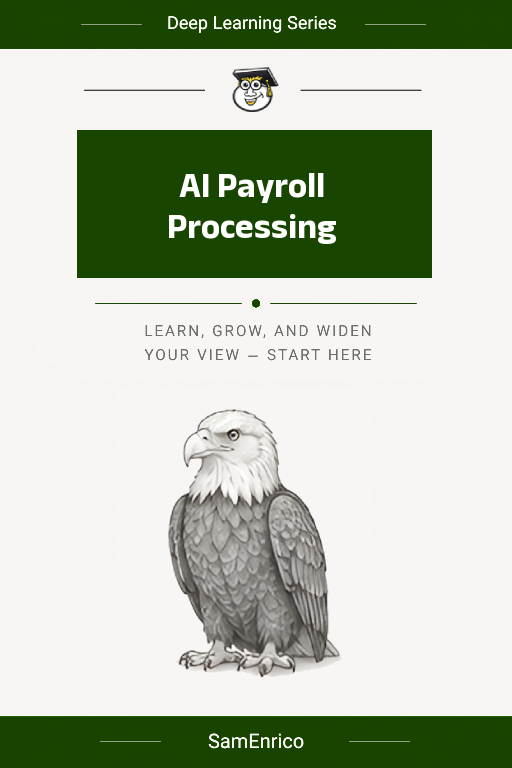
AI Payroll Processing eBook
Automate payroll calculations, tax withholdings, a
by Shanks Queen
Automate payroll calculations, tax withholdings, and direct deposits using AI accounting tools.
Formats
Free sample
Chapter 1: The Static Paycheck Lie--–- On a Tuesday morning in March 2023, a senior finance director at a publicly traded software company did something that should have been impossible. She watched her laptop screen as an AI model flagged a $47,000 discrepancy between what her sales team had earned in commissions and what her payroll system was about to pay them. The discrepancy wasn't an error. It was a feature of her legacy system—a system that had been calculating pay the exact same way for eleven years, processing two-week-old data as if it were gospel, and systematically underpaying her top performers while overpaying departed employees. She had three hours before the ACH deadline.
She fixed the problem manually. And then she quit.That story appears repeatedly across corporate America, though rarely told in public. Finance and HR professionals know the dirty secret that vendors won't admit: most payroll systems are not designed for accuracy. They are designed for predictability. They prioritize batch processing over real-time truth.
They treat payroll as a rearview-mirror activity—paying for work that already happened, often two weeks ago, using data that was stale the moment it was entered. This chapter dismantles the assumption that payroll should be identical every period. It reveals why static pay structures are failing employees and employers alike. And it introduces the core concept that will transform how you think about compensation: the difference between retroactive payroll and real-time payroll intelligence.The Myth of the Stable Paycheck For decades, the predictable paycheck has been celebrated as a pillar of financial stability. Employees budget around it.
Lenders use it to approve mortgages. Government benefits calculate eligibility based on it. But predictability has a dark side: it creates inertia. When payroll systems are built to produce the same output every cycle, they actively resist the adjustments that would make compensation fairer, more dynamic, and more aligned with actual performance.Consider the standard payroll workflow. A pay period ends on Sunday.
Managers approve timecards by Tuesday. Payroll runs on Wednesday. Direct deposits arrive on Friday. That means the work performed on a Friday is not paid until the Friday of the following week—a lag of up to fourteen days for hourly workers and up to thirty days for monthly salaried employees. During those fourteen days, the employee's contribution has already generated value for the company, but the company retains the cash.
This lag is not a technical necessity. It is a legacy convention preserved because "that's how payroll has always been done."The static paycheck assumes that all work in a given period has equal value. It assumes that market conditions do not change within a pay cycle. It assumes that an employee's contribution last Tuesday is perfectly represented by a standard hourly rate or a fixed salary. Each of these assumptions is false.
A salesperson who closes a deal on Monday has generated more value than the same salesperson generated on a slow Friday. A developer who deploys critical code on a Wednesday has produced more impact than during a routine documentation day. Yet static payroll treats Monday and Friday identically.Three companies recognized this absurdity before almost anyone else. Netflix abandoned traditional salaries entirely in the early 2010s, moving to a model where employees choose their own mix of cash and stock options based on personal preference and market conditions. Google introduced role-based compensation bands that adjust quarterly based on internal supply and demand for specific skills.
Microsoft deployed AI-powered bonus algorithms that distribute discretionary pools based on real-time project contribution data rather than annual manager reviews. These are not fringe experiments. They are the leading indicators of a fundamental shift.The 47% Problem: Why Employees Leave According to a 2023 Pew Research Center study of over 11,000 US workers, 47 percent of employees who voluntarily left a job cited unfair pay as a contributing factor. Not low pay—unfair pay. The distinction matters enormously.
Low pay is a budgeting issue. Unfair pay is a trust issue. Employees can accept modest compensation if they believe it is equitable. They will walk away from generous compensation if they believe the system is rigged.What makes pay feel unfair? The data points to three specific failures of static payroll systems.
First, opacity: when employees cannot see how their pay is calculated, they assume the worst. Second, delay: when performance bonuses arrive sixty days after the work that earned them, the psychological connection between effort and reward is severed. Third, inconsistency: when two employees with identical roles and performance receive different pay due to historical anomalies or negotiation disparities, the system loses all credibility.Traditional payroll systems cannot solve these problems because they were never designed to. They are record-keeping systems, not fairness engines. They track what was paid, not what should have been paid.
They generate reports, not insights. And they operate in batch mode, processing thousands of employees identically because that is computationally efficient—not because it is ethically or strategically sound.Algorithmic fairness offers a path forward. When properly designed and regularly audited, AI payroll models can detect and correct pay inequities that humans cannot see. A 2022 study by researchers at Harvard Business School and the University of Chicago examined forty-two companies that deployed AI-powered compensation tools. Across the sample, gender-based pay gaps closed by an average of 38 percent within eighteen months.
Racial pay gaps closed by an average of 31 percent. These improvements came not from reducing anyone's pay, but from identifying where legacy systems had been systematically underpaying certain groups and applying corrective adjustments.The key insight is that algorithmic fairness is not about programming ethics into an AI. It is about programming transparency. An AI model does not need to understand what fairness means. It needs to be able to compare actual pay against predicted pay based on objective factors (role, experience, performance, location) and flag statistically significant deviations.
When a deviation appears consistently across a protected characteristic, the system raises an alert. A human investigator then determines whether the deviation is justified or discriminatory. The AI does not decide. It illuminates.Retroactive vs. Real-Time: The Core Distinction Every payroll system in existence operates on one of two logics: retroactive or real-time.
Understanding this distinction is the single most important conceptual foundation for everything that follows in this book.Retroactive payroll is what almost every company uses today. The logic proceeds in four steps. Step one: define a pay period (weekly, biweekly, semi-monthly, monthly). Step two: wait for the period to end. Step three: calculate total compensation based on hours worked, salary proration, commissions earned, and bonuses achieved during the completed period.
Step four: pay on the next scheduled date. The operative word is "completed." Retroactive payroll looks backward. It pays for work that is already done, often with a delay of days or weeks. This is accounting convenience masquerading as operational necessity.Real-time payroll logic inverts the sequence. Step one: define pay triggers, not pay periods.
A trigger might be a completed project milestone, a signed contract, a customer satisfaction survey result, or simply the passage of time with an option to adjust. Step two: as triggers occur, calculate the compensation owed immediately. Step three: aggregate triggered payments on whatever schedule makes…
This is the end of the free sample. Get the eBook to keep going. Buy now
About this book
Details
- Author
- Shanks Queen
- Publisher
- SamEnrico
- Language
- English
- Genre
- Non-Fiction, Business Brief, Payroll AI
- Released
- 2026-06-01
- Pages (approx.)
- 145
- Available as
- eBook, Audiobook

Read better in the ZLOADR app
Your eBooks on your phone or tablet. Sign in with your SamEnrico account and start reading.
More by Shanks Queen
 EQ Intuition Development GuideShanks Queen$11.99
 Police Officer Failure FearShanks Queen$11.99
 The Caregiver Rare Disease GuideShanks Queen$11.99
 Thunberg Boat Travel Only Commitment GuideShanks Queen$11.99
 Oral Health Dementia Link GuideShanks Queen$11.99
 The Frozen Inferno: Antarctica's Volcanic Secrets RevealedShanks Queen$11.99
 Quetzalcoatl’s Flute: The Serpent God’s Melodic CreationShanks Queen$11.99
 Understanding Forbes–albright SyndromeShanks Queen$17.99
 Bootstrapped Crisis PR PrimerShanks Queen$12.99
 Vacuum Truck OperatorShanks Queen$11.99
 A Beginners Guide to British baseball (Volume 1)Shanks Queen$11.99