
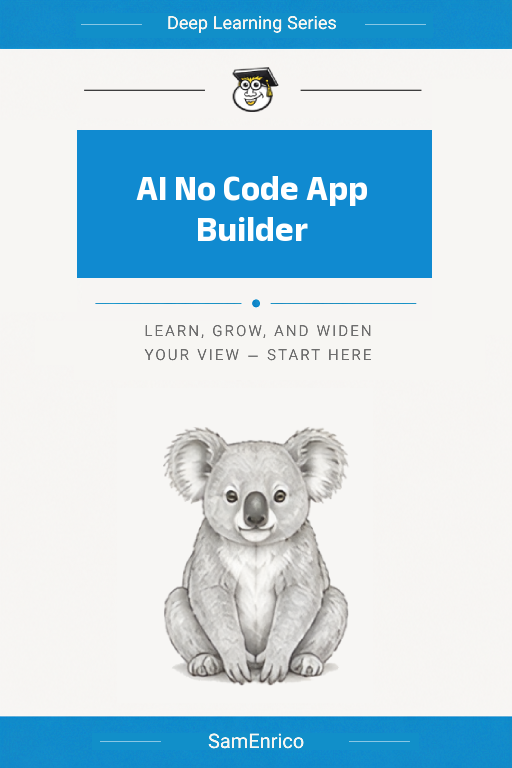
Non-FictionAnnual CheckupNo Code AI
AI No Code App Builder eBook
Use Bubble AI, Glide, or Softr to build business a
Use Bubble AI, Glide, or Softr to build business apps without programming.
Formats
Free sample
Chapter 1: The Permission Revolution--–- You are about to build an app that generates revenue, serves real customers, and solves a genuine business problem. You will do this without writing a single line of traditional code. And you will do it in less time than it takes most software development teams to complete their first sprint planning meeting.This is not a prediction. This is not a theoretical possibility. This is happening right now, every single day, by people who had no coding experience six months ago.
They are building marketplaces, internal tools, client portals, AI-powered chatbots, and Saa S platforms that process thousands of transactions monthly. Their only advantage is that they discovered a truth that the software industry has tried to hide from you: modern no-code tools, combined with generative artificial intelligence, have eliminated the requirement to write programming languages as a prerequisite for building software.Let that sink in for a moment. The gatekeepers of the software world—the recruiters who demanded five years of React experience, the technical co-founders who demanded fifty percent equity, the agencies that charged six figures for a minimum viable product—they have been disrupted. The barrier to entry has not just been lowered; it has been fundamentally reshaped. What took a team of four developers three months to build in 2022 can now be built by a single non-technical founder in three weeks using the right combination of no-code platforms and AI assistance.This book is the map for that journey.
It is not a theoretical exploration of no-code possibilities. It is a battle-tested, platform-agnostic framework for turning your business idea into a revenue-generating application using Bubble, Glide, or Softr—without writing a line of code. By the time you finish the final chapter, you will have built a functional, AI-enhanced application, validated it with real users, connected Stripe to accept payments, and understood exactly how to sell it or scale it further.But before we touch a single tool, we need to address the thing that stops more people than any technical limitation: permission. You need permission to believe that this is possible for you, not just for the case studies you see on Twitter. You need permission to fail fast, to build ugly prototypes, and to launch before you feel ready.
And you need permission to ignore every developer who tells you that real apps require real code.This chapter gives you that permission. It dismantles the myths that keep smart people from building software. It shows you the concrete evidence that no-code businesses are generating real revenue. And it sets the foundation for the repeatable framework that will carry you through the rest of this book.The Myth of the Real Developer The software industry has spent decades constructing an elaborate gatekeeping system disguised as professional standards. The myth goes something like this: real developers write code from scratch, real developers understand algorithms and data structures, real developers have computer science degrees, and anyone building software without these credentials is merely playing with toys.This myth serves a clear economic purpose.
It protects high billing rates. It justifies long development timelines. It creates scarcity where none needs to exist. But like all myths, it collapses under the slightest scrutiny.Consider the history of software abstraction. Every generation of programming has been about raising the level of abstraction away from the machine.
The first programmers wrote in machine code—actual binary instructions fed directly into the computer. Then assembly language abstracted that. Then C abstracted assembly. Then C++ abstracted C. Then Python and Ruby abstracted C++.
Then web frameworks abstracted Python and Ruby. Then no-code platforms abstracted the frameworks.At every step, the programmers of the previous generation declared that the new abstraction was not real programming. The assembly programmers said the same about C programmers. The C programmers said it about Python. The Python developers now say it about no-code.
The pattern is as predictable as it is incorrect.What actually happens is that each abstraction layer allows more people to solve more problems. It does not eliminate the need for deep technical expertise; it simply moves that expertise further down the stack. The developers who once worried about memory management now worry about system architecture. The problems being solved become larger in scope, even as individual solutions become easier to build.No-code is not the end of software development. It is the latest step in a fifty-year progression toward making software creation accessible to more humans.
The developers who dismiss no-code are standing in the same river as the assembly programmers who dismissed C. They are correct that no-code has limitations. They are incorrect that those limitations matter for the vast majority of business applications.What percentage of business problems require custom algorithms, real-time processing at millisecond latency, or handling millions of concurrent users? Less than one percent. The other ninety-nine percent involve moving data from a form to a database, displaying that data to authorized users, sending notifications when things change, and perhaps adding a layer of AI for summarization or classification.
These problems have been solved thousands of times. No-code platforms have packaged those solutions into visual interfaces.Building on these platforms is not cheating. It is standing on the shoulders of the abstraction giants who came before. The most successful software companies of the next decade will not be those that write the most elegant code. They will be those that solve the most valuable problems for their customers, regardless of how the solution is implemented.The Case Studies That Prove the Ceiling Permission requires evidence.
This section provides three real-world case studies of no-code applications that generate significant revenue and serve thousands of users. These are not outliers. They are representative of what is possible when you combine clear problem identification with the right no-code tools.Case Study One: The Bubble Marketplace That Sold for $240,000A former teacher in the Midwest noticed that local artisans had no easy way to sell their products online without paying high commissions to existing marketplaces. She had no technical background, no savings for developers, and a burning frustration with the status quo. Over eight weeks, using Bubble, she built a marketplace where artisans could create storefronts, upload products, process payments through Stripe Connect, and manage their own shipping.The first version was ugly.
The workflow for onboarding new artisans required manual approval because she had not yet figured out how to automate role assignment. The search functionality was basic. But it worked. Artisans signed up because the commission was five percent instead of the industry standard fifteen percent. Buyers came because they found unique products not available elsewhere.Within eighteen months, the marketplace had two thousand active artisans, forty thousand monthly visitors, and annual revenue of one hundred forty thousand dollars (after commissions).
She sold the platform on Acquire.com for two hundred forty thousand dollars—a multiple of roughly two times annual profit. The buyer was a small e-commerce holding company that planned to integrate the marketplace with their existing logistics network. They did not care that the platform was built on Bubble. They cared about the revenue and the user base.Case Study Two: The Glide Internal Tool That…
This is the end of the free sample. Get the eBook to keep going. Buy now
About this book
Details
- Author
- Pullen Whitney
- Publisher
- SamEnrico
- Language
- English
- Genre
- Non-Fiction, Annual Checkup, No Code AI
- Released
- 2026-05-29
- Pages (approx.)
- 160
- Available as
- eBook, Audiobook

Read better in the ZLOADR app
Your eBooks on your phone or tablet. Sign in with your SamEnrico account and start reading.
More by Pullen Whitney
 Hypnotic Visualization MasteryPullen Whitney$11.99
 Acupuncture Fertility EnhancementPullen Whitney$11.99
 The Breath Journal MethodPullen Whitney$11.99
 Facebook Anniversary Comparison CyclePullen Whitney$11.99
 Protecting Your Energy GuidePullen Whitney$11.99
 The Last Tape: The Untold Story of Tupac’s Lost RecordingsPullen Whitney$11.99
 Frozen Hearts: The Secret Love Letters of Willem Barentsz and the Icebound ExpeditionPullen Whitney$11.99
 Wirestock Mobile GuidePullen Whitney$12.99
 Understanding Dwarfism SyndesmodysplasicPullen Whitney$17.99
 Collecting BottlesPullen Whitney$11.99
You may also like
 Hong Kong Handover 1997Dunn Johnnie$11.99
 Zumba For Postnatal Recovery CourseNeal Christian$11.99
 Zumba for BeginnersLadner Nikia$11.99
 YouTube Comment Mining GuideHumes Pandora$12.99
 Worry Box MeditationCarlin Rudy$11.99
 Workplace Stress MeditationNguyen Lynn$11.99
 Workplace Stress and Sleep RepairHawley Ivory$11.99
 Workplace Perfectionism CureDelaney Jeffry$11.99
 Workplace Injustice Anger GuideWallen Isabelle$11.99
 Work Addiction and Burnout LinkGreenwood Ester$11.99
 Women in Yoga and WellnessBeattie Galina$11.99
 Women in Stand Up ComedyChun Evangeline$11.99