
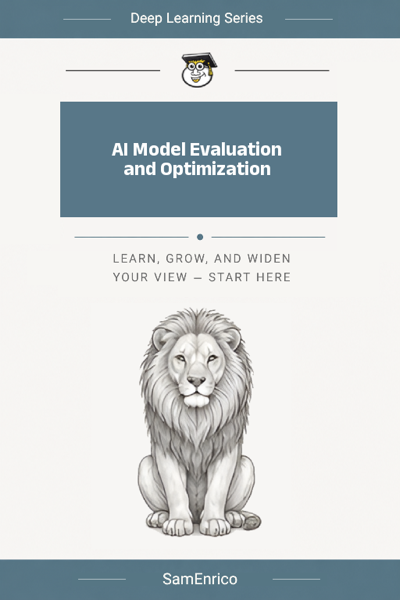
AI Model Evaluation and Optimization eBook
A Coursebook on AI Model Evaluation and Optimizati
A Coursebook on AI Model Evaluation and Optimization
Formats
Free sample
Chapter 1: The Great Inversion--The most expensive mistake in artificial intelligence isn't a model that fails to train. It isn't a dataset that contains bias. It isn't even a deployment that crashes in production. The most expensive mistake is a model that works perfectly on a leaderboard and catastrophically fails for your users.I have watched this mistake happen more than forty times across startups, Fortune 500 companies, and research labs. The pattern is always the same.
A team spends weeks or months selecting the perfect foundation model. They fine-tune it on carefully curated data. They achieve state-of-the-art results on public benchmarks. They celebrate. Then they ship the model to real users.
And within days, sometimes hours, everything falls apart.The chatbot that scored 94 percent on the MMLU benchmark tells a diabetic patient that insulin is optional if you believe hard enough. The code generation model that passes ninety percent of unit tests introduces security vulnerabilities that no test caught. The summarization model that produces beautifully fluent outputs quietly invents facts that never appeared in the source documents.None of these models failed because they were poorly trained. They failed because the people who built them were never trained on how to evaluate them.This book exists to fix that gap.The Shift Nobody Is Talking About For the past decade, the dominant narrative in artificial intelligence has been about building. Build better architectures.
Build larger datasets. Build more efficient training algorithms. The hero of this narrative was the researcher who discovered a novel loss function or the engineer who scaled training to a thousand GPUs. Building was the hard part. Building was where the value lived.That era is over.Today, the most powerful models in the world are not built by most teams.
They are accessed through APIs or downloaded as open-weight foundation models. A single engineer with a laptop can deploy GPT-4, Llama 3, or Claude in an afternoon. The marginal cost of accessing world-class AI has dropped to near zero.What has become expensive, difficult, and rare is the ability to take these powerful but unpredictable foundation models and turn them into reliable products. The hard part is no longer building the model. The hard part is evaluating whether the model works for your specific users, in your specific context, under your specific constraints.This is what I call the Great Inversion.Before roughly 2022, the majority of work in an ML project went into training and fine-tuning.
Evaluation was a final step, a quality assurance checkbox before deployment. Today, that ratio has inverted. The majority of engineering work goes into evaluation, monitoring, and continuous optimization. Training has become commodity. Evaluation has become the competitive differentiator.Let me prove this with a concrete example.Consider two teams building a customer support chatbot for an e-commerce company.
Team A spends two weeks fine-tuning Llama 3 on their support tickets. They achieve ninety-two percent accuracy on their test set. They deploy. Team B spends two days selecting the same model but then spends six weeks building an evaluation pipeline: automated judges, human preference collection, A/B testing infrastructure, drift detection, and red-teaming exercises. They deploy two weeks after Team A.
Their initial accuracy is only eighty-eight percent. But over the next month, they identify failure modes Team A never saw. They optimize prompts, tune retrieval parameters, and adjust safety filters. By week six, they have surpassed Team A's accuracy while maintaining lower latency and fewer safety incidents. By week twelve, Team A is planning a full rebuild while Team B is iterating on their tenth evaluation-driven improvement.Team A optimized for building.
Team B optimized for evaluating. Team B won.Why Traditional Metrics Lie to You If you have worked in machine learning for more than a week, you have been trained to worship at the altar of metrics like accuracy, precision, recall, and F1. These are clean, mathematical, and satisfying. They compress model performance into a single number. They allow you to sort models on a leaderboard.
They give you the illusion of certainty.They are also dangerously misleading for modern AI systems.The problem is not that these metrics are mathematically wrong. The problem is that they measure something that no longer aligns with what you actually care about. Accuracy tells you how often the model's prediction matches the label. But for a generative model that produces paragraphs of text, what is the label? There is no single correct answer.
There are many acceptable answers, many more unacceptable answers, and a vast gray area in between that depends entirely on your user's preferences, your brand voice, and the specific context of the conversation.Consider a simple example. You ask a model to summarize a news article about a controversial political event. One model produces a summary that is factually accurate but dry and bureaucratic. Another model produces a summary that is also factually accurate but captures the emotional weight of the event. A third model produces a summary that is factually accurate but subtly biased toward one political interpretation.
All three models have perfect accuracy if you measure only factual consistency. But they are not equally useful, equally safe, or equally aligned with your users' needs.Traditional metrics cannot see these differences. They are blind to everything that matters.This chapter introduces a framework for understanding what actually matters. We will build on this framework throughout the book, but let me give you the headline now. Modern AI evaluation must measure three distinct families of outcomes: Quality, Operations, and Safety.Quality metrics ask: does the model produce outputs that are correct, useful, and appropriate for the task?
This includes traditional task-specific metrics like exact match for code generation or BLEU for translation. But it also includes newer metrics like faithfulness, coherence, and preference alignment that require more sophisticated measurement approaches.Operational metrics ask: can this model run at the speed, scale, and cost that your product requires? A model that produces beautiful outputs but takes three seconds per token is useless for a real-time chatbot. A model that costs ten cents per query is useless for a startup processing millions of requests. These constraints are not secondary considerations.
They are primary constraints that shape every decision you make.Safety metrics ask: does this model produce outputs that are free from harm, bias, and security vulnerabilities? This is not a compliance checkbox. In production, safety failures are product failures. A model that leaks personally identifiable information, generates toxic content, or can be jailbroken into producing dangerous instructions will destroy user trust and expose you to liability.Throughout this book, you will learn how to measure each of these families with rigor and precision. But before we dive into the how, we need to understand what we are measuring against.
And that requires understanding the specific ways that modern models fail.The Four Faces of Model Failure In traditional machine learning, failures were relatively straightforward. The model made a prediction that didn't match the label. You could look at the confusion matrix, see which classes were problematic, and collect more data. The failure space was bounded.Generative AI has exploded that bounded space into something vast and chaotic. Modern foundation models fail in ways that…
This is the end of the free sample. Get the eBook to keep going. Buy now
About this book
Details
- Author
- Beals Ricarda
- Publisher
- SamEnrico
- Language
- English
- Genre
- Non-Fiction, Informative, Educational
- Released
- 2026-06-03
- Pages (approx.)
- 133
- Available as
- eBook, Audiobook

Read better in the ZLOADR app
Your eBooks on your phone or tablet. Sign in with your SamEnrico account and start reading.
More by Beals Ricarda
 Color Coding Study SystemBeals Ricarda$11.99
 Casino Environment AddictionBeals Ricarda$11.99
 Shift Work Sleep Disorder SolutionsBeals Ricarda$11.99
 Childhood Physical Abuse SurvivorBeals Ricarda$11.99
 Psychological Relapse Prevention in Recovery HousingBeals Ricarda$11.99
 Depression Journal WorkbookBeals Ricarda$11.99
 Recovery After The Golden ShotBeals Ricarda$11.99
 Atomic Bomb Test: Crossroads SeriesBeals Ricarda$11.99
 Resentment Toward In LawsBeals Ricarda$11.99
 The Last Pharaoh’s Gambit: Cleopatra’s Lost FleetBeals Ricarda$11.99
 The Iron Chefs of Nubia: Forging the FutureBeals Ricarda$11.99
 Echoes of the Cosmic Frontier: The Untold Story of the Voyager Golden RecordBeals Ricarda$11.99