
Non-FictionInformativeEducational
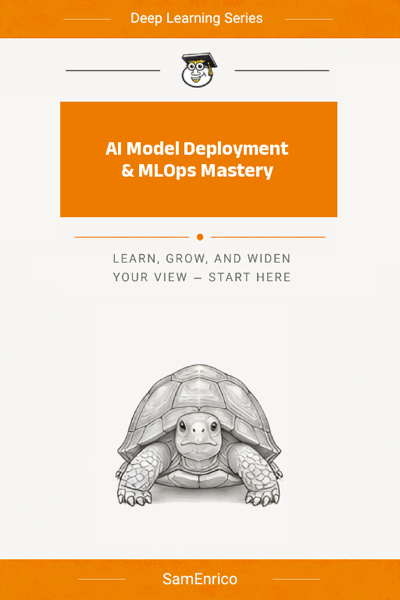
AI Model Deployment & MLOps Mastery eBook
A Coursebook on AI Model Deployment & MLOps Master
A Coursebook on AI Model Deployment & MLOps Mastery
Formats
Free sample
Chapter 1: The 80% Graveyard--–- You have just trained a model that achieves 94% accuracy on your test set. The confusion matrix is beautiful. The ROC curve hugs the top-left corner. Your team lead nods approvingly. Your product manager asks the inevitable question: “When can we put this in front of users?”Statistically speaking, that model will never see production.Let me repeat that: there is a 50% to 80% chance that your model—the one you stayed up late tuning, the one you validated with cross‑validation, the one that beats the current baseline by 7%—will never serve a single prediction to a real user.
This is not hyperbole. Industry surveys from sources as varied as Gartner, Algorithmia, and Venture Beat consistently report that the majority of machine learning models die somewhere between the Jupyter notebook and the API endpoint. They do not fail because they are inaccurate. They fail because they cannot be operationalized.This chapter diagnoses why. More importantly, it gives you the mental framework to become part of the successful 20‑30%—the minority of practitioners whose models actually ship, stay live, and deliver business value.
Welcome to the journey from notebook to microservice.The Notebook Delusion Every ML project begins with noble intentions. A data scientist opens a Jupyter notebook, imports pandas and scikit‑learn (or Py Torch, or Tensor Flow), and begins exploring. Cells are executed out of order. Visualizations appear and disappear. A model takes shape—first linear, then a random forest, finally a gradient‑boosted tree that seems to work.The notebook is a wonderful tool for discovery.
It is an absolutely terrible tool for production.The problem is not the notebook itself. The problem is what happens inside the notebook: a tangled mess of mutable state, hidden side effects, and implicit assumptions that are never written down. In a notebook, you can define a variable in cell 3, overwrite it in cell 12, and rely on its final value in cell 45. Try to turn that into a deployable Python package, and you will discover dependencies that no one remembered to document.Worse, notebooks encourage a style of work that treats data as a given rather than a moving target. “Load the CSV from the data/ folder” becomes an assumption that the CSV will always be there, always have the same columns, and always be correctly formatted.
In production, data does not behave. Data arrives late. Fields go missing. Units change from pounds to kilograms. A new version of an upstream API adds a field that breaks your parsing logic.The notebook works perfectly—until it doesn't.
And the moment it doesn't, you are not equipped to understand why, because the notebook did not force you to write tests, define contracts, or version your inputs.The Great Chasm: Data Science vs. Software Engineering The failure to ship models is rarely a technical failure of the model itself. It is a cultural failure.Data scientists are trained to optimize for accuracy. They ask: “Can I squeeze another 0.5% out of this model?” They experiment. They iterate.
They live in a world of exploratory analysis, where reproducibility is nice but not strictly required for the next insight.Software engineers are trained to optimize for reliability. They ask: “What happens when this service gets ten thousand requests per second? What happens when the database goes down? How do we roll back a bad deploy?” They live in a world of uptime SLAs, monitoring dashboards, and post‑mortems.These two value systems are not incompatible, but they are misaligned by default. Many organizations throw models over the wall from the data science team to the engineering team with nothing more than a pickle file and a half‑written README.
The engineers, understandably, refuse to deploy something that looks like a science experiment. The data scientists, equally understandably, feel that their work is being rejected for reasons they do not understand.The result is the prototype‑to‑production chasm—a no‑man’s‑land where promising models go to die.Consider a typical exchange:Data scientist: “The model is ready. Accuracy is 94%.”ML engineer: “Great. Where are the unit tests for the preprocessing logic?”Data scientist: “We don’t have unit tests. But trust me, it works.”ML engineer: “How do we roll back to the previous version if this one misbehaves?”Data scientist: “We could just keep the old pickle file?”ML engineer: “How long does inference take on a p3.2xlarge instance?”Data scientist: “I… don’t know.
I only ran it on my laptop.”The conversation ends with the model sitting in a Git Hub repository, untouched, while everyone moves on to the next project.The Hidden Costs of Manual Deployment Even when a model does get deployed, the absence of MLOps discipline leads to a different kind of failure: the silent production breakdown.Imagine a fraud detection model that has been serving predictions for six months. It works perfectly—until one day, a partner bank changes the format of their transaction feed. The transaction_amount field, previously a float in USD, is now a string containing a currency code and a value: "USD 49.99". The model’s preprocessing code, which expects a float, crashes. Every request returns a 500 error.
The fraud detection system goes dark.How long until someone notices?In many organizations, the answer is “hours or days.” There is no monitoring for data drift. There is no alerting on prediction failures. There is no automated retraining pipeline to adapt to the new format. A human has to manually inspect logs, realize what changed, update the preprocessing code, retrain the model, and redeploy.By the time the fix is applied, thousands of fraudulent transactions may have gone undetected.This is not a hypothetical. In my consulting work, I have seen exactly this failure pattern at multiple companies.
The common thread is always the same: the model was treated as a one‑off artifact rather than a live system requiring ongoing maintenance. The data scientist who built it had moved to a different team. The documentation was a single Google Doc last updated eight months ago. The deployment pipeline was a shell script on a senior engineer’s laptop.Manual deployment is not just inefficient. It is dangerous.What Is MLOps, Really?MLOps is the application of Dev Ops principles to machine learning.
That sentence appears in every talk, every blog post, and every book on the subject—including this one. But what does it actually mean?Dev Ops, in its essence, is a set of practices designed to shorten the development cycle while increasing reliability. The core pillars are:Continuous Integration (CI): Automatically build and test every change to the codebase. If a change breaks something, the developer knows within minutes, not days.Continuous Delivery (CD): Automatically package and deploy every change that passes CI. Deployments become boring, repeatable, and low‑risk.Continuous Monitoring: Observe systems in production to detect anomalies, measure performance, and guide future development.MLOps adapts these practices for the unique challenges of machine learning.
An ML system is not just code. It is:Code (the training script, the preprocessing logic, the API wrapper)Data (the training dataset, the validation dataset, the feature definitions)Models (the serialized weights, the hyperparameters, the metadata)All…
This is the end of the free sample. Get the eBook to keep going. Buy now
About this book
Details
- Author
- Hamlin Adolfo
- Publisher
- SamEnrico
- Language
- English
- Genre
- Non-Fiction, Informative, Educational
- Released
- 2026-05-09
- Pages (approx.)
- 138
- Available as
- eBook, Audiobook

Read better in the ZLOADR app
Your eBooks on your phone or tablet. Sign in with your SamEnrico account and start reading.
More by Hamlin Adolfo
 Nobel Laureates In Genetics GuideHamlin Adolfo$11.99
 Drug Dependency Stigma Reduction GuideHamlin Adolfo$11.99
 The Medicine Nobel PrionsHamlin Adolfo$11.99
 Clearing Throat as DiscomfortHamlin Adolfo$11.99
 Don Rickles InsultsHamlin Adolfo$11.99
 Rewire Control Freak TalkHamlin Adolfo$11.99
 Big Bend DisappearancesHamlin Adolfo$11.99
 Client Bankruptcy Cash CrashHamlin Adolfo$11.99
 The Long COVID Enigma: A Modern Medical MysteryHamlin Adolfo$11.99
 The Iron Order: Prussia's Blueprints for Modern GovernanceHamlin Adolfo$11.99
 The Bone Carver's Curse: A Feud of Stone and ShadowHamlin Adolfo$11.99
 How to Become a AdjusterHamlin Adolfo$11.99
You may also like
 Hong Kong Handover 1997Dunn Johnnie$11.99
 Zumba For Postnatal Recovery CourseNeal Christian$11.99
 Zumba for BeginnersLadner Nikia$11.99
 YouTube Comment Mining GuideHumes Pandora$12.99
 Worry Box MeditationCarlin Rudy$11.99
 Workplace Stress MeditationNguyen Lynn$11.99
 Workplace Stress and Sleep RepairHawley Ivory$11.99
 Workplace Perfectionism CureDelaney Jeffry$11.99
 Workplace Injustice Anger GuideWallen Isabelle$11.99
 Work Addiction and Burnout LinkGreenwood Ester$11.99
 Women in Yoga and WellnessBeattie Galina$11.99
 Women in Stand Up ComedyChun Evangeline$11.99