
Non-FictionStudent's ShortcutComparison
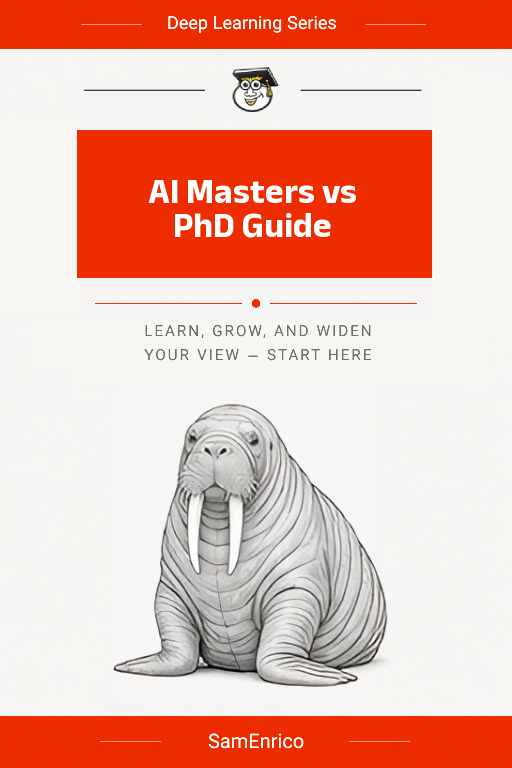
AI Masters vs PhD Guide eBook
Compare terminal master's vs PhD programs for AI c
Compare terminal master's vs PhD programs for AI career goals and research paths.
Formats
Free sample
Chapter 1: The $2 Million Question--The email arrived on a Tuesday afternoon, and it changed everything.Sarah had been staring at her screen for twenty minutes, reading and rereading the same five words: “We regret to inform you…” Her application to the AI Ph D program at Stanford had been rejected. But that wasn’t what stopped her heart. It was the email sitting directly below it in her inbox—an offer letter from a mid-sized tech company in Seattle. Starting salary: 185,000.Signingbonus:185,000. Signing bonus: 185,000.Signingbonus:50,000.
Total first-year compensation: $235,000.She was twenty-three years old. She had a bachelor’s degree in computer science and three undergraduate research papers that nobody outside her university had ever cited.The email thread from her advisor, sent three months earlier, echoed in her mind: “Sarah, you have real potential as a researcher. A Ph D will open doors that a Master’s never can. Don’t sell yourself short for quick money.”But standing between her and that Ph D was five to six years of living on a $35,000 stipend while her undergraduate classmates bought houses and maxed out their 401(k)s. The math was brutal.
The choice was agonizing. And Sarah had no framework for making it.This book is that framework.The Paradox That paralyzes Smart People Every week, someone like Sarah emails me. Sometimes they are undergraduate seniors debating between a funded Ph D offer and a six-figure industry job. Sometimes they are software engineers with three years of experience wondering if leaving work for a Master’s degree is financial suicide. Sometimes they are international students for whom the wrong choice means deportation.They all ask versions of the same question: “What should I do?”And for years, I gave them unsatisfying answers.
“It depends.” “Follow your passion.” “You can always go back to school later.” These clichés are technically true and practically useless. They are the intellectual equivalent of telling someone lost in a forest to “just find the trail.”This book exists because the standard advice is broken. The people giving it—professors who earned their Ph Ds in a different economic era, recruiters who copy-paste job descriptions without understanding the work, and well-meaning friends who project their own regrets onto your decision—are not malicious. They are simply operating with incomplete information.The decision between a terminal Master’s degree and a Ph D in artificial intelligence is unlike the same decision in any other technical field. In civil engineering, the path is clear: a Ph D is for research and academia; a Master’s is for professional practice.
In chemistry, the Ph D is the standard credential for any serious role. In traditional software engineering, graduate degrees are optional decorations, not gateways.But AI is different. It sits at a strange intersection. It is simultaneously a rigorous academic discipline with roots in mathematics, neuroscience, and philosophy, and a hyper-commercialized engineering field where a single deployed model can generate billions in revenue. This duality creates two legitimate, high-prestige career tracks that diverge sharply after undergraduate education.Track One: The Builder.
This person wants to build things that work. They care about latency, throughput, scalability, and user experience. They want to see their code in production, serving millions of requests. They are motivated by impact, not novelty. They are not anti-intellectual—they read papers, they understand the math—but they measure success by whether the model ships, not whether it surprises.Track Two: The Inventor.
This person wants to know things that nobody knows. They care about generalization bounds, convergence proofs, and the theoretical limits of learning. They want to publish papers that advance the field, even if those papers never directly become products. They are motivated by curiosity, not compensation. They are not impractical—they can write production code—but they measure success by whether their work changes how other researchers think.Neither track is superior.
Both are necessary. But they require different training, different timelines, different financial calculations, and—most importantly—different psychological profiles.The tragedy is that most people choose the wrong track not because they lack information, but because they have the wrong information. They listen to professors who have never worked in industry. They read job postings written by HR generalists who do not understand the difference between a research scientist and an ML engineer. They compare themselves to outliers—the self-taught prodigy who landed a job at Open AI without a degree, or the Ph D who spent eight years on a dissertation that nobody reads.This book is the antidote to that noise.The Email That Started Everything Let me tell you about David.David was a software engineer at a large e-commerce company.
He had been there for four years, working on recommendation systems. He was good at his job—really good. His team’s models had increased click-through rates by 12 percent, which translated to over $200 million in additional revenue. His manager had told him he was on track for a promotion to Senior Engineer within the year.But David was bored.He had implemented the same gradient boosting algorithm so many times that he could do it in his sleep. He wanted to understand why certain architectures worked and others failed.
He wanted to read papers at Neur IPS and actually understand them, not just skim the abstracts for buzzwords. He wanted to be the person inventing new methods, not just the person implementing methods invented by others.So he applied to Ph D programs. And he got in. A good one, too—a top-twenty computer science department with a well-known advisor working on deep learning for recommendation systems, which aligned perfectly with David’s industry experience.The offer came with a stipend: 34,000peryear,plustuitionremission.Hiscurrentsalarywas34,000 per year, plus tuition remission. His current salary was 34,000peryear,plustuitionremission.Hiscurrentsalarywas210,000.David did the math.Over five years, his Ph D would cost him approximately 880,000inforgonesalary,assumingmodestraises.Thatdidnotincludetheretirementcontributionshewouldmiss,which,withcompoundinterest,wouldgrowtonearly880,000 in forgone salary, assuming modest raises.
That did not include the retirement contributions he would miss, which, with compound interest, would grow to nearly 880,000inforgonesalary,assumingmodestraises.Thatdidnotincludetheretirementcontributionshewouldmiss,which,withcompoundinterest,wouldgrowtonearly2 million by the time he turned sixty-five. The Ph D would also cost him five years of career progression, meaning that when he graduated at thirty-three, he would be competing for entry-level research roles against twenty-seven-year-olds with the same degree.But David’s advisor told him not to worry about the money. “A Ph D is not a financial decision,” the advisor said. “It’s an intellectual one. If you’re thinking about the money, you’re missing the point.”David trusted his advisor.
He quit his job. He moved to a college town. He started his Ph D.Three years later, he dropped out.The reasons were mundane. His advisor was rarely available. His research project—which had sounded exciting in the offer letter—turned out to be a dead end.
The department’s funding situation changed, and his stipend was cut by 15 percent. He was lonely, stressed, and increasingly convinced that the problems he found interesting were not the problems that led to publications.When David returned to industry, he discovered something worse: the three-year gap in his resume made him…
This is the end of the free sample. Get the eBook to keep going. Buy now
About this book
Details
- Author
- Perales Willia
- Publisher
- SamEnrico
- Language
- English
- Genre
- Non-Fiction, Student's Shortcut, Comparison
- Released
- 2026-06-01
- Pages (approx.)
- 152
- Available as
- eBook, Audiobook

Read better in the ZLOADR app
Your eBooks on your phone or tablet. Sign in with your SamEnrico account and start reading.
More by Perales Willia
 Food Addiction And Orthorexia GuidePerales Willia$11.99
 ADHD Circadian ConnectionPerales Willia$11.99
 Sudden Key Departure Client Loss PreventionPerales Willia$11.99
 Chronic Pain Meditation ScriptsPerales Willia$11.99
 The Low Sex Drive RecoveryPerales Willia$11.99
 Spouse Death and AnxietyPerales Willia$11.99
 Cannabis Use Disorder CollegePerales Willia$11.99
 Second Request Compliance LogPerales Willia$11.99
 Audience Member FocusPerales Willia$11.99
 The Silk and Gold Gambit: How a Merchant Princess Built an EmpirePerales Willia$11.99
 Fionn's Fire: The Boy Who Touched the Salmon of WisdomPerales Willia$11.99
 How to Start a Compressor for Refrigerators Business (Beginners Guide)Perales Willia$11.99
You may also like
 Hong Kong Handover 1997Dunn Johnnie$11.99
 Zumba For Postnatal Recovery CourseNeal Christian$11.99
 Zumba for BeginnersLadner Nikia$11.99
 YouTube Comment Mining GuideHumes Pandora$12.99
 Worry Box MeditationCarlin Rudy$11.99
 Workplace Stress MeditationNguyen Lynn$11.99
 Workplace Stress and Sleep RepairHawley Ivory$11.99
 Workplace Perfectionism CureDelaney Jeffry$11.99
 Workplace Injustice Anger GuideWallen Isabelle$11.99
 Work Addiction and Burnout LinkGreenwood Ester$11.99
 Women in Yoga and WellnessBeattie Galina$11.99
 Women in Stand Up ComedyChun Evangeline$11.99