
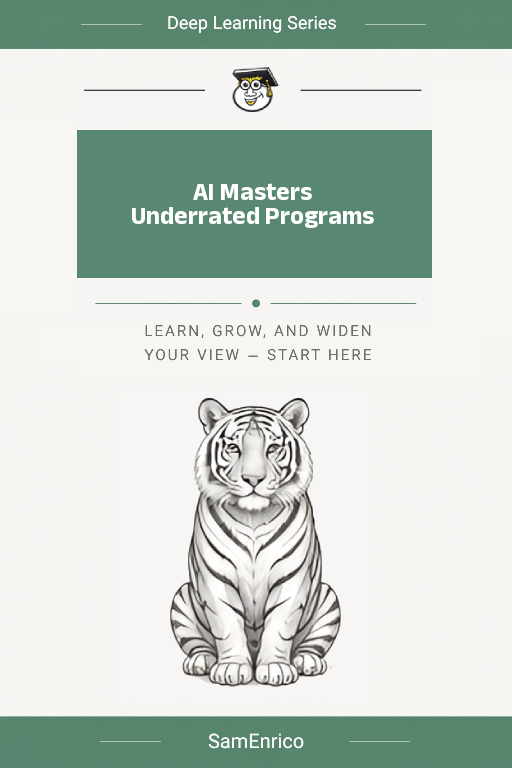
AI Masters Underrated Programs eBook
Discover hidden gems like University of Montreal,
Discover hidden gems like University of Montreal, Aalto University, and University of Freiburg.
Formats
Free sample
Chapter 1: The Monopoly Mirage...--–- In the winter of 2022, as the world collectively gasped at Chat GPT’s ability to write poetry and debug code, a very different scene unfolded in a nondescript building on Avenue de l’Université in Montreal. There, tucked between a used bookstore and a café selling overpriced croissants, a group of researchers were running a seemingly unremarkable experiment. They weren't trying to build a bigger chatbot. They weren’t scraping the entire internet. Instead, they were teaching an AI to distinguish between a dog and a wolf.
The catch? They were deliberately feeding it poor, biased data—images of wolves almost always in snow, dogs almost always in grass. When the AI predictably failed in summer conditions, the researchers didn't panic. They weren't surprised. They were doing what the entire Silicon Valley hype machine seems to have forgotten how to do: they were asking why the model failed, not just celebrating what it could do.This book is a journey to those quiet labs, the ones the headlines ignore.
It is an exploration of three exceptional institutions—the University of Montreal (Mila), Aalto University in Finland, and the University of Freiburg in Germany—that have become the world’s most important “underrated” programs in artificial intelligence. They are the anti-dote to the monoculture. They are the proof that there is another way to build AI: one that is open, rigorous, human-centric, and far more robust than the brittle giants we are currently being sold.The Illusion of the Only Game in Town It is easy to believe that the future of artificial intelligence is being written exclusively in the boardrooms of San Francisco and Seattle. The headlines are dominated by a handful of powerful narratives: the relentless scaling of large language models (LLMs) at Open AI, the integration of AI into every consumer product at Google and Meta, and the breathless hype around Artificial General Intelligence (AGI) from a cadre of billionaire futurists. This concentration of attention, capital, and talent has created what we call a monoculture—an ecosystem where a single set of values, priorities, and methodologies dominates all others.But as bestsellers like Arvind Narayanan and Sayash Kapoor's AI Snake Oil have meticulously documented, this monoculture is built on a dangerous foundation.
It prioritizes scale over safety, memorization over genuine understanding, and marketing hype over reproducible science. The result is a generation of AI systems that are breathtakingly fluent but frighteningly brittle. A chatbot that can pass the bar exam can still fail to count the number of syllables in a word. An image generator that can create photorealistic art cannot reliably count the fingers on a human hand. This is not a temporary bug; as we will see, it is a fundamental feature of the “bigger is better” approach.This book argues that while Silicon Valley has been racing to build a bigger digital brain, the quiet quadrants of global research have been quietly building a better one.
The solutions to the very problems outlined by the most insightful AI critics are not theoretical. They already exist, being debugged, explained, and humanized in Montreal, Helsinki, and Freiburg.Beyond the Headlines: Introducing the Quiet Quadrant The first step to seeing the real future of AI is to look away from the flashing lights of the tech campuses and toward a different kind of innovation ecosystem. We will call this the Quiet Quadrant: a geographical and intellectual space spanning Canada, Northern Europe, and Germany. These are not underfunded backwaters. They are home to world-class research powerhouses, funded by public grants and national AI strategies, not venture capital.
However, they are “underrated” in the sense that their contributions, their philosophies, and their very existence are often invisible to the global, English-language tech press.Our first stop is Montreal, home to Mila (the Quebec Artificial Intelligence Institute). Co-founded by one of the true "godfathers of deep learning," Yoshua Bengio, Mila is the world's largest academic research center for deep learning. But unlike its corporate counterparts, Mila is a non-profit, open-science institution. It publishes all its research. It requires ethics training for all its students.
Its leaders have publicly called for moratoriums on the most dangerous forms of AI development. Mila is not a competitor to Big Tech; it is a corrective. It is proof that you can be at the very frontier of AI science while still holding the precautionary principle as a core value.Next, we travel to Helsinki, Finland, to explore Aalto University. Aalto is a unique fusion of engineering, business, and design—a rare combination that shapes everything it does. While Silicon Valley is obsessed with digital worlds, Aalto focuses on the physical one.
Its researchers apply machine learning to real, messy, constrained problems: optimizing truck routes on icy Finnish roads, reducing energy consumption in data centers, and helping factories predict equipment failures. They don't ask “What cool new thing can AI do?” They ask, “What real-world problem needs solving?” This systems-thinking approach is the perfect antidote to the AI solutionism that plagues so many corporate rollouts.Finally, we venture to the University of Freiburg in Germany, a hidden giant in the world of embodied and neuro-inspired AI. Freiburg represents the best of German precision: a deep respect for tradition in logic, symbolic AI, and formal verification, combined with a pioneering spirit in robotics and neuroscience. Their central, controversial, and vital argument is that pure pattern matching—no matter how much data you feed it—will never lead to genuine intelligence or reasoning. Their solution is a revolutionary form of hybrid AI, which combines the pattern-recognition power of neural networks with the verifiable logic of symbolic systems.Why the Monoculture is a Risk to Progress To understand why these “underrated” programs are so critical, we must first understand the risks of the monoculture we have allowed to form.
When one paradigm—scaling neural networks with vast amounts of data—dominates all others, several dangerous things happen.First, we lose scientific diversity. Science advances not by consensus, but by a contest of ideas. In the early days of AI, there was a vibrant diversity of approaches: symbolic AI, evolutionary algorithms, fuzzy logic, and Bayesian networks. Today, thanks to the immense success of deep learning, the vast majority of research funding and talent has flowed into a single channel. This starves other promising, and potentially more robust, approaches of the oxygen they need to develop.
The hybrid neuro-symbolic systems being built at Freiburg are a direct challenge to this orthodoxy, but they struggle to compete for attention and resources against the latest LLM.Second, we mistake memorization for mastery. As the bestseller The AI Con by Emily Bender and Alex Hanna has forcefully argued, large language models are not thinking engines; they are "stochastic parrots." They are exceptionally good at remixing the statistical patterns of their training data to produce plausible-sounding text. But this is not understanding. It is a sophisticated form of memorization and recombination. When a model fails on a problem just slightly outside its training distribution—the "dog in the summer" scenario—it is a catastrophic failure of generalization.
The researchers in Montreal, by focusing on out-of-distribution generalization and causality, are tackling this problem head-on, while most of the…
This is the end of the free sample. Get the eBook to keep going. Buy now
About this book
Details
- Author
- Minton Chanell
- Publisher
- SamEnrico
- Language
- English
- Genre
- Non-Fiction, Student's Shortcut, Hidden
- Released
- 2026-05-28
- Pages (approx.)
- 112
- Available as
- eBook, Audiobook

Read better in the ZLOADR app
Your eBooks on your phone or tablet. Sign in with your SamEnrico account and start reading.
More by Minton Chanell
 Shoulder Pain Meditation GuideMinton Chanell$11.99
 Basketball Free Throw Hypnosis GuideMinton Chanell$11.99
 Retail Relapse Prevention GuideMinton Chanell$11.99
 Debt Stress Survival GuideMinton Chanell$11.99
 Burnout and Physical HealthMinton Chanell$11.99
 Building Your Personal BoardMinton Chanell$11.99
 Press Release For ResearchMinton Chanell$11.99
 Filipino Caregiver ReunionMinton Chanell$11.99
 Five Senses Grounding MeditationMinton Chanell$11.99
 The Star of the Indian Ocean: The Voyages of Dom Francisco de AlmeidaMinton Chanell$11.99
 The Golden Lyre: Socrates and the Birth of Western ThoughtMinton Chanell$11.99
 How to Become a Microfiche DuplicatorMinton Chanell$11.99