
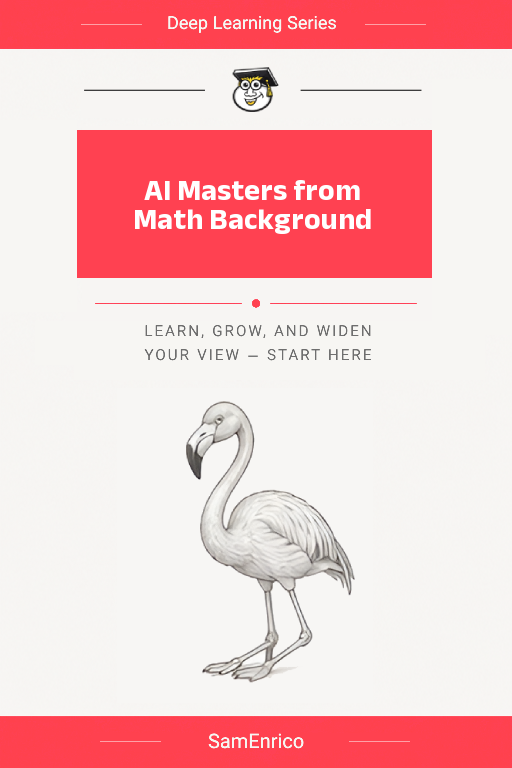
Non-FictionStudent's ShortcutMath
AI Masters from Math Background eBook
Leverage math/stats degrees for AI programs with p
Leverage math/stats degrees for AI programs with proper CS and programming prep.
Formats
Free sample
Chapter 1: The Invisible Superpower...-- Every morning, you open Linked In and see another computer science graduate posting about their fifth internship, their third side project, or their acceptance into a prestigious coding bootcamp. Meanwhile, you spent four years proving theorems, deriving estimators, and understanding why matrices behave the way they do. You look at job postings for "Machine Learning Engineer" and see requirements like "5+ years of Python experience" and "Strong software engineering background." You feel like you are playing a game where everyone else started ten years ahead of you.Here is the truth that no one in the AI industry wants to admit: you are actually ahead of them.The people who memorize model.fit() and model.predict() without understanding what happens inside are a dime a dozen. The people who can derive the gradient of a loss function, analyze the curvature of a loss landscape, and explain why batch size affects convergence in the language of stochastic differential equations are incredibly rare. And those are exactly the people that top AI labs—Open AI, Deep Mind, Anthropic—are desperate to hire.This chapter exists to reframe everything you think you know about your math degree.
It is not a disadvantage. It is not something to hide or apologize for. It is your superpower. The only gap between where you are and where you want to be is tactical, not fundamental. You need to learn how to translate proofs into code, how to structure a project that doesn't collapse under its own weight, and how to present yourself as the rare hybrid you truly are.
This book teaches you exactly that.By the end of this chapter, you will understand why mathematicians and statisticians are uniquely positioned to dominate in artificial intelligence, you will have a clear roadmap for the twelve chapters ahead, and you will have completed the first concrete action items that begin transforming your math background into an AI career.The Two Types of AI Practitioners Walk into any data science team meeting and you will observe two distinct species of practitioners. Recognizing them is the first step to understanding where you belong.Type A: The Memorizer The Memorizer learned AI from online courses that emphasized APIs over mathematics. They can call model.fit() with confidence. They know that Random Forest Classifier() usually works well. They have memorized that "learning rate should be around 0.001" and that "Adam is better than SGD." But when the model fails to converge—when the loss oscillates wildly or plateaus at a value far above the theoretical minimum—the Memorizer panics.
They start randomly tweaking hyperparameters. They add more layers because "deeper is better." They change the activation function from Re LU to sigmoid without understanding the derivative implications. They are playing a game of trial and error, hoping to stumble upon a configuration that works.The Memorizer treats hyperparameters as magic numbers. They do not understand why batch size affects generalization. They cannot explain why certain architectures suffer from vanishing gradients while others do not.
When you ask them to derive the gradient of the loss function with respect to the weights, they look at you as if you have asked them to translate Sanskrit.Here is the harsh reality: the Memorizer is replaceable. There are thousands of bootcamp graduates who can call APIs. There are very few who can debug them.Type B: The Mathematician The Mathematician looks at model.fit() and sees gradient descent. They see the loss function as a surface in high-dimensional space, and they understand that they are trying to find the lowest point on that surface using only local information. When the loss does not decrease, they do not randomly change the learning rate.
They check the gradient norm. They analyze whether the gradients are exploding or vanishing. They look at the condition number of the Hessian to understand why optimization is slow.The Mathematician understands that batch size is not just a performance parameter—it controls the variance of the gradient estimates and therefore the dynamics of the optimization process. They know that larger batches give more accurate gradients but reduce the stochasticity that helps escape sharp local minima. They can derive the relationship between batch size, learning rate, and convergence rates.The Mathematician sees neural networks for what they truly are: compositions of functions.
A deep network is just a function f(x)=f L(f L−1(...f1(x)...))f(x) = f_L(f_{L-1}(...f_1(x)...))f(x)=f L(f L−1(...f1(x)...)) where each layer applies a linear transformation followed by a nonlinear activation. The entire apparatus of backpropagation is simply the chain rule from first-semester calculus, applied repeatedly and efficiently.And here is the secret that the industry knows but does not advertise: The Mathematician is irreplaceable. Top AI labs actively recruit mathematicians because they solve the problems that stump everyone else. When a model fails to generalize from training data to test data, that is a problem of function space complexity—something mathematicians understand intuitively. When a model is unstable to small perturbations in the input, that is a problem of Lipschitz constants and Jacobian norms—core mathematical concepts.At Deep Mind, researchers with pure mathematics backgrounds have led breakthroughs in protein folding (Alpha Fold) and game playing (Alpha Go).
At Open AI, the teams that solved the generalization puzzle in large language models included mathematicians who thought in terms of information theory and statistical mechanics. At Anthropic, the interpretability team—the group trying to understand what neural networks actually learn—is staffed predominantly by mathematicians and theoretical physicists.You have the same background. You have the same capacity. The only difference is that those people learned to code.The Imposter Syndrome Trap (And Why It Is Lying to You)Let me name the fears that are probably running through your mind right now. I have heard them from hundreds of math and statistics graduates:"I cannot compete with someone who has been coding since age twelve.""I do not know what Git is, and everyone else seems to use it effortlessly.""My code is slow and ugly.
I write loops that take minutes to run when a CS graduate would write vectorized operations that take seconds.""I have never deployed anything to the cloud. I do not know what a REST API is. I am embarrassed to show my work to anyone."These fears are real. Acknowledging them is not weakness. But here is the reframe that changes everything:A computer science graduate might take two years to learn the mathematics you already know.
You need three to six months to learn the engineering you are missing. That is a four-to-one time advantage.Let me make this concrete. Consider what a typical CS graduate needs to learn to become truly proficient in AI:Linear algebra (vectors, matrices, eigenvalues, singular value decomposition)Multivariate calculus (gradients, Jacobians, Hessians, chain rule in multiple dimensions)Probability theory (random variables, distributions, expectation, variance, Bayesian inference)Statistics (estimation, hypothesis testing, confidence intervals, maximum likelihood)Optimization (gradient descent, convexity, Lagrange multipliers, duality)That is at least two years of focused study for someone without a mathematical background. Most CS graduates never learn it deeply—they learn just enough to pass…
This is the end of the free sample. Get the eBook to keep going. Buy now
About this book
Details
- Author
- Boudreaux Raguel
- Publisher
- SamEnrico
- Language
- English
- Genre
- Non-Fiction, Student's Shortcut, Math
- Released
- 2026-05-29
- Pages (approx.)
- 150
- Available as
- eBook, Audiobook

Read better in the ZLOADR app
Your eBooks on your phone or tablet. Sign in with your SamEnrico account and start reading.
More by Boudreaux Raguel
 Self Hypnosis For Runners GuideBoudreaux Raguel$11.99
 Buy Nothing Month BlueprintBoudreaux Raguel$11.99
 Ear Pain Meditation GuideBoudreaux Raguel$11.99
 Circadian Rhythm Case StudiesBoudreaux Raguel$11.99
 Press Release For PartnershipsBoudreaux Raguel$11.99
 Workplace Burnout Prevention PlanBoudreaux Raguel$11.99
 Networking at Industry ConferencesBoudreaux Raguel$11.99
 Outfit Check AnxietyBoudreaux Raguel$11.99
 Ethiopian Jewish Aliyah JourneyBoudreaux Raguel$11.99
 The Vanishing at the Cecil Hotel: A Dark DescentBoudreaux Raguel$11.99
 Mami Wata’s Golden Mirror: The Trickster’s BargainBoudreaux Raguel$11.99
 The Euroleague Heist: How Dirk Nowitzki and the Mavericks Stole the 2011 NBA TitleBoudreaux Raguel$11.99
You may also like
 Hong Kong Handover 1997Dunn Johnnie$11.99
 Zumba For Postnatal Recovery CourseNeal Christian$11.99
 Zumba for BeginnersLadner Nikia$11.99
 YouTube Comment Mining GuideHumes Pandora$12.99
 Worry Box MeditationCarlin Rudy$11.99
 Workplace Stress MeditationNguyen Lynn$11.99
 Workplace Stress and Sleep RepairHawley Ivory$11.99
 Workplace Perfectionism CureDelaney Jeffry$11.99
 Workplace Injustice Anger GuideWallen Isabelle$11.99
 Work Addiction and Burnout LinkGreenwood Ester$11.99
 Women in Yoga and WellnessBeattie Galina$11.99
 Women in Stand Up ComedyChun Evangeline$11.99