
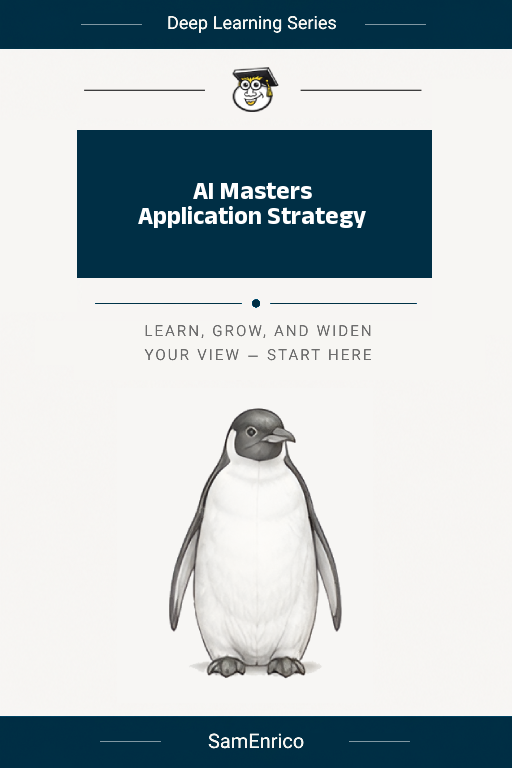
Non-FictionStudent's ShortcutStrategy
AI Masters Application Strategy eBook
Apply to reach, target, and safety programs based
Apply to reach, target, and safety programs based on profile strength and research fit.
Formats
Free sample
Chapter 1: The Unspoken Crisis--The email arrived on a Tuesday morning in March. Three hundred and forty-seven days of preparation—the GRE study schedule, the research statement rewritten eleven times, the cold emails sent to fourteen professors, the Git Hub repository polished until every commit message was perfect—reduced to two sentences. "Thank you for your application. We regret to inform you that we are unable to offer you admission." Not a single acceptance. Eight applications, eight rejections.
The student had a 3.8 GPA from a top-twenty university, two summers of research experience, and a letter from a well-known professor who called them "one of the most promising undergraduates I have taught in a decade." By every conventional measure, they were an ideal candidate. And they got rejected everywhere.This story is not an anomaly. It is the new normal.Over the past four years, a silent crisis has engulfed graduate admissions in artificial intelligence. Between 2020 and 2024, application volumes to top AI master's programs increased by three hundred to five hundred percent. At Carnegie Mellon's Machine Learning Department, acceptance rates for the funded master's track dropped below five percent.
At Stanford's Computer Science program with an AI specialization, the effective acceptance rate for international applicants fell to approximately two percent. At the University of Edinburgh's prestigious AI master's program, applications tripled while cohort sizes remained flat. The numbers tell a brutal story: tens of thousands of qualified applicants are competing for hundreds of seats.But the raw statistics, alarming as they are, miss the deeper crisis. The real problem is not that admission has become difficult. The real problem is that most applicants are using a strategy that stopped working five years ago.
They are following advice written for a different era—an era when "I have a passion for artificial intelligence" was a compelling statement, when a high GPA and strong test scores were enough to open doors, when the term "machine learning" had not yet become a buzzword printed on cereal boxes.That era is dead. And most applicants do not know it.This chapter reveals the unspoken crisis in AI admissions: the chasm between what applicants think committees want and what committees actually seek. You will learn why generic applications are now actively harmful, how the very popularity of AI has created a tragedy of the commons where qualified candidates cannibalize each other's chances, and why the most dangerous phrase in your application is the phrase you probably believe is your strongest asset.Most importantly, you will take a diagnostic quiz that will honestly tell you whether you are currently a "Generalist"—doomed to the rejection pile—or a "Specialist"—ready to compete. This classification will determine how you read the rest of this book.The Great Flood: How AI Admissions Changed Forever To understand why applications are failing, you must first understand the magnitude of what has happened. This is not a gradual trend.
This is a flood.Consider the following data points, gathered from publicly available admissions statistics and internal departmental reports:At the University of California, Berkeley, applications to the computer science master's program increased by four hundred and sixty percent between 2017 and 2023. The cohort size increased by less than five percent.At the Massachusetts Institute of Technology, the number of applicants listing artificial intelligence or machine learning as their primary research interest increased by three hundred percent between 2019 and 2024. The number of available AI advisor slots increased by twelve percent.At the University of Toronto, home to one of the world's leading AI research groups, applications to the master's program in computer science doubled between 2021 and 2023 alone.These numbers are not outliers. They reflect a global phenomenon driven by three converging forces.The first force is economic. The median starting salary for a machine learning engineer in the United States is now approximately one hundred fifty thousand dollars.
For graduates of top AI master's programs, the figure can exceed two hundred thousand dollars in total compensation. When a two-year degree can increase your lifetime earnings by several million dollars, demand becomes overwhelming.The second force is cultural. Artificial intelligence has moved from academic research labs to the center of public consciousness. Large language models have made AI tangible to billions of people. The result is a generation of students who have grown up reading about AI breakthroughs, who see AI as the defining technology of their era, and who are absolutely certain that they want to work in this field.
Certainty, however, is not the same as preparation.The third force is structural. Undergraduate computer science enrollment has exploded simultaneously. At many top universities, the number of computer science majors has grown by three hundred percent or more over the past decade. These students all need somewhere to go after graduation. Graduate programs are the natural destination, but they have not expanded at anywhere near the same rate.The mathematics is inexorable.
When the supply of qualified applicants grows exponentially while the supply of available seats grows linearly, the admissions process transforms from a qualification screen into a lottery. But it is not a random lottery. It is a lottery in which you can buy extra tickets—not with money, but with strategy.The Tragedy of the Commons: Why Your Passion Is Hurting You Here is the paradox at the heart of modern AI admissions: the very quality that you believe makes you a compelling applicant—your passion for artificial intelligence—has become a liability.Every single applicant claims to be passionate about AI. Every single statement of purpose contains some variation of "I have always been fascinated by artificial intelligence" or "I want to use AI to solve real-world problems" or "The rapid advances in deep learning have inspired me to pursue graduate study." These statements are not wrong. They are simply meaningless.When admissions committees read ten thousand applications, they develop an automatic filter for generic language.
The phrase "passionate about AI" triggers the same response as a spam email. The committee member's brain silently translates it: "This applicant has not done the work to figure out what they actually care about."This phenomenon is a classic tragedy of the commons. When every applicant shares a common resource—the committee's attention—the rational strategy for any individual applicant is to signal their fit as broadly as possible. But when every applicant does this, the signal becomes noise. The resource is depleted.
Everyone loses.The applicants who succeed are the ones who break the pattern. They do not claim to love AI. They demonstrate specific, verifiable engagement with a narrow subproblem within AI. Their applications read not like love letters to a field, but like technical memos written by someone who has already done the work.Consider two hypothetical statements of purpose openings. The first is generic: "I have always been passionate about artificial intelligence and its potential to transform healthcare.
I want to apply machine learning to improve patient outcomes." This statement says nothing. It signals that the applicant has read the brochure and can string together buzzwords.The second is specific: "During my undergraduate research on chest X-ray classification, I observed that attention-based models consistently outperformed CNNs on rare disease detection but required…
This is the end of the free sample. Get the eBook to keep going. Buy now
About this book
Details
- Author
- Moreland Perla
- Publisher
- SamEnrico
- Language
- English
- Genre
- Non-Fiction, Student's Shortcut, Strategy
- Released
- 2026-06-01
- Pages (approx.)
- 146
- Available as
- eBook, Audiobook

Read better in the ZLOADR app
Your eBooks on your phone or tablet. Sign in with your SamEnrico account and start reading.
More by Moreland Perla
 Pancreatitis Pain MeditationMoreland Perla$11.99
 Sales and Discount Addiction HelpMoreland Perla$11.99Sales and Discount Addiction HelpMoreland Perla$11.99
 Observing Breath Length GuideMoreland Perla$11.99
 Upwork Client Red Flags GuideMoreland Perla$11.99
 The Art of Strategic NetworkingMoreland Perla$11.99
 Smart Light System GuideMoreland Perla$11.99
 Press Release For EventsMoreland Perla$11.99
 Voice Record DesensitizationMoreland Perla$11.99
 Annual Antitrust Penalty TrendsMoreland Perla$11.99
 Voices of Revolution: How Augusto Boal Transformed Theater into a Weapon for ChangeMoreland Perla$11.99
 The Last Whispers of AtlantisMoreland Perla$11.99
You may also like
 Hong Kong Handover 1997Dunn Johnnie$11.99
 Zumba For Postnatal Recovery CourseNeal Christian$11.99
 Zumba for BeginnersLadner Nikia$11.99
 YouTube Comment Mining GuideHumes Pandora$12.99
 Worry Box MeditationCarlin Rudy$11.99
 Workplace Stress MeditationNguyen Lynn$11.99
 Workplace Stress and Sleep RepairHawley Ivory$11.99
 Workplace Perfectionism CureDelaney Jeffry$11.99
 Workplace Injustice Anger GuideWallen Isabelle$11.99
 Work Addiction and Burnout LinkGreenwood Ester$11.99
 Women in Yoga and WellnessBeattie Galina$11.99
 Women in Stand Up ComedyChun Evangeline$11.99