
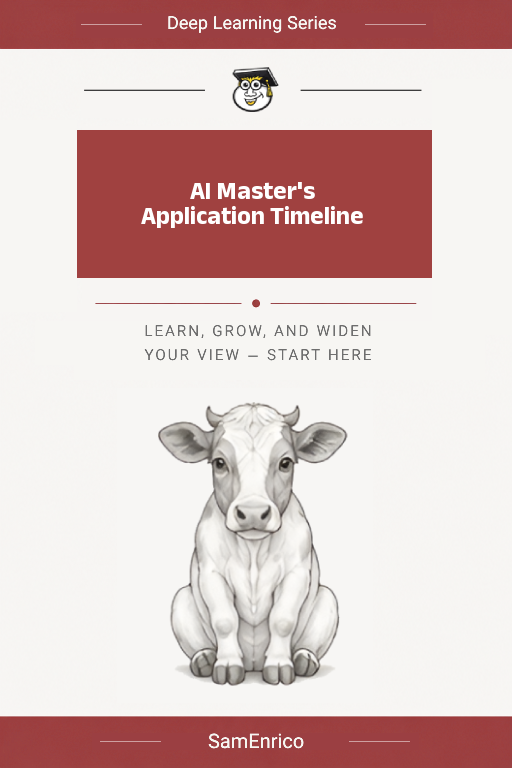
Non-FictionStudent's ShortcutApplication Timeline
AI Master's Application Timeline eBook
Creates 12-month application timeline for AI maste
Creates 12-month application timeline for AI master's programs including test preparation, research, and document gathering.
Formats
Free sample
Chapter 1: The Rankings Lie--–- Every year, thousands of ambitious students make the same mistake. They open US News & World Report, sort computer science graduate programs by rank, and begin building their application list from the top down. Stanford, MIT, Carnegie Mellon, UC Berkeley – the usual suspects. They spend months crafting perfect essays, polishing Git Hub repositories, and begging professors for letters of recommendation. Then December arrives, and so do the rejection letters.
Not because they weren't qualified. Not because their GPAs were too low. But because they were playing the wrong game entirely.The dirty secret of AI master's admissions is that rankings are almost useless as a predictor of where you will get in – or even where you should want to go. A program ranked #15 might reject you while a program ranked #35 gives you a full scholarship and a direct line to a faculty mentor who literally wrote the textbook on your favorite subfield. A "safety school" might have a 10% acceptance rate for AI because thousands of overqualified applicants had the same idea.
Meanwhile, a "reach school" might admit you because your unusual background fills a gap in their incoming cohort.This chapter dismantles the ranking obsession and replaces it with something far more useful: a framework for understanding program fit, a decision tree for the GRE trap that catches 70% of applicants, and a bridge plan for anyone coming from a non-traditional background. By the end of this chapter, you will not have a list of "top 10 programs." You will have a strategic target list of 12-15 schools where you have a genuine chance of admission – and more importantly, where you will actually thrive.The Three Program Personalities Before you can evaluate any program, you need to understand that AI master's degrees are not created equal. They fall into three distinct archetypes, each with its own admissions criteria, culture, and career outcomes. Applying to all three with the same strategy is like using the same resume for a research scientist position and a software engineering role – technically possible, but guaranteed to fail.Personality One: The Research Powerhouse These are the programs that dominate rankings: Stanford, MIT, Carnegie Mellon, UC Berkeley, University of Washington. Their AI master's programs are often structured as feeder systems for Ph Ds.
Courses are theoretical, assignments require original thinking rather than rote implementation, and the expectation is that you will work in a lab, contribute to a publication, and seriously consider continuing to a doctorate.What they look for: Research experience is non-negotiable. If you have not worked on a project that involved formulating a hypothesis, designing an experiment, analyzing results, and writing up findings, you are unlikely to be competitive. Publication credit is not required – most undergraduates don't have it – but you must be able to articulate what you learned from the research process. These programs also prioritize mathematical maturity. Real analysis, advanced probability, and optimization theory are not just recommended; they are expected.The hidden filter: Research powerhouses admit students who can hit the ground running as research assistants.
That means they look for candidates who already know how to read papers, implement methods from those papers, and identify limitations. If your application says "I want to learn research," you will be rejected in favor of someone who says "I have already done research and here is what I would do differently."Who should apply: You, if you have a publication or a significant research project (thesis, capstone with original component, industry research internship), a GPA above 3.8 in relevant coursework, and a genuine interest in potentially pursuing a Ph D. You should not apply if your goal is to become an industry engineer or if you have no research experience.Personality Two: The Industry Pipeline These programs are less famous but often more useful for the majority of applicants. Think Northeastern's Khoury College, University of Southern California, Georgia Tech's Online Master of Science in Computer Science (OMSCS), University of Texas at Austin, and many strong state schools. They prioritize job placement over Ph D placement.
Curricula emphasize applied projects, team collaboration, and tools you will actually use in industry – Spark, Kubernetes, MLflow, production deployment pipelines.What they look for: Work experience is valued more highly than research experience. Internships, co-ops, open source contributions, and industry projects all count. These programs want to see that you can function on a team, deliver working software, and communicate technical decisions to non-technical stakeholders. The GRE is often optional or lightly considered. Letters of recommendation from industry managers are acceptable alongside academic letters.The hidden filter: Industry pipeline programs are wary of "professional students" – people who have never held a real job and are collecting degrees to avoid the workforce.
If your entire resume is academic, you will need to explain why you want a master's and what you will do with it. Conversely, if you have five years of engineering experience but no recent academic references, you will need to demonstrate that you still have the mathematical foundations (linear algebra, calculus, probability) fresh enough to succeed.Who should apply: You, if your primary goal is to get a better job in AI engineering, if you have industry experience (internships count!), if your GPA is solid but not perfect (3.3-3.7 range), or if you are a career changer coming from another field. You should not apply if you are dead set on a Ph D or if you have no interest in working in industry after graduation.Personality Three: The Theory-First Curriculum These programs are less common in the United States but dominate in Europe and Asia: ETH Zurich, EPFL, University of Cambridge, National University of Singapore, KAIST, Tsinghua. They prioritize mathematical depth over applied skills. Courses derive algorithms from first principles, prove convergence guarantees, and require fluency in analysis and linear algebra at a level that would make many U.S.
Ph D students sweat.What they look for: Transcripts are everything. These programs will calculate your grades in every math course you have ever taken. They want to see Calculus III (multivariable), Linear Algebra (proof-based, not computational), Probability (measure-theoretic or advanced), and often Real Analysis or Optimization. Research experience is valued but not as highly as mathematical preparation. The GRE is often required and Quant scores below 165 are disqualifying.The hidden filter: Theory-first programs admit students who can follow mathematical arguments in lectures conducted in the instructor's second language (often English with a heavy accent).
If you struggled with proof-based math, you will struggle here. These programs have high dropout rates among students who underestimated the mathematical demands.Who should apply: You, if you love proofs more than code, if you have a strong mathematics background even if your programming skills are average, if you are considering a Ph D in theoretical machine learning, or if you are an international student targeting European or Asian programs. You should not apply if you want to build deployable models or if you struggled with Calculus II.The Self-Assessment: Finding Your Personality Match Now that you understand the three personalities, take out a sheet of paper – or open a spreadsheet – and answer these ten questions honestly. There is no right answer; the goal is to identify which…
This is the end of the free sample. Get the eBook to keep going. Buy now
About this book
Details
- Author
- Gagnon Akilah
- Publisher
- SamEnrico
- Language
- English
- Genre
- Non-Fiction, Student's Shortcut, Application Timeline
- Released
- 2026-05-29
- Pages (approx.)
- 152
- Available as
- eBook, Audiobook

Read better in the ZLOADR app
Your eBooks on your phone or tablet. Sign in with your SamEnrico account and start reading.
More by Gagnon Akilah
 Naturopathy for Pediatric HealthGagnon Akilah$11.99
 Bribri Sibö PriestessGagnon Akilah$11.99
 Mutual Friends After DivorceGagnon Akilah$11.99
 Jamaican Jerk Sauce EmpireGagnon Akilah$11.99
 The Penis Envy Dream GuideGagnon Akilah$11.99
 The Poisoned Inkwell: The First Literary Detective Who Exposed a DynastyGagnon Akilah$11.99
 Reefer Trailer MechanicGagnon Akilah$11.99
 Understanding Seckel Syndrome 2Gagnon Akilah$17.99
 Franchise Food Safety GlobalGagnon Akilah$12.99
 How to Start a National Physical Laboratory Business (Beginners Guide)Gagnon Akilah$11.99
You may also like
 Hong Kong Handover 1997Dunn Johnnie$11.99
 Zumba For Postnatal Recovery CourseNeal Christian$11.99
 Zumba for BeginnersLadner Nikia$11.99
 YouTube Comment Mining GuideHumes Pandora$12.99
 Worry Box MeditationCarlin Rudy$11.99
 Workplace Stress MeditationNguyen Lynn$11.99
 Workplace Stress and Sleep RepairHawley Ivory$11.99
 Workplace Perfectionism CureDelaney Jeffry$11.99
 Workplace Injustice Anger GuideWallen Isabelle$11.99
 Work Addiction and Burnout LinkGreenwood Ester$11.99
 Women in Yoga and WellnessBeattie Galina$11.99
 Women in Stand Up ComedyChun Evangeline$11.99