
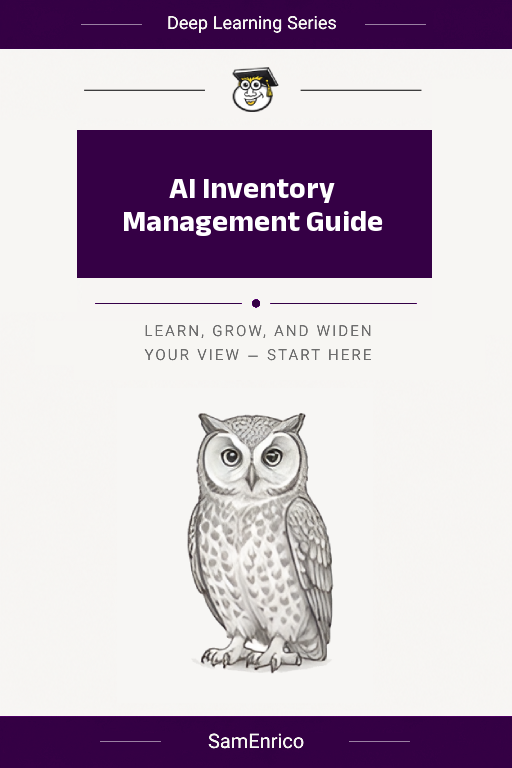
Non-FictionAnnual CheckupInventory AI
AI Inventory Management Guide eBook
Use Zoho Inventory AI or Cin7 to predict demand an
Use Zoho Inventory AI or Cin7 to predict demand and optimize stock levels.
Formats
Free sample
Chapter 1: Trapped on Shelves--–- The meeting had started like any other Tuesday morning. Maria, the operations director for a mid-sized outdoor gear retailer, clicked open her inventory dashboard to find the same two problems she had faced for the past eighteen months. Her top-selling hiking backpack—the one that generated forty percent of her margin—was out of stock again. Meanwhile, three thousand units of a discontinued tent model sat in the warehouse, collecting dust and accruing storage fees. She had seven days of stock for products that flew off the shelves and seven years of stock for products nobody wanted.
Her CFO had just asked why the company was borrowing money to buy inventory while write-offs were climbing. Her warehouse manager was threatening to quit because of the chaos. And her customers were posting one-star reviews about backorders.Maria was not alone. Every day, thousands of inventory managers, business owners, and supply chain professionals sit in the same chair, staring at the same impossible puzzle. How much should I order?
When should I order it? Where should I put it? These questions seem simple. But the answers have bankrupted more companies than any other operational failure.This chapter does not offer a quick fix. Instead, it reveals the true cost of what most businesses accept as "good enough" inventory management.
It names the emotional, financial, and operational toll of manual forecasting. It defines what inventory intelligence actually means—and why most reports are not intelligent at all. And it introduces the two AI engines that will serve as the tools for the rest of this book: Zoho Inventory AI and Cin7 Foresight AI.By the time you finish this chapter, you will understand why your current system is failing, why it is not your fault, and why artificial intelligence is not a luxury but a necessity for survival.The Mathematics of Failure Traditional inventory management relies on a deceptively simple formula: reorder point equals average daily usage multiplied by supplier lead time, plus safety stock. This formula has been taught in business schools for decades. It appears in countless spreadsheets, ERP systems, and warehouse management software packages.
And it fails catastrophically in modern markets.Consider the assumptions buried inside that formula. First, it assumes that future demand will look like past demand. Second, it assumes that supplier lead times are stable and predictable. Third, it assumes that no external shocks will disrupt the pattern. In a world of same-day delivery, Tik Tok-driven demand spikes, and supply chain disruptions from geopolitical events, these assumptions are not just optimistic.
They are dangerous.Take the example of a small beverage company that sold flavored sparkling water. For three years, their sales followed a predictable pattern: steady growth during summer months, a dip in winter, and a spike during the holiday season. Their inventory system, built on a basic reorder point model, worked fine. Then a single influencer posted a twenty-second video of someone drinking their product on a beach. Within forty-eight hours, demand increased by eight hundred percent.
Their reorder point formula, based on three years of historical data, never saw it coming. They ran out of stock in six hours. By the time they could order more raw materials, produce new units, and ship to retailers, the trend had died. They lost over two hundred thousand dollars in potential revenue and spent another fifty thousand on expedited freight trying to catch up.This is not a story about bad luck. It is a story about bad math.
Traditional reorder points are backward-looking. They are designed for stable, predictable, repetitive environments. Modern commerce is none of those things.The problem extends beyond demand spikes. Supplier lead times have become wildly inconsistent. A component that used to arrive in five days now takes fifteen—or fifty.
A freight container that cost three thousand dollars two years ago now costs fifteen thousand—or is simply unavailable. Traditional formulas treat lead time as a fixed number. AI treats it as a probability distribution, constantly updated with real-time data from carrier tracking, port delays, and supplier performance.When you rely on traditional reorder points, you are essentially driving a car while looking only in the rearview mirror. You know where you have been. You have no idea what is coming.The Emotional Ledger Inventory management is not a purely analytical discipline.
It is an emotional one. Ask any warehouse manager or operations director about their relationship with stock levels, and you will hear words like anxiety, exhaustion, and guilt. These emotions are not incidental. They are structural features of a broken system.Consider the emotional toll of a stockout. You receive an email from your largest customer.
They needed five hundred units by Friday. You have forty-two. Your sales representative is on the phone, apologizing. Your customer is threatening to switch to a competitor. Your CEO wants to know why you did not see this coming.
You stay late, searching for alternatives: air freight from a different supplier, splitting the order across three warehouses, calling in favors with logistics providers. You go to bed at midnight, exhausted but relieved that you found a solution. Then you wake up to discover that another product, the one you thought was overstocked, has suddenly gone viral and is now backordered for six weeks.This cycle repeats indefinitely. Each stockout triggers a firefighting response. Each firefighting response consumes time and energy that should have been spent on strategy.
Each strategic failure creates the next fire. The result is burnout.The numbers bear this out. A 2024 survey of supply chain professionals found that sixty-eight percent reported symptoms of burnout, compared to forty-one percent across other business functions. Inventory managers described their work as "constant triage" and "never being able to catch up." The average inventory manager spends less than twenty percent of their time on strategic analysis. The rest goes to expediting, apologizing, and manually adjusting spreadsheets that were outdated the moment they were saved.The irony is that most of this firefighting is unnecessary.
The information needed to prevent stockouts already exists somewhere in your organization—in sales forecasts, in marketing calendars, in supplier communications, in weather data, in social media trends. But it exists in silos. No human being can synthesize all of this data in real time. You are not failing because you are bad at your job. You are failing because the job, as traditionally defined, is impossible for a human to do well.The Cash Flow Trap Stockouts are painful.
But overstocks are quietly lethal. While stockouts create immediate crises, excess inventory slowly suffocates a business by trapping cash that could be used for growth.Inventory is often called an asset on balance sheets. But from a cash flow perspective, unsold inventory is not an asset. It is a liability. Every dollar sitting on a shelf as slow-moving stock is a dollar that cannot be used for payroll, marketing, product development, or debt reduction.
It is a dollar that is actively costing you money through storage fees, insurance, handling costs, and the risk of obsolescence.The scale of this problem is staggering. According to industry data, the average company holds inventory worth fifteen to thirty percent…
This is the end of the free sample. Get the eBook to keep going. Buy now
About this book
Details
- Author
- Hollingsworth Silas
- Publisher
- SamEnrico
- Language
- English
- Genre
- Non-Fiction, Annual Checkup, Inventory AI
- Released
- 2026-06-01
- Pages (approx.)
- 153
- Available as
- eBook, Audiobook

Read better in the ZLOADR app
Your eBooks on your phone or tablet. Sign in with your SamEnrico account and start reading.
More by Hollingsworth Silas
 Loneliness Thought ReframingHollingsworth Silas$11.99
 Teen Appearance Pressure GuideHollingsworth Silas$11.99
 Spin Class Heart Rate Training ManualHollingsworth Silas$11.99
 Cyberstalking Mental Health Victim CasesHollingsworth Silas$11.99
 Antwerp Diamond Heist Motive AnalysisHollingsworth Silas$11.99
 The Pacific Pioneers: How the Apollo Program Relied on a Forgotten OceanHollingsworth Silas$11.99
 The Last Shot: The Miracle of the 1992 Dream Team's Final GameHollingsworth Silas$11.99
 How to Become a Case Packer And SealerHollingsworth Silas$11.99
 Cross Border Union SolidarityHollingsworth Silas$12.99
 Understanding Double DiscordiaHollingsworth Silas$17.99
 CalligrapherHollingsworth Silas$11.99
You may also like
 Hong Kong Handover 1997Dunn Johnnie$11.99
 Zumba For Postnatal Recovery CourseNeal Christian$11.99
 Zumba for BeginnersLadner Nikia$11.99
 YouTube Comment Mining GuideHumes Pandora$12.99
 Worry Box MeditationCarlin Rudy$11.99
 Workplace Stress MeditationNguyen Lynn$11.99
 Workplace Stress and Sleep RepairHawley Ivory$11.99
 Workplace Perfectionism CureDelaney Jeffry$11.99
 Workplace Injustice Anger GuideWallen Isabelle$11.99
 Work Addiction and Burnout LinkGreenwood Ester$11.99
 Women in Yoga and WellnessBeattie Galina$11.99
 Women in Stand Up ComedyChun Evangeline$11.99