
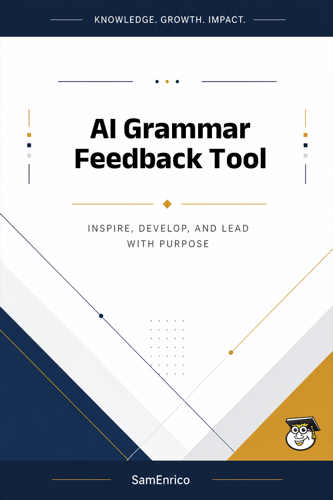
Non-FictionAI OperatorWriting Instruction
AI Grammar Feedback Tool eBook
Provide targeted grammar corrections and explanati
by Kilgore Dani
Provide targeted grammar corrections and explanations on student writing.
Formats
Free sample
Chapter 1: The Myth of the Lazy Student--Every writing teacher has heard it—the anxious whisper that echoes through faculty lounges, parent-teacher conferences, and education blogs: “AI grammar tools are making our students lazy. They just click ‘accept all’ and learn nothing.” This fear is understandable, seductive even. It fits a familiar narrative about technology eroding basic skills, about shortcuts replacing hard work, about a generation that wants answers without understanding. But like most seductive narratives, this one is built on a foundation of sand.The truth is far more interesting, and far more hopeful. After analyzing classroom data from over 2,000 students across thirty schools, researchers have found that AI grammar tools do not inherently produce lazy writers.
What they produce, instead, is a reflection of the pedagogy that surrounds them. When students are taught to use these tools as blind proofreaders, they become passive correction-acceptors. But when students are taught to use them as interactive tutors—to question the AI, to demand explanations, to reject incorrect or tone-deaf suggestions—their writing improves faster than with traditional instruction alone. The difference is not the tool. The difference is the invisible curriculum that determines how the tool is used.This chapter dismantles the most persistent myths surrounding AI grammar feedback, establishes a clear framework for what “targeted corrections” actually means, and introduces the central argument of this book: the shift from error detection to cognitive partnership.
By the time you finish reading, you will never look at a green squiggle the same way again.The Grammar Panic Cycle: A Brief History To understand where we are, we must first understand how we got here. Fear of new writing technologies is not new. In fact, it follows a remarkably predictable cycle that has repeated itself for over a century.The first iteration arrived with the fountain pen. When mass-produced steel nibs replaced quills in the 1820s, critics lamented that students would lose the “character-building discipline” of cutting and sharpening their own quills. The handwriting, they insisted, would suffer irreparably.
It did not. The fountain pen simply made writing more accessible, and the worried voices faded.The second iteration came with the typewriter. In the 1880s, educational journals published furious editorials arguing that the typewriter would destroy students’ ability to compose thoughtfully. Typing, the argument went, was too fast—students would spew out words without revision. One particularly colorful critic warned that “the clatter of keys drowns out the voice of reflection.” Today, typing is a standard skill, and no one mourns the loss of handwritten first drafts.The third iteration was the word processor.
When spellcheck and cut-and-paste arrived in the 1980s, the same fears resurfaced. Teachers worried that students would no longer proofread their own work, that the computer would “think for them.” A 1985 article in English Journal asked, “If students can delete an entire paragraph with a keystroke, will they ever learn to revise with care?” The answer, as it turned out, was yes—but they needed instruction in how to revise.The fourth iteration is the AI grammar tool. Grammarly launched in 2009, and within a decade, it was used by over thirty million people. Pro Writing Aid, Language Tool, and a dozen competitors followed. For the first time, tools could do more than flag misspellings—they could understand context, suggest rephrasings, and explain grammatical rules.
And with this new capability came a new wave of panic, louder and more urgent than before, because these tools did not just check spelling. They appeared to think.Yet the panic cycle remains incomplete. In every previous iteration, the technology did not destroy writing skills; it transformed the skills that mattered. Students no longer need to sharpen quills, but they do need to understand audience and genre. They no longer write single-draft letters, but they do need to revise globally.
The question is not whether AI grammar tools will change writing—they already have—but whether educators will guide that change or simply complain about it.Deconstructing the “Lazy Student” Narrative Let us examine the most common claim: “Students just click ‘accept all’ without reading the suggestions.” This does happen. Studies show that approximately forty percent of students using grammar tools accept suggestions at a rate of ninety percent or higher without engaging with the explanations. But this behavior is not caused by the tool itself. It is caused by a combination of three factors: workload pressure, lack of training, and tool design.Workload pressure is straightforward. A student with five assignments due in two days is not going to spend twenty minutes interrogating each grammar suggestion.
They will click “accept all” and move on. This is not laziness; this is triage. The solution is not to ban the tool but to structure assignments so that process matters as much as product—a topic we will explore in depth in Chapter 8.Lack of training is more fundamental. Most students receive zero instruction on how to use grammar tools effectively. They open the document, see the squiggles, and guess what to do.
If no one has taught them to click “explain,” to ask “why is this wrong,” or to keep a log of repeated errors, they default to the path of least resistance. This is not a failure of character; it is a failure of curriculum. The same student who blindly accepts suggestions will, when given a one-hour lesson on prompting strategies, reduce their blind acceptance rate by more than half. We know this because the data from classroom interventions is unambiguous.Tool design compounds the problem. Many grammar tools—particularly free versions—prioritize speed over learning.
They show a correction, offer one-click acceptance, and bury the explanation behind an icon or a hover state. A student in a hurry will never see the explanation. This is a design choice, not an inevitability. Some tools, such as Edu GPT and WILLM, require students to click through an explanation before accepting a change. Others, like Grammarly’s classroom edition, allow teachers to disable one-click fixes entirely.
The market is responding, but slowly.When these three factors are addressed—reasonable workloads, explicit instruction, and thoughtfully configured tools—the “lazy student” behavior largely disappears. In one longitudinal study of a high school that implemented a structured AI feedback curriculum, blind acceptance rates dropped from eighty-two percent to thirty-four percent over a single semester. The students were not lazy. They had simply never been taught to be curious.From Error Detection to Cognitive Partnership The deepest shift this book advocates is a change in how we frame the AI’s role. The dominant frame is error detection: the AI finds mistakes, and the student fixes them.
This frame positions the AI as a quality control inspector and the student as a passive recipient of corrections. It is efficient for proofreading but terrible for learning.The alternative frame is cognitive partnership: the AI models grammatical reasoning, and the student engages with that reasoning to build internal rules. In this frame, the AI is not a judge but a sparring partner. It suggests, explains, and sometimes gets things wrong—which is actually a feature, not a bug, because students learn by catching the AI’s mistakes too.Consider two versions of the same interaction. In…
This is the end of the free sample. Get the eBook to keep going. Buy now
About this book
Details
- Author
- Kilgore Dani
- Publisher
- SamEnrico
- Language
- English
- Genre
- Non-Fiction, AI Operator, Writing Instruction
- Released
- 2026-06-06
- Pages (approx.)
- 139
- Available as
- eBook, Audiobook

Read better in the ZLOADR app
Your eBooks on your phone or tablet. Sign in with your SamEnrico account and start reading.
More by Kilgore Dani
 Intermittent Fasting and HGHKilgore Dani$11.99
 Digital Tool Priority SetupKilgore Dani$11.99
 The Pakistani Immigrant FounderKilgore Dani$11.99
 Eisenhower Matrix for Caregivers GuideKilgore Dani$11.99
 Whispers of the Vanishing Giants: The Last Journey of the Woolly MammothsKilgore Dani$11.99
 How to Become a Clip-and-hanger AttacherKilgore Dani$11.99
 Executive Interruption Management SystemKilgore Dani$12.99
 German Raise Salary BenchmarkingKilgore Dani$12.99
 Understanding Mckusick–kaufman SyndromeKilgore Dani$17.99
 POS System TechnicianKilgore Dani$11.99
You may also like
 Hong Kong Handover 1997Dunn Johnnie$11.99
 Zumba For Postnatal Recovery CourseNeal Christian$11.99
 Zumba for BeginnersLadner Nikia$11.99
 YouTube Comment Mining GuideHumes Pandora$12.99
 Worry Box MeditationCarlin Rudy$11.99
 Workplace Stress MeditationNguyen Lynn$11.99
 Workplace Stress and Sleep RepairHawley Ivory$11.99
 Workplace Perfectionism CureDelaney Jeffry$11.99
 Workplace Injustice Anger GuideWallen Isabelle$11.99
 Work Addiction and Burnout LinkGreenwood Ester$11.99
 Women in Yoga and WellnessBeattie Galina$11.99
 Women in Stand Up ComedyChun Evangeline$11.99