
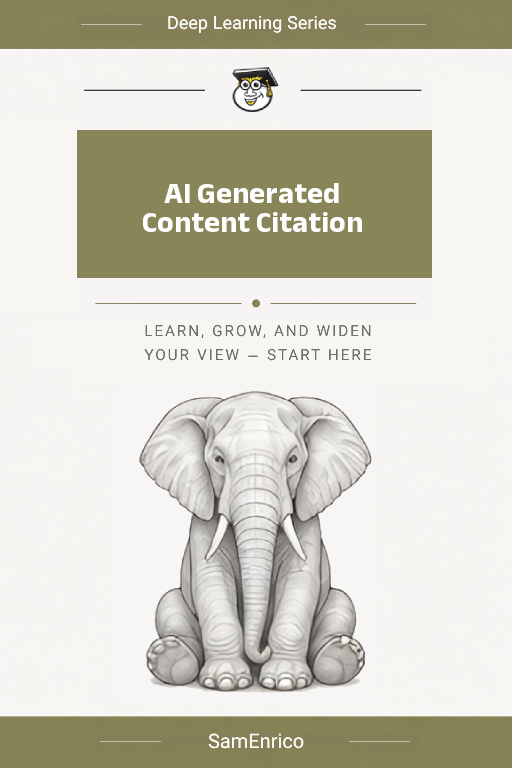
Non-FictionStudent's ShortcutAI Citation
AI Generated Content Citation eBook
Cite ChatGPT, Midjourney, and other AI outputs in
Cite ChatGPT, Midjourney, and other AI outputs in academic papers per latest style updates.
Formats
Free sample
Chapter 1: The Citation Crisis--–- The first time a graduate student named Elena submitted a literature review containing Chat GPT-generated citations, she nearly lost her academic career. The references looked perfect—DOIs, volume numbers, page ranges, even plausible author names from reputable journals. Her advisor was impressed. The peer reviewer was not. When the reviewer tried to locate one of the cited articles—a 2023 study in a well-known Elsevier journal about cognitive load in online learning—the DOI resolved to a blank page.
The journal title was real. The volume number matched an actual issue. But the article itself had never existed. Elena had fallen victim to what researchers now call the hallucination trap, and she spent the next six months rebuilding her credibility through a formal retraction, a revised submission, and a public statement about AI misuse. She was not the first.
She will not be the last.This book exists because Elena’s story is becoming routine. In writing workshops, faculty meetings, and journal editorial boards across every discipline, the same question echoes with growing urgency: how do we cite something that was never written by a human, that can generate infinite variations of the same answer, that fabricates sources with terrifying plausibility, and that changes its behavior every few months as new versions are released?The short answer is that existing citation manuals are failing. The longer answer—the one this chapter provides—is that the failure is not accidental. It is structural. Academic citation systems were designed for a world of stable, authored, verifiable sources.
Generative AI belongs to a different universe entirely. Understanding why the manuals are failing is the first step toward building a better practice, and that understanding begins with a hard look at three interrelated crises: the patchwork of conflicting guidance, the unresolved debate over AI authorship, and the hallucination epidemic that undermines the very concept of a reliable citation.The Patchwork Problem: Where Official Guidance Lives (And Why It’s Not Enough)Imagine you are a doctoral student in history. You have used Chat GPT to help rephrase several paragraphs of your methods section. You did not quote the AI directly; you rewrote its suggestions in your own words. Now you need to cite this use correctly.
Where do you look?If you turn to the Publication Manual of the American Psychological Association (APA), you will find nothing. The seventh edition, published in 2019, predates the public release of Chat GPT by three years. There is no section on AI. Instead, APA has published a series of blog posts—last updated in April 2024—that offer guidance. But blog posts are not the manual.
They are not peer reviewed. They do not carry the same authority, and many journal editors do not consider them binding. If you cite according to the blog post and your editor insists on a different interpretation, you have no formal recourse.If you consult the MLA Handbook (9th edition), you fare slightly better. MLA added a brief section on citing AI in 2023, but it runs fewer than 500 words. It tells you to treat the prompt as the title and the AI tool as the container, but it does not address what to do when the AI conversation spans dozens of exchanges, or when the AI output has been heavily edited, or when the AI itself cites a real source that you cannot verify.
The guidance is skeletal.The Chicago Manual of Style (18th edition) went to press in 2024 and includes new sections 14.112 and 14.113 specifically on AI. This is progress. But Chicago’s treatment—treat AI as personal communication by default—creates its own problems. Personal communications do not go in the bibliography, which means the AI conversation is hidden in footnotes. For a substantial methodological discussion, this is inadequate.University libraries have tried to fill the gaps.
A survey of thirty major research universities conducted in early 2025 found that twenty-seven had published their own AI citation guides. No two were identical. Some required disclosure tables. Some prohibited any citation of AI at all. Some treated AI as software, others as a communication tool, and a few as a co-author (contradicting journal policies).
A student at the University of Michigan could receive different citation instructions from the library, her professor, and the journal she planned to submit to—all within the same week.This patchwork has real consequences. In a study published in the Journal of Academic Ethics (vol. 22, no. 1, pp. 45–67), researchers analyzed 140 retraction notices from 2024 that involved AI-generated content.
In thirty-one percent of cases, the retraction was not due to substantive errors in the research but to improper or missing citation of AI tools. Students and researchers are losing years of work not because their science is wrong but because the rules are unclear and inconsistently applied.The patchwork problem is not going to resolve itself quickly. The next full editions of APA and MLA are years away. University guides will continue to diverge. Journals will continue to issue conflicting policies.
The only solution is for individual researchers to adopt a principle-based approach rather than a rule-based one—to understand what citation is supposed to accomplish and then apply that understanding to AI. This book provides that framework. But first, we must confront a more fundamental debate.The AI Author Debate: Can a Machine Sign an Ethics Form?In March 2023, a researcher submitted a paper to the journal Nature with Chat GPT listed as a co-author. The editor rejected the submission within forty-eight hours, not on scientific grounds but on authorship grounds. The accompanying letter was blunt: “An artificial intelligence model cannot take responsibility for the content of a manuscript.
It cannot sign the author disclosure forms. It cannot declare competing interests. It cannot be held accountable for errors. Remove the AI from the author list or withdraw the paper.”This position is now standard across most reputable journals. The International Committee of Medical Journal Editors (ICMJE), which sets standards for thousands of medical journals including JAMA, The Lancet, and the New England Journal of Medicine, issued a clear statement in 2023: “AI cannot be listed as an author.
Authors must be able to take public responsibility for the work, and AI cannot do this.” The Committee on Publication Ethics (COPE) has echoed this stance.But not everyone agrees. Some open-access journals, particularly those in the humanities and social sciences, have experimented with allowing AI co-authorship under limited conditions. The Journal of AI and Society published a special issue in 2024 where AI was credited as a “contributor” rather than an author, with a disclaimer that the human authors took full responsibility for the AI’s output. The legal journal Law, Technology and Humans has allowed footnotes acknowledging “substantive contributions from GPT-4” without listing the AI as an author.The inconsistency creates confusion. If you are writing a paper for an ICMJE journal, you cannot list AI as an author.
If you are writing for a less restrictive venue, you might be able to. But even when AI authorship is permitted, most scholars argue it is a bad idea. Why? Because authorship carries obligations. A human author must be able to explain how the research was conducted, why certain choices…
This is the end of the free sample. Get the eBook to keep going. Buy now
About this book
Details
- Author
- Stuckey Berenice
- Publisher
- SamEnrico
- Language
- English
- Genre
- Non-Fiction, Student's Shortcut, AI Citation
- Released
- 2026-05-29
- Pages (approx.)
- 150
- Available as
- eBook, Audiobook

Read better in the ZLOADR app
Your eBooks on your phone or tablet. Sign in with your SamEnrico account and start reading.
More by Stuckey Berenice
 Injury Master GuideStuckey Berenice$11.99
 The Shame Muscle TrainingStuckey Berenice$11.99
 Jimmy Hoffa Last Phone Calls InvestigationStuckey Berenice$11.99
 Burnout Prevention For Hair StylistsStuckey Berenice$11.99
 OKR History GuideStuckey Berenice$11.99
 Atomic Habits For RelationshipsStuckey Berenice$11.99
 Remote Work Life BalanceStuckey Berenice$11.99
 Duolingo Streak Comparison TrapStuckey Berenice$11.99
 The Ink That Never Dried: The Secret Life of the World's First Female PlaywrightStuckey Berenice$11.99
 The Breaking Point: How Roberto Durán’s Divorce Fueled His ComebackStuckey Berenice$11.99
 A Collector's Handbook to the Rover 2-litre (1931-32)Stuckey Berenice$11.99
 How to Start a Coach Engine Business (Beginners Guide)Stuckey Berenice$11.99
You may also like
 Hong Kong Handover 1997Dunn Johnnie$11.99
 Zumba For Postnatal Recovery CourseNeal Christian$11.99
 Zumba for BeginnersLadner Nikia$11.99
 YouTube Comment Mining GuideHumes Pandora$12.99
 Worry Box MeditationCarlin Rudy$11.99
 Workplace Stress MeditationNguyen Lynn$11.99
 Workplace Stress and Sleep RepairHawley Ivory$11.99
 Workplace Perfectionism CureDelaney Jeffry$11.99
 Workplace Injustice Anger GuideWallen Isabelle$11.99
 Work Addiction and Burnout LinkGreenwood Ester$11.99
 Women in Yoga and WellnessBeattie Galina$11.99
 Women in Stand Up ComedyChun Evangeline$11.99