
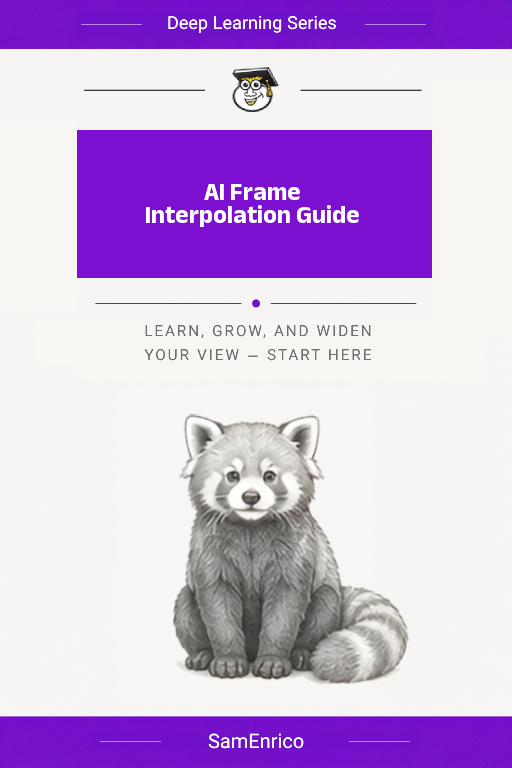
Non-FictionAI OperatorFrame Interpolation
AI Frame Interpolation Guide eBook
Generate smooth slow-motion video using AI frame i
Generate smooth slow-motion video using AI frame interpolation techniques.
Formats
Free sample
Chapter 1: The Stutter Reality---- Your footage looks terrible. Not because you're a bad filmmaker, not because your camera is cheap, and not because you missed the moment. The problem is far more fundamental, and far more fixable, than any of those. Your footage stutters because reality moves faster than your camera can capture. And for the last hundred years, we've just accepted this limitation as unchangeable physics.
It's not. Welcome to the end of choppy video.Every video you have ever watched, every clip you have ever shot, every cinematic moment that felt just slightly off – they all share a dirty secret. The camera lied to you. Not maliciously. Not intentionally.
But it lied. When you watch a 30 frames per second video of a baseball being hit, you are not seeing the baseball. You are seeing 30 snapshots per second, each one a frozen slice of time, with vast invisible gaps between them. Your brain, desperate to make sense of this slideshow, does something remarkable. It invents motion.
It fills in the gaps with a best guess, a neurological smooth-talking trick that has worked well enough for over a century of cinema. But here is the truth your brain hides from you: between every frame you see, there is a ghost world of missing information.This chapter is called "The Stutter Reality" because that stutter – that tiny, almost imperceptible jump between frames – is the fundamental problem this entire book solves. And once you learn to see it, you will never unsee it. More importantly, you will learn to erase it.The Lie Your Camera Tells You Let us start with a simple experiment. Open any video on your phone – a child running through sprinklers, a car driving past, a basketball swishing through a net.
Pause it at any moment. What you see is a perfectly sharp, frozen instant. Now advance one frame. Just one. In most video, that is 1/30th of a second later.
Look at how far everything moved. The child's foot jumped six inches. The car teleported forward a full meter. The basketball shifted from above the rim to below it in a single frame.That jump is the lie. In reality, motion is continuous.
The child's foot passed through every millimeter of those six inches. The car occupied every centimeter of that meter. The basketball arced through every point along its trajectory. Your camera recorded exactly zero of those intermediate positions. It picked 30 instants out of an infinite continuum and declared, "This is the video."For most of film history, this was not a problem.
Audiences accepted it because they had no alternative. The 24 frames per second standard of cinema was chosen not because it looked real, but because it was the minimum speed required to trick the brain into perceiving motion without unbearable flicker. It was a compromise between cost and credibility. And we have been living with that compromise ever since.But compromises have consequences. The stutter you see in fast motion – the judder during a whip pan, the strobe effect of rotating helicopter blades, the unnatural jerkiness of a sprinting athlete – these are not flaws in your technique.
They are the mathematical reality of sampling a continuous world at discrete intervals. The Nyquist-Shannon sampling theorem, a pillar of signal processing, states that to accurately represent a frequency, you must sample at more than twice its rate. Apply this to motion: to accurately capture a fast-moving object, you need a frame rate more than double the speed of that motion across your frame. Most consumer cameras fail this test spectacularly.Why Your Brain Hates Stutter (Even When You Don't Notice It)Here is where things get interesting. Your visual system is not a camera.
It is a prediction engine. The human eye captures high-resolution detail only in a tiny central region called the fovea, about two degrees of visual angle. Everything else is low-resolution peripheral vision. You perceive a sharp, stable world not because your eyes see it that way, but because your brain constructs it from saccades (rapid eye movements), memory, and constant prediction.Enter persistence of vision and the critical flicker fusion threshold. Persistence of vision refers to the approximately 0.05 to 0.1 seconds that a visual impression remains on your retina after the stimulus disappears.
This is why a fast sequence of still images appears as continuous motion – each image lingers just long enough to bridge the gap to the next. The critical flicker fusion threshold (CFF) is the frequency at which a flickering light stops appearing to flicker and appears continuous. For most humans under typical viewing conditions, the CFF is around 50 to 60 Hz.Here is the crucial distinction that most explanations get wrong. Cinema works at 24 frames per second not because 24fps reaches the CFF, but because movie projectors use a shutter that flashes each frame two or three times (creating 48 or 72 flashes per second). The frame rate is 24, but the flicker rate is 48 or 72.
Additionally, cinematic motion blur – created by a 180-degree shutter angle where each frame exposes for half the frame interval – smears fast movement across each frame, smoothing the transition between discrete positions. Your smartphone, by default, uses a much faster shutter to freeze motion and reduce blur. That frozen sharpness comes at a cost: without motion blur to bridge the gaps, the stutter becomes brutally visible.This is why your i Phone footage of a child running looks more stuttery than a Hollywood film of a car chase, even though the film has a lower frame rate. The film has motion blur baked into every frame. Your phone has sharp, frozen, staccato instants.The Real-World Cost of Low Frame Rates Let me share a story that illuminates this problem.
In 2018, a wildlife documentary crew spent three weeks in the Antarctic filming leopard seals hunting penguins. They captured stunning 4K footage at 60 frames per second using high-end cinema cameras. When they returned to edit, they realized the most dramatic moment – a seal launching out of the water to snatch a penguin – lasted less than half a second in real time. At 60fps, that was 30 frames. Enough to see what happened, but not enough to feel the violence, the spray, the explosive power of the strike.
The editor wanted slow motion, but slowing 60fps footage by 4x would drop the effective frame rate to 15fps – unwatchable stutter. The sequence went into the film at real speed. The moment was recorded but never felt.Contrast this with a different production. A commercial director shooting a luxury car spot requested high-speed Phantom cameras at 1000 frames per second. The budget was 40,000foronedayofthatcamerarental.Theresultingslowmotionwasbreathtaking–waterdropletshanginginair,tiretreadsdeformingagainstasphalt,dustcloudsbloominglikeflowers.Theadwonawards.Theagencybilledtheclient40,000 for one day of that camera rental.
The resulting slow motion was breathtaking – water droplets hanging in air, tire treads deforming against asphalt, dust clouds blooming like flowers. The ad won awards. The agency billed the client 40,000foronedayofthatcamerarental.Theresultingslowmotionwasbreathtaking–waterdropletshanginginair,tiretreadsdeformingagainstasphalt,dustcloudsbloominglikeflowers.Theadwonawards.Theagencybilledtheclient150,000. The secret? That director knew something you are about to learn: smooth slow motion is not a luxury.
It is a competitive advantage.Every creator reading this book has lost money, engagement, or artistic impact because of choppy video. The You Tuber whose action sequence got skipped because it looked "cheap." The wedding…
This is the end of the free sample. Get the eBook to keep going. Buy now
About this book
Details
- Author
- Andrus Soraya
- Publisher
- SamEnrico
- Language
- English
- Genre
- Non-Fiction, AI Operator, Frame Interpolation
- Released
- 2026-05-30
- Pages (approx.)
- 144
- Available as
- eBook, Audiobook

Read better in the ZLOADR app
Your eBooks on your phone or tablet. Sign in with your SamEnrico account and start reading.
More by Andrus Soraya
 Anxiety Soothing Self TalkAndrus Soraya$11.99
 Sunrise Awakening CalmAndrus Soraya$11.99
 Social Media Fitness InfluencerAndrus Soraya$11.99
 Bechuanaland Botswana GuideAndrus Soraya$11.99
 The John Wayne Gacy Police FailuresAndrus Soraya$11.99
 The Golden Deception: The Heist of the Kushan TreasureAndrus Soraya$11.99
 Platform SpecialistAndrus Soraya$11.99
 Remote Conflict Resolution Role PlaysAndrus Soraya$12.99
 Understanding Mucopolysaccharidosis Type I Scheie SyndromeAndrus Soraya$17.99
 How to Become a Cloth TesterAndrus Soraya$11.99
You may also like
 Hong Kong Handover 1997Dunn Johnnie$11.99
 Zumba For Postnatal Recovery CourseNeal Christian$11.99
 Zumba for BeginnersLadner Nikia$11.99
 YouTube Comment Mining GuideHumes Pandora$12.99
 Worry Box MeditationCarlin Rudy$11.99
 Workplace Stress MeditationNguyen Lynn$11.99
 Workplace Stress and Sleep RepairHawley Ivory$11.99
 Workplace Perfectionism CureDelaney Jeffry$11.99
 Workplace Injustice Anger GuideWallen Isabelle$11.99
 Work Addiction and Burnout LinkGreenwood Ester$11.99
 Women in Yoga and WellnessBeattie Galina$11.99
 Women in Stand Up ComedyChun Evangeline$11.99