
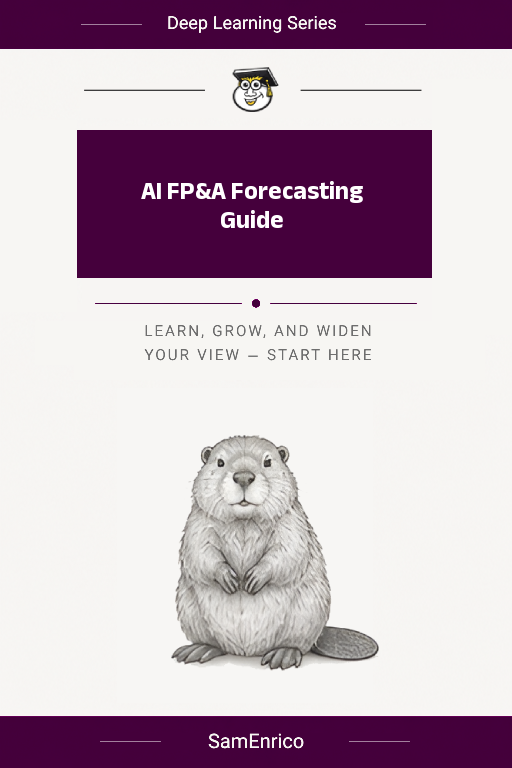
Non-FictionAI OperatorFP&A Analytics
AI FP&A Forecasting Guide eBook
Build driver-based financial models and rolling fo
Build driver-based financial models and rolling forecasts using AI that adapts to changing business conditions.
Formats
Free sample
Chapter 1: The 65% Wasteland--–- The email arrived at 4:47 PM on a Thursday. Your CEO wants the revised forecast on her desk by Monday morning. The numbers have shifted—again—because sales missed their pipeline target, supply chain raised prices unexpectedly, and two key customers delayed payments. You open the latest export from the ERP system. The columns don’t align with last month’s structure.
The CRM data uses different territory names. Three spreadsheets later, you realize you’ve spent two hours just getting the data to match, and you haven’t analyzed a single number yet.This scene plays out in finance departments every single week. The problem is not that you lack skill, intelligence, or dedication. The problem is the system itself. The traditional annual budget and its quarterly offspring—the static forecast—were designed for a world that no longer exists.
They assume stability, predictability, and slow-moving markets. None of those assumptions hold today.This book exists for one reason: to help you escape that trap. By the time you finish this chapter, you will understand exactly why the annual budget is actively harmful, what the data actually says about AI-assisted forecasting, and why 65 percent of your team’s time is currently being wasted on work that machines should be doing. More importantly, you will leave with a clear mandate to kill the annual budget cycle and replace it with something better—continuous, adaptive, probabilistic planning powered by AI.Let’s begin with a hard truth: your annual budget is already wrong.The Budget That Locks You in the Past Every year, thousands of companies go through the same ritual. The finance team spends three to six months building a detailed annual budget.
Departments negotiate. Assumptions are debated. Spreadsheets are passed back and forth until everyone agrees on a single number for revenue, a single number for expenses, and a single number for profit. The budget is approved, printed, and celebrated.And then the world changes.By the second quarter, the assumptions baked into that budget are already outdated. A new competitor entered the market.
Interest rates moved. A supplier raised prices. Your best salesperson quit. None of these events were in the budget. But your team is still measured against those static numbers, chasing targets that no longer reflect reality.This is not a failure of execution.
It is a failure of the budgeting model itself.The annual budget locks in assumptions from six to twelve months ago. It creates a false sense of precision, treating single numbers as if they were guarantees. It forces finance teams to spend their time explaining why actual results deviate from outdated plans rather than helping the business adapt to what is actually happening.Consider what happens inside a typical FP&A department during budget season. Teams manually consolidate data from multiple systems. They copy numbers from Excel into Power Point.
They reconcile conflicting figures from sales, operations, and marketing. By the time the budget is finalized, the data is already stale.The problem is structural, not personal. You cannot build an accurate twelve-month forecast using static assumptions in a dynamic world. The only rational response is to abandon the annual budget as the primary planning tool and replace it with something fundamentally different: a rolling forecast that updates continuously, driven by the actual drivers of your business, powered by AI that detects patterns no human could see.The Twenty-Three-Point Gap The case against static forecasting is not merely theoretical. The data is overwhelming.A comprehensive survey of FP&A leaders conducted in 2025 asked a simple question: how often do your forecasts produce results that stakeholders consider “good”?
For organizations relying on traditional, static forecasting methods—typically annual budgets with quarterly reforecasts—the answer was 42 percent. In other words, more than half the time, the forecast missed the mark in ways that mattered to decision-makers.For organizations that had implemented AI-assisted forecasting—using machine learning to detect patterns, probabilistic methods to express uncertainty, and automated data pipelines to reduce manual work—the number jumped to 65 percent.That difference—twenty-three percentage points—is not marginal. It is the difference between a finance team that is constantly explaining away misses and a finance team that is trusted as a strategic partner. It is the difference between a CEO who rolls their eyes when the forecast is presented and a CEO who leans forward to ask probing questions about what comes next.Twenty-three points is also the difference between a team that spends its time reconciling spreadsheets and a team that spends its time analyzing scenarios, testing assumptions, and helping the business pivot before the competition does.Yet despite this evidence, the majority of FP&A teams continue to rely on static, annual budgeting processes. Why?
Because change is hard. Because Excel is comfortable. Because no one ever got fired for building a budget the way it has always been done. But that calculus is shifting. The cost of standing still is now higher than the cost of change.The 65 Percent Wasteland Let’s look inside the typical FP&A team’s calendar.
Where does the time actually go?According to the same 2025 survey, FP&A professionals spend only 35 percent of their time on what they would consider high-value analysis: interpreting results, building scenarios, advising business partners, and developing strategy.The remaining 65 percent of their time is consumed by something else entirely: manual data wrangling.What does data wrangling look like in practice? It means exporting data from the ERP system into Excel. It means reformatting columns so they match last month’s structure. It means reconciling customer names between the CRM and the billing system. It means hunting down the source of a discrepancy between two spreadsheets that should be identical but are not.
It means copying numbers from one workbook to another because the systems do not talk to each other.None of this work requires financial judgment. None of it leverages the expertise your team spent years developing. All of it is mechanical, repetitive, and automatable.Think about what 65 percent represents. For a team of ten FP&A professionals, that is the equivalent of more than six full-time employees spending their entire week on work that adds no strategic value. For a team of fifty, that is thirty-three people.The waste is staggering.
And it is entirely unnecessary.Modern AI and automation tools can handle the vast majority of data wrangling automatically. They can connect directly to source systems, extract data on schedule, clean and transform it according to rules you define, and load it into a forecast model without human intervention. The only reason this work still happens manually is inertia—and the mistaken belief that it is faster to just do it yourself than to build the automation.This book will show you how to reclaim that 65 percent. Not by working harder, but by working differently. By building systems that handle the mechanical work so your team can focus on what actually matters: analysis, insight, and strategy.The Probabilistic Mindset If static budgets are the enemy and data wrangling is the waste, what is the solution?
It begins with a fundamental shift in how you think about forecasting.Traditional forecasting asks a single question: what number will…
This is the end of the free sample. Get the eBook to keep going. Buy now
About this book
Details
- Author
- Hershberger Stefany
- Publisher
- SamEnrico
- Language
- English
- Genre
- Non-Fiction, AI Operator, FP&A Analytics
- Released
- 2026-05-30
- Pages (approx.)
- 137
- Available as
- eBook, Audiobook

Read better in the ZLOADR app
Your eBooks on your phone or tablet. Sign in with your SamEnrico account and start reading.
More by Hershberger Stefany
 Facebook Marketplace Compulsion GuideHershberger Stefany$11.99
 LBO Management Buyout GuideHershberger Stefany$11.99
 Add On Acquisition Modeling GuideHershberger Stefany$11.99
 Mindful Breathing for Anxiety ReductionHershberger Stefany$11.99
 Bariatric Surgery Travel GuideHershberger Stefany$11.99
 The Lullaby Killer: How a Musician’s Obsession Unraveled a NationHershberger Stefany$11.99
 The Impossible Catch: The Day Don Larsen Threw PerfectionHershberger Stefany$11.99
 Snapshot Aesthetic PhotographyHershberger Stefany$11.99
 Animal Subjects Proposal GuideHershberger Stefany$12.99
 How to Become a InlayerHershberger Stefany$11.99
 Understanding Cataract, Congenital IchthyosisHershberger Stefany$17.99
You may also like
 Hong Kong Handover 1997Dunn Johnnie$11.99
 Zumba For Postnatal Recovery CourseNeal Christian$11.99
 Zumba for BeginnersLadner Nikia$11.99
 YouTube Comment Mining GuideHumes Pandora$12.99
 Worry Box MeditationCarlin Rudy$11.99
 Workplace Stress MeditationNguyen Lynn$11.99
 Workplace Stress and Sleep RepairHawley Ivory$11.99
 Workplace Perfectionism CureDelaney Jeffry$11.99
 Workplace Injustice Anger GuideWallen Isabelle$11.99
 Work Addiction and Burnout LinkGreenwood Ester$11.99
 Women in Yoga and WellnessBeattie Galina$11.99
 Women in Stand Up ComedyChun Evangeline$11.99