
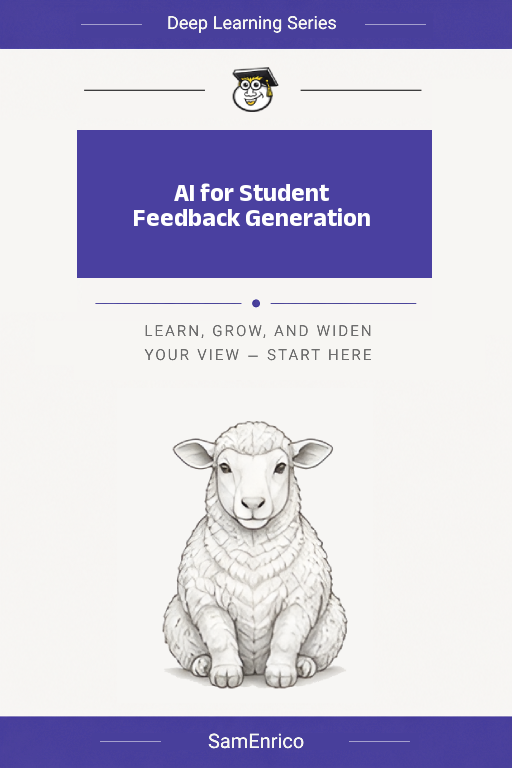
Non-FictionAI OperatorEducational Technology
AI for Student Feedback Generation eBook
Generate personalized feedback for student work, h
by Moser Jamaal
Generate personalized feedback for student work, highlighting strengths and areas for improvement.
Formats
Free sample
Chapter 1: The Sunday Night Sorrow--–- Maria Vasquez had been teaching high school English for fourteen years, and she could not remember the last time she spent a Sunday evening with her own children. The stack of 112 persuasive essays sat on her passenger seat like a guilty conscience, each page representing a student who deserved her full attention and a family dinner she had just missed for the fourth week in a row. She sat in her minivan in the school parking lot at 7:47 PM, the engine off, the November cold seeping through the windows, and she did something she had promised herself she would not do again: she wept. Seven minutes of quiet, exhausted tears, the kind that come not from a single catastrophe but from the slow accumulation of a thousand small failures—the comment she could not write, the student she could not reach, the weekend she could not reclaim.This book is for Maria. And for the math teacher who brings home 140 lab reports.
For the university professor who spends twelve hours on a single batch of freshman compositions only to see students glance at the grade and recycle the paper. For the elementary school teacher who writes "Great job!" on thirty identical worksheets and feels the emptiness of those words. For every educator who entered this profession to teach children and discovered they had become a grading machine instead.This is not a book about artificial intelligence. This is a book about teacher survival, student dignity, and the radical act of reclaiming your time without sacrificing your standards. The AI is merely the lever.
You are the engineer.The Feedback Bottleneck: A Crisis Hiding in Plain Sight Teaching has always been a profession defined by its invisible labor. The lesson plans created at midnight, the emails answered on Sunday afternoons, the careful marginalia written during lunch breaks that go uneaten. But no invisible labor weighs more heavily on teachers than the act of giving feedback. It is the single most time-consuming, emotionally draining, and pedagogically essential task in education—and it is collapsing under its own weight.Let us name the problem: the feedback bottleneck. This is the gap between the personalized, developmental feedback students need to grow and the limited time, energy, and cognitive bandwidth teachers have to provide it.
Research has consistently shown that detailed, specific, actionable feedback is one of the highest-leverage interventions in education. John Hattie's landmark meta-analysis of over 800 studies identified feedback as having an effect size of 0.73—well above the 0.40 threshold considered the "hinge point" for significant student growth. In plain language: good feedback works. It works better than reducing class size, better than school uniforms, better than most curricular reforms.But here is the dirty secret that no education conference wants to admit: teachers cannot physically provide that level of feedback at scale. A typical secondary teacher has 150 students across five classes.
If each student submits a one-page assignment weekly, that is 150 pages to read and respond to. Research on grading speed suggests that high-quality, individualized feedback takes approximately 10 to 15 minutes per student submission when done properly—including reading, analyzing, writing comments, and linking feedback to rubrics or learning objectives. Do the math. 150 students multiplied by 10 minutes equals 1,500 minutes, or 25 hours. Per assignment.
Per week.Maria in the minivan is not a failure. She is a statistic.The Cognitive Limits of Human Feedback The problem is not just time; it is cognitive capacity. Psychologists have long known that humans suffer from decision fatigue—the deterioration of decision quality after a long session of decision making. Grading is an intense cognitive activity that requires sustained attention, pattern recognition, evaluation against standards, and creative composition of responses. After the thirtieth essay, even the most dedicated teacher begins to write shorter comments, repeat the same phrases, or miss subtle errors they would have caught earlier.Worse, the very act of grading triggers a negativity bias.
Research on feedback psychology shows that humans naturally notice errors more readily than successes. Without explicit training, teachers—like all humans—default to pointing out what is wrong rather than celebrating what is right. This is not malice; it is evolution. Our brains are wired to detect threats, and a dangling modifier feels like a threat to clarity. But this bias has consequences.
Students who receive primarily corrective feedback become defensive, demotivated, and less likely to revise. They learn to associate feedback with punishment, not growth.The feedback bottleneck, then, is not merely a scheduling problem. It is a pedagogical crisis. Teachers cannot give enough feedback, cannot sustain the quality of feedback across large volumes, and cannot overcome their own cognitive biases without help. Something has to change.A Brief History of Failure: Why Automation Has Not Worked Before Before we arrive at the solution, we must understand why previous attempts to solve the feedback bottleneck have failed.
The history of automated grading is, to be charitable, a graveyard of good intentions.The Era of Scantrons and Multiple Choice The first wave of automation was simple: machines that could grade multiple-choice tests. Scantron systems, introduced in the 1970s, allowed teachers to process hundreds of bubble sheets in minutes rather than hours. For objective assessments—math facts, vocabulary quizzes, reading comprehension checks—this was a genuine breakthrough. But it solved the wrong problem. Multiple-choice tests cannot assess critical thinking, argumentation, creativity, or synthesis.
They measure recognition, not reasoning. Teachers knew this, but the efficiency gains were so seductive that multiple-choice testing expanded far beyond its appropriate domain.The Rubric Automation Era The second wave attempted to automate writing assessment using natural language processing (NLP). Companies like ETS developed systems such as e-rater, which could score essays based on surface-level features: sentence length, vocabulary diversity, grammar errors, and keyword matching. These systems were trained on thousands of human-scored essays and could produce a score in seconds. The problem?
They were easily gamed. Students learned to write long sentences with rare words and formulaic structures, producing high scores on nonsense essays. One famous experiment submitted an essay composed entirely of the phrase "the the the" rearranged in different patterns, and the system gave it a passing score. More troubling, these systems penalized creative risk-taking and non-standard dialects. A student writing in African American Vernacular English or using unconventional but effective rhetorical structures would receive lower scores not because their thinking was flawed but because their language deviated from the training data.The fundamental flaw of these early systems was that they tried to replicate what a teacher does without understanding what a teacher understands.
They looked at surface features because surface features are measurable. But teaching is about meaning, not mechanics.The Generative AI Shift: From Scoring to Understanding Everything changed in 2022 with the public release of large language models (LLMs) like Chat GPT. Unlike the pattern-matching systems of the past, LLMs do not look for keywords or count sentence lengths. They are trained to predict the next word in a sequence, but in doing so, they develop something resembling understanding. They can identify a thesis statement, evaluate whether evidence supports a claim, detect logical fallacies, and even recognize irony and tone.
They can read a student's math proof and identify exactly where the reasoning diverged from the correct path. They can…
This is the end of the free sample. Get the eBook to keep going. Buy now
About this book
Details
- Author
- Moser Jamaal
- Publisher
- SamEnrico
- Language
- English
- Genre
- Non-Fiction, AI Operator, Educational Technology
- Released
- 2026-06-01
- Pages (approx.)
- 158
- Available as
- eBook, Audiobook

Read better in the ZLOADR app
Your eBooks on your phone or tablet. Sign in with your SamEnrico account and start reading.
More by Moser Jamaal
 Attraction Nonverbal DetectionMoser Jamaal$11.99
 Post Office Window PostersMoser Jamaal$11.99
 Gacy Artistic OutputMoser Jamaal$11.99
 Social Smoking Pressure ScriptsMoser Jamaal$11.99
 The Sumo Sweethearts: A European Love Story in the DojoMoser Jamaal$11.99
 ERP Product MarketingMoser Jamaal$11.99
 Learn to Play the Slide TrumpetMoser Jamaal$11.99
 How to Start a Carpet Soap Business (Beginners Guide)Moser Jamaal$11.99
You may also like
 Hong Kong Handover 1997Dunn Johnnie$11.99
 Zumba For Postnatal Recovery CourseNeal Christian$11.99
 Zumba for BeginnersLadner Nikia$11.99
 YouTube Comment Mining GuideHumes Pandora$12.99
 Worry Box MeditationCarlin Rudy$11.99
 Workplace Stress MeditationNguyen Lynn$11.99
 Workplace Stress and Sleep RepairHawley Ivory$11.99
 Workplace Perfectionism CureDelaney Jeffry$11.99
 Workplace Injustice Anger GuideWallen Isabelle$11.99
 Work Addiction and Burnout LinkGreenwood Ester$11.99
 Women in Yoga and WellnessBeattie Galina$11.99
 Women in Stand Up ComedyChun Evangeline$11.99