
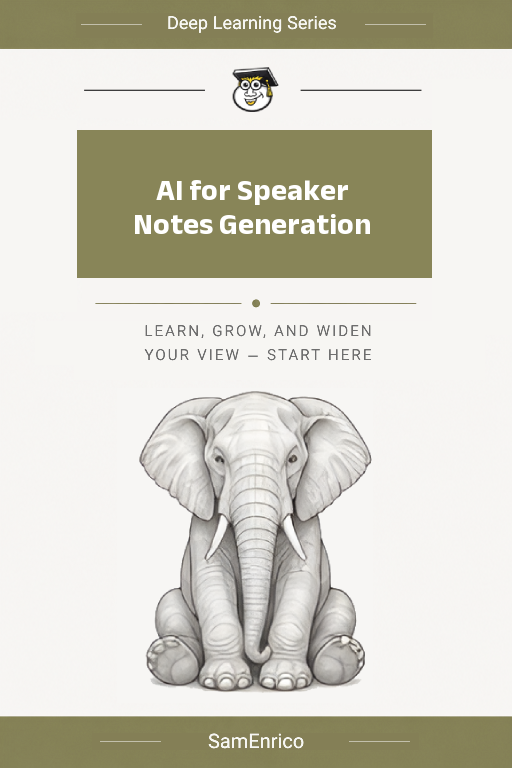
Non-FictionAI OperatorCorporate Communications
AI for Speaker Notes Generation eBook
Generate speaker notes, talking points, and delive
Generate speaker notes, talking points, and delivery tips from slide content using AI.
Formats
Free sample
Chapter 1: The Empty Slide Phenomenon--–- The CEO walked to the podium, clicked to his first slide, and began to read. "Our Q3 results reflect a strategic realignment of resources toward higher-margin opportunities." The slide behind him displayed those exact words. The audience of forty investors glanced at the screen, then at their phones, then at the exit signs. Seven minutes later, a venture capitalist in the third row whispered loud enough for the whole room to hear: "I could have read this deck on my own time." The CEO never recovered. The meeting ended early.
The round did not close.That CEO was not incompetent. He had a beautiful deck. He had data. He had a product that actually worked. What he did not have was speaker notes—real notes, designed for a human voice, designed for eye contact, designed for the messy, emotional, unpredictable act of speaking to other humans.
He had slides. And he treated those slides as his script.This book exists because that scene plays out ten thousand times every single day, in boardrooms and conference halls, in school auditoriums and sales pitches, in town halls and TEDx rehearsals. Beautiful slides. Terrible talks. And the gap between them is not content.
The gap is delivery architecture—the invisible scaffolding that turns a deck into a conversation.The Bullet Point Trap Let us name the enemy. The enemy is not Power Point, not Keynote, not Google Slides. The enemy is the assumption that because information fits on a slide, it belongs in a mouth. This is the Bullet Point Trap, and it has captured nearly every professional who has ever opened presentation software.Consider the anatomy of a typical slide. It contains a title, three to seven bullet points, perhaps a chart or an image.
The speaker stands beside the screen, facing the projection, and reads each bullet point in sequence. Sometimes they add a transitional phrase: "As you can see…" or "Moving on to our next point…" But the core activity is reading aloud what the audience can already see.Here is what happens neurologically when you read your slides. The audience’s visual cortex processes the words on the screen. Simultaneously, their auditory cortex processes the same words coming from your mouth. This redundancy triggers a phenomenon called "cognitive backlog"—the brain recognizes duplicate input and reduces attention.
Within ninety seconds, the audience stops listening to you and starts reading ahead. They are now on slide five while you are still on slide two. You have lost them.But the damage goes deeper than attention. Reading slides destroys trust. When you read, your body language announces something terrible: I did not prepare enough to speak these words without a crutch.
The audience does not consciously think this. They feel it. They feel the lack of eye contact, the hesitation between slides, the flatness of a voice that is reciting rather than conversing. They conclude, often correctly, that you do not fully own your material.The cruel irony is that slide readers are usually the people who worked hardest on their presentations. They spent hours perfecting fonts, aligning logos, choosing the exact shade of blue for the pie chart.
They treated the slide deck as the deliverable—the thing that would prove their competence. And then, in the moment that mattered most, the deck ate them alive.Why Beautiful Slides Fail Let us examine a specific case. A product manager named Sarah spent two weeks building a fifty-slide deck for a new feature launch. Her slides were gorgeous: custom illustrations, animated transitions, a consistent color palette that matched the brand guidelines. She rehearsed by clicking through the slides alone in her office, muttering the bullet points to herself.On launch day, she stood before a hundred and fifty colleagues.
The first slide appeared. She read the title. Then she realized something terrible: the bullet points on slide two were not in the order she wanted to say them. She paused. She scanned.
She found her place. The audience watched her search. By slide seven, she had lost all momentum. A senior director in the front row asked a question about slide four—a slide Sarah had already clicked past. She could not answer without clicking backward.
The room filled with the sound of forty people clicking their mice, flipping through their own copies of the deck, waiting for her to catch up.Sarah’s slides did not fail because they were ugly. They failed because they were designed for the eye—for reading, for asynchronous consumption, for the quiet solitude of a desk. They were not designed for the ear. They were not designed for a human voice moving through time, building tension, making eye contact, responding to a room.This is the fundamental insight that separates effective speakers from everyone else: Slides are visual aids for the audience. Speaker notes are performance aids for you.
They are different artifacts, serving different functions, built with different constraints. And until you treat them as separate, you will continue to read your slides and wonder why no one remembers what you said.The Three Voices Problem To understand why slides fail as scripts, we need to understand the Three Voices. Every piece of communication contains one of these voices, and confusion between them is the root of almost every bad presentation.Voice One: The Slide Voice. This is written language optimized for scanning. It uses bullet points, short phrases, incomplete sentences.
It assumes the reader can go backward, reread, skip ahead. It is logical, dense, and cold. Example: "Q3 revenue: $14.2M (+8% Yo Y). Driven by enterprise segment growth. Retention rate 94%."Voice Two: The AI Draft Voice.
This is the voice that large language models produce when asked to generate speaker notes. It is complete sentences, clear structure, logical flow. It is better than the Slide Voice for speaking, but it is still flat. It lacks rhythm, surprise, and the subtle markers of human conversation—the pauses, the repetitions, the moments of hesitation that make speech feel alive. Example: "Our Q3 revenue reached fourteen point two million dollars, which represents an eight percent increase year over year.
This growth was primarily driven by our enterprise segment, where retention rates remained strong at ninety-four percent."Voice Three: The Performed Voice. This is the voice you actually want to use on stage. It has contractions. It has sentence fragments. It has rhetorical questions, changes in pace, moments of quiet and moments of emphasis.
It sounds like a human talking to humans, not a textbook reading itself aloud. Example: "Fourteen point two million. That's the number. Up eight percent. And here's the thing—most of that came from enterprise.
Which means our bet on big clients? It's working. Ninety-four percent of them stayed with us. That's not an accident."Most speakers skip directly from Voice One (Slide Voice) to Voice Three (Performed Voice) in their heads. They look at the bullet points and try to improvise a natural performance.
This works for about thirty seconds. Then they forget a number. Then they lose their place. Then they default back to reading. The gap between Voice One and Voice Three is too…
This is the end of the free sample. Get the eBook to keep going. Buy now
About this book
Details
- Author
- Hutcherson Tresa
- Publisher
- SamEnrico
- Language
- English
- Genre
- Non-Fiction, AI Operator, Corporate Communications
- Released
- 2026-05-30
- Pages (approx.)
- 141
- Available as
- eBook, Audiobook

Read better in the ZLOADR app
Your eBooks on your phone or tablet. Sign in with your SamEnrico account and start reading.
More by Hutcherson Tresa
 SeaBee Construction VetHutcherson Tresa$11.99
 Emotion Journaling MethodHutcherson Tresa$11.99
 The Art Of Small Talk MasteryHutcherson Tresa$11.99
 Twelve Step Literature Library GuideHutcherson Tresa$11.99
 The Beirut Banker: A Victorian-Era Fraud That Changed ForensicsHutcherson Tresa$11.99
 Heavy Equipment Field MechanicHutcherson Tresa$11.99
 Learn to Play the Tenor BanjoHutcherson Tresa$11.99
 How to Become a Garment-alteration ExaminerHutcherson Tresa$11.99
You may also like
 Hong Kong Handover 1997Dunn Johnnie$11.99
 Zumba For Postnatal Recovery CourseNeal Christian$11.99
 Zumba for BeginnersLadner Nikia$11.99
 YouTube Comment Mining GuideHumes Pandora$12.99
 Worry Box MeditationCarlin Rudy$11.99
 Workplace Stress MeditationNguyen Lynn$11.99
 Workplace Stress and Sleep RepairHawley Ivory$11.99
 Workplace Perfectionism CureDelaney Jeffry$11.99
 Workplace Injustice Anger GuideWallen Isabelle$11.99
 Work Addiction and Burnout LinkGreenwood Ester$11.99
 Women in Yoga and WellnessBeattie Galina$11.99
 Women in Stand Up ComedyChun Evangeline$11.99