
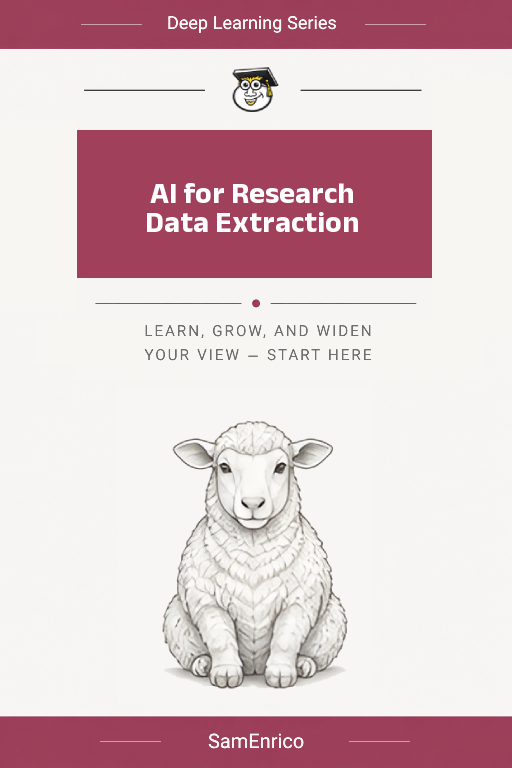
researchAI OperatorIntelligence Gathering
AI for Research Data Extraction Audiobook
Extract tables, statistics, and key data points fr
Extract tables, statistics, and key data points from research documents using AI.
Formats
Free sample
Chapter 1: The 3 AM Confession--It is 3:00 in the morning. You have forty-seven PDFs open across eight browser tabs, your citation manager claims you have “only” thirty-four more papers to code for your systematic review, and somewhere in the pile of digital debris is a single hazard ratio that could either confirm your hypothesis or send you back to square one. Your coffee cup is empty. Your cursor has been blinking at the same spot in your extraction spreadsheet for eleven minutes. Your hand hurts from copying and pasting p-values.
And in the quiet of your exhausted brain, you admit something you would never say out loud to your advisor, your co-authors, or your funding body: I cannot keep doing this.This is not a failure of your work ethic. It is not a lack of organizational skill. It is not a sign that you chose the wrong profession. What you are experiencing is the collision between the exponential growth of scientific literature and the medieval technology of manual data extraction. The system is broken, and you are not the one who broke it.Every year, more than five million scholarly articles are published.
In biomedicine alone, a new paper appears approximately every thirty seconds. For researchers conducting systematic reviews, meta-analyses, or even just ambitious literature reviews, the math becomes terrifying. If you need to extract key data from two hundred papers, and each paper takes twenty-five minutes to manually scan for tables, statistics, sample sizes, p-values, confidence intervals, and methodology descriptions, you are looking at more than eighty-three hours of pure extraction work. That is two full work weeks of nothing but hunting for numbers and copying them into spreadsheets. And that assumes you never make a mistake.But you will make mistakes.
The research on data extraction accuracy is sobering. Studies of manual systematic review extraction have found error rates between 10 and 30 percent for simple numeric data, with higher error rates for complex statistical results. A meta-analysis of data extraction studies published in the Journal of Clinical Epidemiology found that even trained extractors disagreed on basic outcomes in nearly one in five papers. When you are manually copying a p-value of 0.043 from a PDF table into a spreadsheet, your eyes can skip a decimal, transpose digits, or simply misread a blurry scan. The reproducibility crisis in science is not only about p-hacking and small sample sizes.
It is also about honest, exhausted researchers making honest transcription errors that nobody ever catches because the raw extraction sheets…
This is the end of the free sample. Get the Audiobook to keep going. Buy now
About this book
Details
- Author
- Whelan Vannesa
- Publisher
- SamEnrico
- Language
- English
- Genre
- research, AI Operator, Intelligence Gathering
- Released
- 2026-06-01
- Pages (approx.)
- 117
- Available as
- eBook, Audiobook

Listen in the VoxFlicks app
Audiobooks and audio dramas wherever you go. Sign in with your SamEnrico account and press play.
More by Whelan Vannesa
 Soviet Sniper WomanWhelan Vannesa$11.99
 NVC For Celebration GuideWhelan Vannesa$11.99
 Step Ten Daily Inventory GuideWhelan Vannesa$11.99
 Never Run Out Of Things To SayWhelan Vannesa$11.99
 Beneath the Ziggurat: The Lost Code of EnkiWhelan Vannesa$11.99
 Head of TechnologyWhelan Vannesa$11.99
 How to Start a Carburettors for Industrial Engines Business (Beginners Guide)Whelan Vannesa$11.99
 Learn to Play the BandolónWhelan Vannesa$11.99
You may also like
 Scientific Research On TM GuideMartens Nathanial$11.99
 Research Proposal Methodology Section MasteryPauley Debroah$11.99
 Research Proposal Appendix CompilationRaines Tyisha$11.99
 Academic Researcher Distraction GuideFord Virgil$11.99
 TM Research and ScienceCovert Nicki$11.99
 Social Anxiety Research ReviewRoberge Cole$11.99
 Research Proposal Significance Section GuideBock Tory$12.99
 Research Proposal Reviewer PsychologyLugo Tawanda$11.99
 Research Proposal Research Questions DesignLara Robbi$11.99
 Research Proposal References and CitationsPatten Shanice$11.99
 Research Proposal Mixed Methods DesignCameron Omega$11.99
 Research Proposal Data Management PlanAnderson Roberto$12.99