
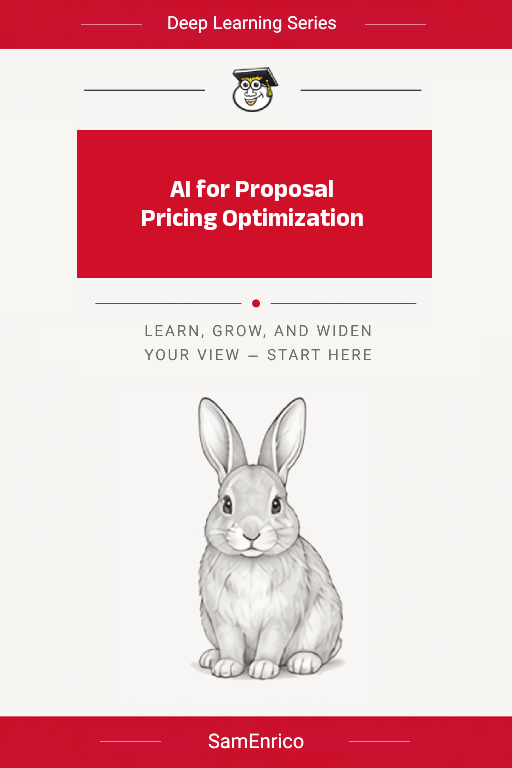
AI for Proposal Pricing Optimization eBook
Analyze past win/loss data to suggest optimal pric
by Gould Thanh
Analyze past win/loss data to suggest optimal pricing and discounting strategies for proposals.
Formats
Free sample
Chapter 1: The Post-Mortem Crisis--Every company has a graveyard. It is quiet, digital, and buried inside your CRM. The “Lost” folder contains thousands of deals that died for reasons no one can quite remember. The sales rep who lost them has moved on, or their memory has conveniently softened. The official reason—“price”—is logged in a dropdown menu, but no one believes it.
And the worst part? You keep making the same mistakes because you never bothered to perform an autopsy.This book exists because of a simple, brutal truth: you are probably losing deals for the wrong reasons, and discounting is not the solution. In fact, discounting may be the slowest form of corporate suicide—death by a thousand small cuts to your margin, each one justified by urgency, fear, or laziness.But there is good news buried in that graveyard. Every lost deal is a tuition payment. Every “no” contains the exact instructions for turning future “nos” into “yeses.” The problem is that most companies refuse to read the manual sitting in their own databases.
They collect data obsessively. They analyze almost nothing. And then they wonder why their pricing strategy feels like throwing darts in the dark.This chapter is the autopsy. It will show you why winning hides fatal flaws, why “price” is almost always a lie, and how a closed-loop system powered by AI can turn your past failures into your greatest competitive advantage.The Seduction of the “Won” Folder Let us start with a dangerous illusion: the belief that winning means you did something right.It feels obvious, does it not? You won the deal.
The customer signed the contract. The revenue is booked. Everyone celebrates. But here is the uncomfortable truth that most sales leaders refuse to acknowledge: you can win for the wrong reasons. A customer can buy from you despite your pricing strategy, not because of it.
They can choose you because your competitor self-destructed, because a procurement officer was lazy, because the timing happened to favor you, or because a decision-maker liked your salesperson’s joke during a golf outing.None of these reasons are repeatable. None of them are scalable. And worst of all, they hide the flaws that will eventually kill you.Consider a hypothetical but all-too-common scenario. A B2B software company wins a 500,000deal.Thesalesrepgaveanunauthorized15500,000 deal. The sales rep gave an unauthorized 15% discount at the last minute to close before quarter end.
The deal is marked “Won.” The rep gets a commission check. The VP of Sales praises the rep for “getting it done.” But what really happened? The company left 500,000deal.Thesalesrepgaveanunauthorized1575,000 on the table. Worse, they taught the customer that asking for a discount works. Worse still, they created an internal culture where discounting is rewarded.
And most dangerous of all, no one will ever question the discount because the deal is marked “Won.”The “Won” folder is a graveyard of bad habits disguised as success stories. Every unprofitable win, every unnecessary discount, every deal closed despite a flawed pricing strategy—they all sit in that folder, smiling at you, daring you to ask questions. And because no one asks questions, the bad habits become standard operating procedure.This is what the author calls The Post-Mortem Crisis: organizations that refuse to examine their corpses because they are too busy celebrating their survivors. The result is a slow, steady erosion of margin masked by top-line growth.The “Price” Scapegoat If the “Won” folder hides your flaws, the “Lost” folder hides your answers. But to find those answers, you must first get past the single most useless word in sales: price.Ask any sales rep why they lost a deal, and 80% of the time they will say “price.” The customer said we were too expensive.
The competitor came in lower. Procurement squeezed us. On the surface, these explanations seem plausible. Customers are price-sensitive. Budgets are real.
Competitors do undercut you.But here is what the data from thousands of win/loss analyses actually shows: price is the stated reason for loss in the majority of cases, but the actual reason in only a minority.Why the gap? Because “price” is easy. It is safe. It shifts blame away from the salesperson, the product, the proposal, or the company. A sales rep who says “we lost on price” is saying, “It wasn’t my fault.
The customer was cheap. There was nothing I could do.” This is comforting. It is also almost always wrong.What lurks beneath “price” is a much messier, more actionable set of truths. Here is what customers are actually saying when they say “you were too expensive”:Risk aversion: “We don’t trust that your solution will work, so we are not willing to pay a premium for uncertainty.”Value articulation failure: “We do not understand how your solution will save us money or make us money, so we are defaulting to the cheapest option.”Timing misalignment: “We are not ready to buy at this moment, and ‘too expensive’ is a polite way to say ‘not now.’”Feature gap: “You are missing a capability that the competitor has, so we are discounting your price to compensate for the gap.”Relationship deficit: “We do not like or trust your team enough to pay full price.”Power move: “We say you are expensive to see if you will flinch and give us a better deal.”Notice that not one of these underlying reasons is solved by dropping your price. In fact, dropping price can make several of them worse.
If a customer is worried about risk, a lower price signals lower quality. If a customer is not ready to buy, a discount just trains them to wait for the next discount. If there is a feature gap, a discount does not close the gap—it just makes you the cheaper, inferior option.The author has worked with dozens of companies across software, manufacturing, professional services, and healthcare. In every single case, when they conducted proper win/loss interviews (which you will learn in Chapter 3), the percentage of deals truly lost on price dropped from the perceived 80% to an actual 15–25%. The rest were lost on value, trust, timing, relationships, or competence.This is not just an academic distinction.
It is millions of dollars in margin walking out the door because you are discounting the wrong problem.The Closed-Loop System: An Introduction If the problem is clear—companies ignore their loss data, misdiagnose their failures, and discount reflexively—then the solution must be systematic. That solution is what this book calls the Closed-Loop System.A Closed-Loop System is a framework where historical win/loss data feeds an AI model that predicts optimal pricing for future proposals, and then the outcomes of those proposals feed back into the model to make it smarter. It is called “closed-loop” because every outcome—win or loss—becomes an input for the next decision. The system learns continuously. It never stops improving.Here is how it works at a high level:Collect Data: You conduct deep win/loss interviews (Chapter 3) and deploy lightweight win/loss surveys (Chapter 11).
Every deal, won or lost, generates structured and unstructured data.Structure the Narrative: You tag that data with a standardized taxonomy…
This is the end of the free sample. Get the eBook to keep going. Buy now
About this book
Details
- Author
- Gould Thanh
- Publisher
- SamEnrico
- Language
- English
- Genre
- Non-Fiction, AI Operator, Revenue Operations
- Released
- 2026-05-26
- Pages (approx.)
- 140
- Available as
- eBook, Audiobook

Read better in the ZLOADR app
Your eBooks on your phone or tablet. Sign in with your SamEnrico account and start reading.
More by Gould Thanh
 Proxemics Personal Space CourseGould Thanh$11.99
 Small Talk for Deep IntrovertsGould Thanh$11.99
 The Network Effect Growth GuideGould Thanh$11.99
 Listening For Hidden EmotionsGould Thanh$11.99
 The Angel of the Andes: How a Nurse Defied War and DeathGould Thanh$11.99
 Donor Services RepresentativeGould Thanh$11.99
 Learn to Play the C Melody SaxophoneGould Thanh$11.99
 How to Start a Cargo Handling for Air Transport Business (Beginners Guide)Gould Thanh$11.99
You may also like
 AI Sales Script GeneratorRau Melvina$12.99
 AI Sales Email PersonalizationPartridge Dennis$12.99
 AI Proposal Generation TemplatesBowens Humberto$12.99
 AI for Sales Training MaterialsPayton Gillian$12.99
 AI for Sales Presentation DecksMattson Rina$12.99
 AI for Sales Battle CardsRitter Therese$12.99
 AI for RFP Response AutomationCantwell Michaele$12.99
 AI Customer Case Study GenerationChurchill Zora$12.99
 AI Sales Enablement and Proposal GuideWhitaker Larita$12.99