
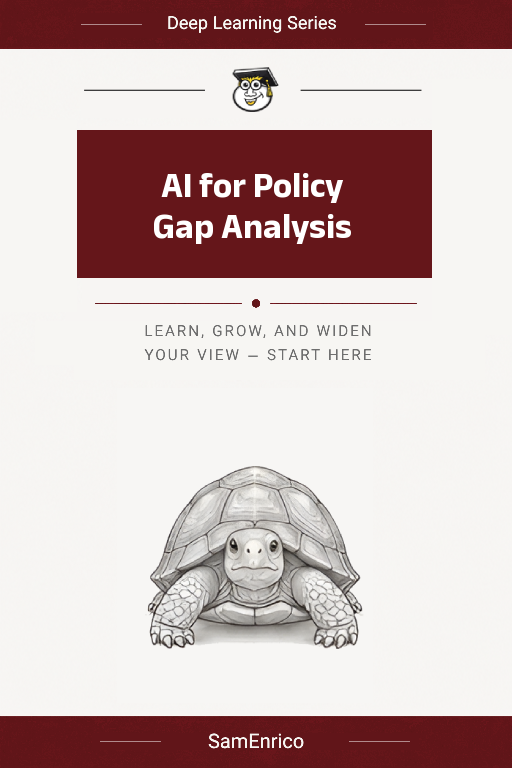
Non-FictionAI OperatorRegulatory Tech
AI for Policy Gap Analysis eBook
Identify gaps between your compliance policies and
Identify gaps between your compliance policies and regulatory requirements using AI.
Formats
Free sample
Chapter 1: The Hidden Gap--–- On a humid Tuesday morning in July 2023, a compliance officer named Sarah Chen walked into her office at a regional bank in Chicago, made a cup of coffee, and opened an email that would end her career.The email was from the Office of the Comptroller of the Currency. It was 847 pages long. Sarah scrolled past the boilerplate legal language to page twelve, where a single paragraph informed her that the bank had been assessed a $47 million civil money penalty. The violation: failure to maintain an effective anti-money laundering program. The specific gap: the bank's internal transaction monitoring policy had not been updated to reflect a regulatory change that had taken effect fourteen months earlier.Sarah had been the bank's Chief Compliance Officer for six years.
She had built the compliance department from three people to twenty-seven. She had passed every internal audit, every external examination, every third-party risk assessment. She had done everything right. And now she was personally named in the enforcement action, facing a $250,000 fine of her own money and a potential prohibition from working in banking ever again.The worst part? Sarah's team had performed a manual gap analysis eighteen months before the fine.
They had reviewed every regulation, compared it against every policy, documented every finding. The analysis had taken 2,200 person-hours and cost the bank $1.8 million. It was, by every measure of traditional compliance, a thorough and professional job. But the regulatory change that would eventually sink the bank had been published four months after Sarah's team finished their analysis. By the time the new rule took effect, her team was already working on the next year's priorities.
The gap opened silently, invisibly, and with catastrophic consequences.Sarah's story is not an outlier. It is not a cautionary tale about incompetence or negligence. It is the inevitable outcome of a system that has become structurally impossible to operate.The Billion-Dollar Blind Spot Since the 2008 financial crisis, global corporations have accumulated over $300 billion in regulatory fines. Not fines for fraud, embezzlement, or malicious misconduct. Fines for policy gaps—invisible disconnects between what a company's internal rules say and what external regulators require.
These fines have been paid by banks, technology companies, healthcare providers, manufacturers, and every other industry subject to regulation. They have been paid in the United States, the European Union, China, Singapore, and dozens of other jurisdictions. And they have been accelerating every year.In 2010, global regulatory fines totaled approximately 12billion.By2020,thatnumberhadgrownto12 billion. By 2020, that number had grown to 12billion.By2020,thatnumberhadgrownto86 billion. In 2025, based on current enforcement trends and the wave of new AI-specific regulations coming into effect, industry analysts project fines will exceed $150 billion for the first time.
This is not because companies are becoming more reckless. It is because the gap between policy and regulation is growing faster than any human team can possibly close.Consider the raw mathematics. A single compliance officer, working at peak efficiency, can read approximately 200 words per minute. That is 12,000 words per hour, 96,000 words per eight-hour day, roughly 24 million words per year. That sounds impressive until you compare it to the regulatory output of just three major jurisdictions: the United States federal register publishes approximately 80,000 new or amended rules annually, totaling roughly 200 million words.
The European Union's official journal publishes approximately 150,000 pages of new legislation per year. China's National People's Congress and its subordinate agencies issue tens of thousands of regulatory documents annually.In other words, one compliance officer working full-time, reading at maximum speed, with no breaks, no meetings, no emails, and no other responsibilities, cannot read even a fraction of the regulations published in a single year by a single jurisdiction. And that is just reading—not understanding, not analyzing, not comparing against internal policies, not documenting gaps, not implementing fixes.The problem is not that compliance professionals are slow or unskilled. The problem is that the regulatory universe has expanded exponentially while human cognitive throughput has remained constant. A compliance team that was adequately staffed in 2010 to monitor regulatory changes is now understaffed by a factor of ten.
A manual gap analysis that was thorough in 2015 is now obsolete before it is printed.The Speed of Regulation To understand why gap analysis has become impossible, we need to understand how regulation has changed. Thirty years ago, regulation moved slowly. A new law might take years to draft, months to debate, and weeks to publish. Companies had time to respond. Compliance departments could read new regulations, compare them against internal policies, identify gaps, and implement changes before the effective date.That world no longer exists.Regulation now moves at digital speed.
Regulators use AI to draft rules. They publish updates in real time. They issue guidance documents, interpretive letters, and enforcement actions that carry the force of law without the traditional legislative process. The result is a constant, accelerating stream of regulatory change that never pauses and never slows.The numbers are staggering. In 2024 alone, global regulatory bodies issued over 60,000 changes to existing rules.
That averages more than 160 changes per day, including weekends and holidays. These changes range from minor clarifications (changing a single word in a definition) to major overhauls (rewriting entire sections of the financial code). Each change potentially creates a gap with some internal policy somewhere in some company. And each gap, if undetected and unclosed, is a future fine waiting to happen.Consider a concrete example. In 2022, the Securities and Exchange Commission proposed a rule requiring public companies to disclose certain climate-related risks.
The proposed rule was 506 pages long. It referenced 17 existing regulations, 8 international standards, and 3 pending legislative actions. It used 47 defined terms, 12 of which were new or modified definitions not used elsewhere in the SEC rulebook. And it had a comment period of only 60 days—not nearly enough time for even the most well-resourced compliance department to fully analyze the implications.The final rule, when it was adopted in 2024, had changed substantially from the proposal. More than 200 pages had been added.
Thirty-one existing regulations were now implicated instead of 17. Fourteen defined terms had changed again. Any company that had based its gap analysis on the proposed rule was now operating on outdated information. Any company that had waited for the final rule was now racing against an effective date that was only 90 days away.This is the new normal. Regulation moves faster than human analysis.
Manual gap analysis, once a best practice, is now a liability.The AI Paradox Here is where the story gets even more troubling. The same companies that cannot keep up with regulatory change are simultaneously rushing to deploy artificial intelligence across their operations. According to EY's 2025 Global Compliance Survey, 75% of enterprises now use Generative AI in some capacity. These same companies are using AI to write code, generate marketing copy, summarize documents, and assist with customer service. They are using AI everywhere except where they need it most.Only 33% of enterprises have implemented specific controls for regulatory alignment of their AI systems.
And only 12% have deployed AI to assist with compliance monitoring. The vast majority of compliance departments are still using manual processes—spreadsheets, email chains, shared drives, and human memory—to track regulatory changes and identify policy gaps.…
This is the end of the free sample. Get the eBook to keep going. Buy now
About this book
Details
- Author
- Dyson Kristeen
- Publisher
- SamEnrico
- Language
- English
- Genre
- Non-Fiction, AI Operator, Regulatory Tech
- Released
- 2026-05-30
- Pages (approx.)
- 149
- Available as
- eBook, Audiobook

Read better in the ZLOADR app
Your eBooks on your phone or tablet. Sign in with your SamEnrico account and start reading.
More by Dyson Kristeen
 Teen Self Worth After FailureDyson Kristeen$11.99
 NVC In Prison ProgramsDyson Kristeen$11.99
 Canva Brand Identity for RoofersDyson Kristeen$11.99
 Finding the Right SponsorDyson Kristeen$11.99
 How to Start a Cleansing Tissues Business (Beginners Guide)Dyson Kristeen$11.99
 Learn to Play the YotarDyson Kristeen$11.99
 Guestroom Attendant Self InspectorDyson Kristeen$11.99
You may also like
 Hong Kong Handover 1997Dunn Johnnie$11.99
 Zumba For Postnatal Recovery CourseNeal Christian$11.99
 Zumba for BeginnersLadner Nikia$11.99
 YouTube Comment Mining GuideHumes Pandora$12.99
 Worry Box MeditationCarlin Rudy$11.99
 Workplace Stress MeditationNguyen Lynn$11.99
 Workplace Stress and Sleep RepairHawley Ivory$11.99
 Workplace Perfectionism CureDelaney Jeffry$11.99
 Workplace Injustice Anger GuideWallen Isabelle$11.99
 Work Addiction and Burnout LinkGreenwood Ester$11.99
 Women in Yoga and WellnessBeattie Galina$11.99
 Women in Stand Up ComedyChun Evangeline$11.99