
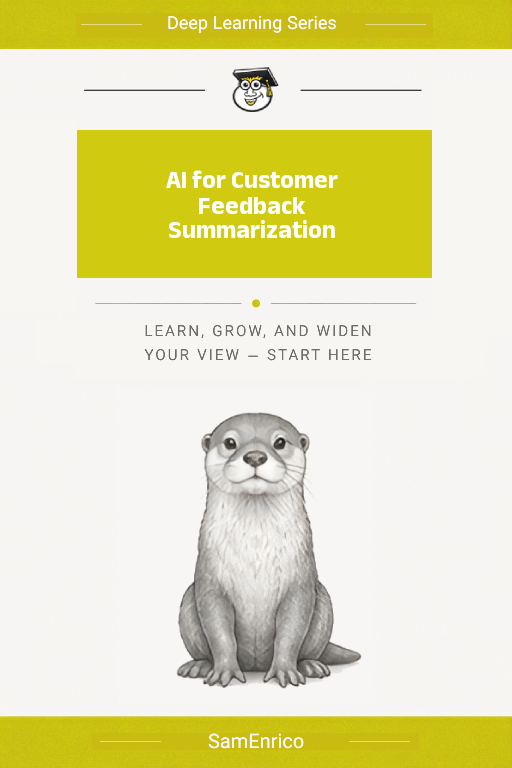
Non-FictionAI OperatorConsumer Insights
AI for Customer Feedback Summarization eBook
Summarize customer feedback from surveys into key
by Good Izola
Summarize customer feedback from surveys into key takeaways and action items using AI.
Formats
Free sample
Chapter 1: The Feedback Graveyard--–- Every business is sitting on a graveyard. It is not filled with failed products or bankrupt divisions. It is filled with buried customer voices—thousands of survey responses, support tickets, and social media comments that were collected with good intentions and then abandoned. Companies spend millions each year asking customers for feedback. They send post-interaction surveys, Net Promoter Score questionnaires, and follow-up emails.
Customers oblige. They type out thoughtful paragraphs about what is broken, what delights them, and what they desperately need. And then nothing happens.The feedback lands in a spreadsheet, a database, or a Saa S tool dashboard. A marketing analyst spends three hours skimming the first two hundred responses, pulls out a few quotable lines for a presentation, and the rest sinks into the archive. That is the feedback graveyard.
It is quiet, well-organized, and utterly wasteful.This chapter is about why that graveyard exists, why traditional methods of analyzing customer feedback fail, and how a fundamental shift in thinking—powered by artificial intelligence—can resurrect those buried voices. More importantly, this chapter will convince you that summarization is not just a convenience. It is a business imperative.The Paradox of More Data, Less Understanding Let us start with a simple question: If you collected twice as much customer feedback next quarter, would you understand your customers twice as well? The instinctive answer is yes. More data should mean more clarity.
But in practice, the opposite happens. Every additional survey response, every extra support ticket, and every new social media mention adds to the noise. The ratio of signal to noise does not improve with volume. It degrades.Consider a typical mid-sized Saa S company. It sends out a customer satisfaction survey after every support interaction, approximately 5,000 surveys per month.
The average response rate is fifteen percent, yielding 750 completed surveys. Each open-ended response averages thirty words. That is 22,500 words of qualitative feedback every month, or roughly the length of a short novel. Add in app store reviews, social media mentions, and chatbot transcripts, and the total easily exceeds 50,000 words per month.A single human can read about 200 words per minute. To process 50,000 words, that human needs just over four hours of pure reading time—no analysis, no cross-referencing, no prioritization.
To actually extract insights, categorize themes, and identify action items, multiply that by a factor of five or ten. Most organizations do not have that kind of time. So they do what humans naturally do when overwhelmed: they sample.The marketing manager reads the first fifty responses. The product manager reads the ones that mention a specific feature they own. The customer success lead reads the angry ones.
Each person walks away with a different, incomplete picture. Decisions are made based on fragments. And the rest of the feedback—the 95 percent that did not get read—stays buried.This is not a failure of effort. It is a failure of method. Traditional feedback analysis was designed for a world where feedback was scarce.
That world no longer exists.The Illusion of Manual Analysis Many organizations still rely on manual analysis for their open-ended feedback. A junior analyst or an intern is handed a spreadsheet with thousands of rows and asked to "find themes." The process is straightforward but deeply flawed. The analyst reads each comment, assigns a category (pricing, usability, feature request, bug, etc.), and perhaps notes the sentiment. After several days of mind-numbing work, they produce a bar chart of the top five categories and a few memorable quotes.On the surface, this seems reasonable. But the flaws are systemic and severe.First, manual analysis does not scale.
A hundred responses take an hour. A thousand responses take a day. Ten thousand responses take weeks. By the time the analysis is complete, the customer landscape has changed. Product updates have shipped.
Pricing has adjusted. Competitors have launched new features. The analysis is a historical document, not a decision-making tool.Second, manual analysis is biased. Humans are pattern-seeking creatures, but we are also exhaustion-prone. The first two hundred responses get careful attention.
The next two hundred get cursory glances. By the end of the file, the analyst is scanning for keywords rather than reading for meaning. This introduces systematic bias: early responses, recent responses, and emotionally charged responses all receive disproportionate weight.Third, manual analysis cannot handle nuance. A customer might say, "I love the new dashboard, but the loading time is killing me." A human analyst has to choose: positive or negative? Feature request or bug report?
The forced choice strips away the complexity. Real feedback is rarely one thing. It is layered, contradictory, and context-dependent.Fourth, manual analysis is slow. The gap between collecting feedback and acting on it can stretch from weeks to months. By the time a problem is identified, dozens more customers have experienced it.
The opportunity for proactive intervention has passed. You are no longer solving problems. You are writing postmortems.These limitations are not solved by hiring more analysts or buying better spreadsheet software. They are solved by changing the analytical medium from human cognition to machine learning.The Signal Versus Noise Problem Information theory offers a useful framework for thinking about feedback. Every piece of customer feedback contains both signal (useful, actionable insight) and noise (irrelevant or redundant content).
The goal of analysis is to maximize signal extraction while minimizing noise.Manual analysis accomplishes this by brute force: read everything, remember what matters, and discard the rest. But human memory and attention are limited. The signal-to-noise ratio of raw feedback is typically very low. A single survey response might contain one sentence of actionable insight buried in two paragraphs of context, politeness, and digression. Extracting that sentence requires reading the entire response.
That is inefficient, but it is possible for a few hundred responses. For a few thousand, it becomes impossible.AI approaches the problem differently. Instead of reading every word linearly, AI models learn to identify patterns of signal across thousands of examples. They do not get tired. They do not skip the second half of the file.
They do not favor early responses over late ones. They process every word of every response with the same consistent attention.More importantly, AI can aggregate signal across responses in ways that humans cannot. A human analyst might notice that ten different customers mentioned slow loading times. But those ten comments are embedded in hundreds of other comments. By the time the analyst has finished reading, the individual examples have blurred together.
The AI, by contrast, can simultaneously hold all ten comments in memory, cluster them by semantic similarity, and report them as a unified theme.This is not about replacing human judgment. It is about augmenting human pattern recognition. The AI finds the signal. The human decides what to do with it.Why Summarization Changes Everything Most discussions of AI in customer feedback focus on sentiment analysis. Is this comment positive or negative?
That is useful but shallow. Knowing that a customer is unhappy does not tell you why they are unhappy or what to do about it. Sentiment is a thermometer. Summarization is a diagnostic report.Automatic summarization transforms a collection of raw feedback…
This is the end of the free sample. Get the eBook to keep going. Buy now
About this book
Details
- Author
- Good Izola
- Publisher
- SamEnrico
- Language
- English
- Genre
- Non-Fiction, AI Operator, Consumer Insights
- Released
- 2026-05-29
- Pages (approx.)
- 157
- Available as
- eBook, Audiobook

Read better in the ZLOADR app
Your eBooks on your phone or tablet. Sign in with your SamEnrico account and start reading.
More by Good Izola
 Step Seven Humility PrayerGood Izola$11.99
 Anger Management EQ CourseGood Izola$11.99
 Canva Brand Identity for SnapchatGood Izola$11.99
 Teen Friendship Self EsteemGood Izola$11.99
 The Asura's Last Stand: Ravana's Forgotten LamentGood Izola$11.99
 Learn to Play the BerimbauGood Izola$11.99
 High-Signal Content CreationGood Izola$11.99
 How to Become a Garment FitterGood Izola$11.99
You may also like
 Hong Kong Handover 1997Dunn Johnnie$11.99
 Zumba For Postnatal Recovery CourseNeal Christian$11.99
 Zumba for BeginnersLadner Nikia$11.99
 YouTube Comment Mining GuideHumes Pandora$12.99
 Worry Box MeditationCarlin Rudy$11.99
 Workplace Stress MeditationNguyen Lynn$11.99
 Workplace Stress and Sleep RepairHawley Ivory$11.99
 Workplace Perfectionism CureDelaney Jeffry$11.99
 Workplace Injustice Anger GuideWallen Isabelle$11.99
 Work Addiction and Burnout LinkGreenwood Ester$11.99
 Women in Yoga and WellnessBeattie Galina$11.99
 Women in Stand Up ComedyChun Evangeline$11.99