
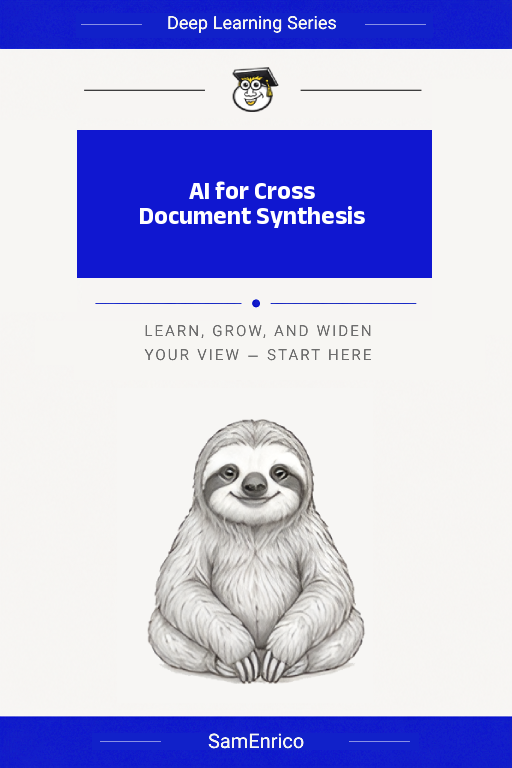
Non-FictionAI OperatorIntelligence Gathering
AI for Cross Document Synthesis
Synthesize findings across multiple research docum
Synthesize findings across multiple research documents. Identify common themes and conflicting evidence.
Formats
About this book
Free sample
Chapter 1: The 47-Tab Nightmare--–- The email arrived at 11:47 PM on a Sunday. “Can you summarize the state of AI-powered literature synthesis by Tuesday? Need to know where the field stands—agreements, disagreements, and where we should invest. Attached are 47 PDFs.”Your cursor blinked on a blank document. Forty-seven PDFs.
Thirty-one open browser tabs. A spreadsheet you started three hours ago that now has seventeen columns and no clear logic. And somewhere in that digital landfill, buried across six different folders, was the one paper you vaguely remember reading last month that directly contradicted everything you were about to write.This is not a failure of effort. It is a failure of method.The problem you are facing has a name, though few researchers speak it aloud. It is called fragmentation blindness: the systematic inability to see patterns, contradictions, and gaps when information is scattered across multiple sources.
You are not alone. Every week, thousands of researchers, analysts, and knowledge workers sit down to synthesize ten, twenty, or fifty documents. And every week, most of them produce something that is either dangerously incomplete or confidently wrong.This chapter is about why that happens. More importantly, it is about why the default human approach to synthesis—reading linearly, memorizing claims, and hoping connections emerge—is fundamentally broken when scaled beyond three to five documents. And it introduces the framework that will guide everything else in this book: the Chain of Abstraction.But first, let us name the enemy.The Hidden Cognitive Cost of Context Switching In the 1990s, a group of cognitive psychologists at the University of Michigan conducted a now-famous experiment.
They asked participants to perform two simple tasks: sorting shapes by color and sorting shapes by shape. When participants did these tasks one after the other, they were fast and accurate. When the researchers forced them to switch back and forth—color, shape, color, shape—performance plummeted. The researchers called this the “switch cost.” Every time the brain shifts from one mental model to another, it loses time, accuracy, and working memory.That study involved two tasks. You have forty-seven documents.Every time…
This is the end of the free sample. Get the eBook to keep going. Buy now
Contents
- Chapter 1
- Chapter 2
- Chapter 3
- Chapter 4
- Chapter 5
- Chapter 6
- Chapter 7
- Chapter 8
- Chapter 9
- Chapter 10
- Chapter 11
- Chapter 12
Details
- Author
- Littlefield Linnie
- Publisher
- SamEnrico
- Language
- English
- Genre
- Non-Fiction, AI Operator, Intelligence Gathering
- Released
- 2026-05-30
- Pages (approx.)
- 132
- Available as
- eBook, Audiobook

Read better in the ZLOADR app
Your eBooks on your phone or tablet. Sign in with your SamEnrico account and start reading.
More by Littlefield Linnie
 NVC For Boundary SettingLittlefield Linnie$11.99
 Canva Brand Identity for Dance StudiosLittlefield Linnie$11.99
 Teen Perfectionism Recovery PlanLittlefield Linnie$11.99
 Step Three Decision WorkbookLittlefield Linnie$11.99
 The Velvet Crown: How Black Composers Shaped European AristocracyLittlefield Linnie$11.99
 Learn to Play the AutoharpLittlefield Linnie$11.99
 How to Start a Card Embossing Business (Beginners Guide)Littlefield Linnie$11.99
 Head of ITLittlefield Linnie$11.99
You may also like
 Hong Kong Handover 1997Dunn Johnnie$11.99
 Zumba For Postnatal Recovery CourseNeal Christian$11.99
 Zumba for BeginnersLadner Nikia$11.99
 YouTube Comment Mining GuideHumes Pandora$12.99
 Worry Box MeditationCarlin Rudy$11.99
 Workplace Stress MeditationNguyen Lynn$11.99
 Workplace Stress and Sleep RepairHawley Ivory$11.99
 Workplace Perfectionism CureDelaney Jeffry$11.99
 Workplace Injustice Anger GuideWallen Isabelle$11.99
 Work Addiction and Burnout LinkGreenwood Ester$11.99
 Women in Yoga and WellnessBeattie Galina$11.99
 Women in Stand Up ComedyChun Evangeline$11.99