
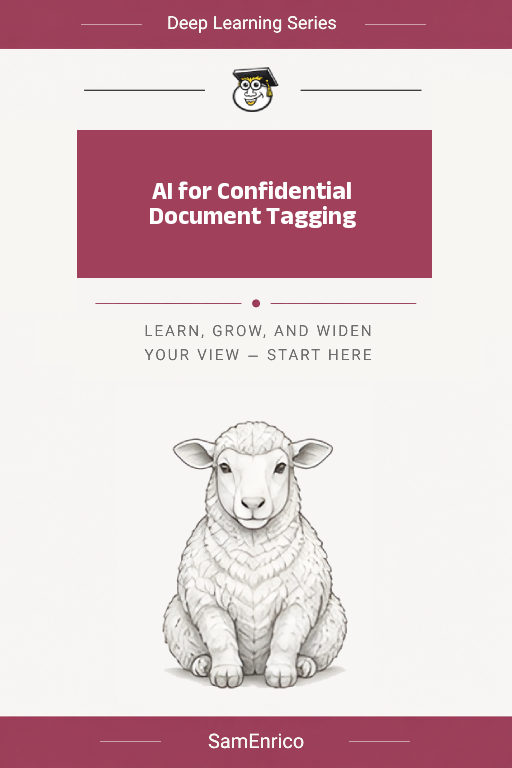
AI for Confidential Document Tagging
Tag confidential, internal, and public documents u
by Babb Liliana
Tag confidential, internal, and public documents using AI classification models.
Formats
About this book
Free sample
Chapter 1: The Silent Tsunami–- On a Tuesday morning in March 2023, the chief information security officer of a mid-sized healthcare technology firm watched her inbox fill with forty-seven breach notification emails in under eleven minutes. An employee had uploaded a spreadsheet containing 14,000 patient records—including diagnoses, social security numbers, and treatment plans—to a vendor portal she had mistakenly labeled as "Public" two years earlier. The spreadsheet had been downloaded 2,300 times before anyone noticed. The company's cyber liability insurance carrier would later deny coverage, citing "failure to maintain adequate data classification controls" as a willful negligence exclusion. The CISO was terminated on Friday afternoon.
By Monday, the company's stock had dropped 19 percent.This is not an outlier. It is not a cautionary tale about unusual incompetence or uniquely bad luck. It is the statistical norm dressed in the clothes of a scandal. The Ponemon Institute estimates that 63 percent of data breaches originate from internal misclassification or mishandling of documents—not from sophisticated external hacking rings, not from zero-day exploits, but from ordinary employees putting the wrong file in the wrong folder or clicking the wrong sharing permission. The average cost of such a breach now exceeds 4.45million,andthatnumberrisesto4.45 million, and that number rises to 4.45million,andthatnumberrisesto5.4 million when healthcare or financial data is involved.
More than half of those costs come from detection, escalation, and post-breach response—the frantic hours and days spent trying to figure out what was leaked, who saw it, and whether regulators need to be notified.The problem hiding in plain sight is this: organizations have no reliable way to know what their own data is.They know how many petabytes they store. They know their cloud storage bills. They know, in the aggregate, that they have "a lot" of documents. But ask a CISO how many confidential documents actually reside on their public-facing Share Point site, and you will receive either a wild guess or a confession. Ask a compliance officer which internal memos contain forward-looking statements that should not have been shared externally, and they will hand you a policy document, not a dataset.
The gap between what organizations know they should know and what they actually know about their own information is the…
This is the end of the free sample. Get the eBook to keep going. Buy now
Contents
- Chapter 1
- Chapter 2
- Chapter 3
- Chapter 4
- Chapter 5
- Chapter 6
- Chapter 7
- Chapter 8
- Chapter 9
- Chapter 10
- Chapter 11
- Chapter 12
Details
- Author
- Babb Liliana
- Publisher
- SamEnrico
- Language
- English
- Genre
- Non-Fiction, AI Operator, Information Governance
- Released
- 2026-05-29
- Pages (approx.)
- 153
- Available as
- eBook, Audiobook

Read better in the ZLOADR app
Your eBooks on your phone or tablet. Sign in with your SamEnrico account and start reading.
More by Babb Liliana
 Emotional Intelligence AssessmentBabb Liliana$11.99
 Gurkha Khukuri FighterBabb Liliana$11.99Emotional Intelligence AssessmentBabb Liliana$11.99
 Stress Digestion Connection CourseBabb Liliana$11.99
 Step Two Sanity DefinitionBabb Liliana$11.99
 The Hollow King’s Curse: Enki’s Forgotten ProphecyBabb Liliana$11.99
 Learn to Play the CharangoBabb Liliana$11.99
 Hunting Team LeadBabb Liliana$11.99
 How to Become a Lining-machine OperatorBabb Liliana$11.99
You may also like
 AI for Records Retention SchedulingWelsh Suzette$12.99
 AI for Records Management WorkflowHoffmann Bradly$12.99
 AI for Email ClassificationMarroquin Mai$12.99
 AI for PII Detection and ClassificationMast Dacia$12.99
 AI for Contract ClassificationUpton Nell$12.99
 AI Document Classification GuideSadler Antone$12.99
 AI for Legal Document ClassificationMontero Racheal$12.99
 AI for HR Document ClassificationDennison Donovan$12.99
 AI for Invoice ClassificationEaton Neoma$12.99