
Non-FictionAI OperatorIntelligence GatheringInformative
AI for Competitive Intelligence eBook
Summarize competitor reports, earnings calls, and
A Coursebook on AI for Competitive Intelligence
Formats
Free sample
Chapter 1: The $2 Billion Blindspot...--It was 10:47 AM on a Tuesday when the CEO of a mid-sized logistics company learned that his largest competitor had just signed an exclusive agreement with a national retail chain. The deal closed at 9:00 AM. The competitor's earnings call, where the CEO had hinted at "a major partnership in the final stages," had taken place eleven days earlier. His own competitive intelligence team had flagged the call as "routine." They had summarized the transcript in four pages. The word "partnership" appeared exactly once, buried on page twelve of the original document.
No one had connected it to the retail chain. No one had asked the AI to look for it because they didn't have an AI. They had a spreadsheet and a hope.By the time the CEO picked up the phone to call his head of strategy, the competitor had already captured seven percent of the market segment his company had been targeting for eighteen months. The board meeting the following week lasted four hours. Two hours were spent discussing what had happened.
The other two hours were spent discussing who would be fired. The competitive intelligence director was gone by Friday. So was the VP of strategy. The CEO survived, but only because he had founded the company. His equity was now worth forty percent less than it had been before that Tuesday morning.This is not a hypothetical scenario.
The company was called Newgistics. The competitor was called Ship Monk. The year was 2023. And the problem was not that the information didn't exist. The problem was that the information existed in the wrong form—trapped inside a thirty-seven-page earnings transcript, embedded in careful, lawyer-approved language, surrounded by two pages of boilerplate risk factors and three pages of financial tables that no human had time to read carefully.
The information was public. It was legally obtained. It was completely useless because no one had the tools to find it before it mattered.This book is about making sure that never happens to you.--The Traditional CI Model Is Broken Let me be precise about what I mean when I say traditional competitive intelligence is broken. I am not saying it is ineffective in an absolute sense. For the past thirty years, the core CI workflow—gather documents, read documents, summarize documents, distribute summaries—has been the standard practice at thousands of companies.
It produced value. It helped executives make better decisions. It paid for itself many times over. But that era is ending for one simple reason: the volume of information has grown faster than the number of humans available to process it, and the gap is now so large that no amount of hard work or late nights can close it.Consider the math. In 2005, a typical public company produced four earnings calls per year, two 10-K filings, four 10-Q filings, and perhaps a dozen press releases.
That was roughly twenty to thirty documents annually. A CI analyst responsible for ten competitors was looking at two hundred to three hundred documents per year. That was manageable. A dedicated analyst could read every word, highlight every meaningful signal, and produce a quarterly briefing that captured ninety percent of what mattered.Today, that same company produces all of the above, plus quarterly investor presentations, ESG reports, sustainability disclosures, diversity audits, customer webinars, product launch events, analyst day presentations, podcast interviews with the CEO, regulatory filings in multiple jurisdictions, and a continuous stream of social media content from the C-suite. The volume has increased by a factor of ten, and in some cases, by a factor of fifty.
A CI analyst responsible for ten competitors today is looking at roughly two thousand to three thousand documents per year. That is not manageable. No human can read every word of two thousand dense, technical documents and still have time to think about what they mean.The hidden cost of this volume is not the labor expense of employing analysts. The hidden cost is the signal that gets missed. Every hour between a competitor's announcement and your strategic response is an hour they own the narrative.
If your competitor raises prices on a Wednesday and you don't know until Friday, they have captured two days of margin improvement before you can react. If your competitor announces a geographic expansion into Southeast Asia and your strategy team doesn't discuss it until the quarterly offsite six weeks later, they have already hired local salespeople, signed distribution agreements, and scheduled their first customer meetings.This is the death by a thousand cuts of traditional CI. No single missed signal destroys a company. But the accumulation of missed signals—the partnership you didn't see coming, the pricing change you reacted to three days late, the product feature you could have matched but didn't because you learned about it from a customer instead of from your own intelligence system—creates a slow, steady erosion of competitive position. And eventually, as in the case of Newgistics, the erosion becomes a collapse.--From Reactive Monitoring to Predictive Intelligence The shift this book advocates is not incremental.
It is not about doing the same things faster or cheaper. It is a fundamental reorientation of what competitive intelligence is and what it can do. The old model was reactive monitoring: you waited for competitors to do something, you read about it, you summarized it, and you distributed the summary. The new model is predictive intelligence: you use AI to detect weak signals, synthesize them across sources, and forecast what competitors are likely to do next—before they do it.Let me make this concrete. Under reactive monitoring, the question you ask is: "What did Competitor X announce yesterday?" Under predictive intelligence, the question you ask is: "What is Competitor X likely to announce in the next ninety days, based on their hiring patterns, R&D spending, supply chain changes, and executive communications?"The difference is not subtle.
Reactive monitoring looks backward. Predictive intelligence looks forward. Reactive monitoring tells you what happened. Predictive intelligence tells you what is about to happen. Reactive monitoring makes you a historian.
Predictive intelligence makes you a strategist.Consider the difference in practical terms. A reactive CI analyst reads an earnings call transcript and notes that the CEO said, "We are investing heavily in automation." That is a fact. It is true. It is also useless because it tells you nothing about what the competitor is actually doing. Every CEO says they are investing heavily in everything.
The phrase has been drained of meaning by overuse.A predictive intelligence system, by contrast, would detect the following weak signals over a six-month period: the competitor posted seventeen job openings for robotics engineers (up from zero the previous year), filed three patents related to warehouse automation, changed its procurement system to a vendor that specializes in robotic integration, and mentioned "labor cost pressure" in four consecutive earnings calls with increasing intensity. The AI does not ask, "Did they say they are investing in automation?" The AI asks, "What is the probability that they will announce a robotics initiative within the next six months?" And it answers with a specific number, a confidence interval, and a list…
This is the end of the free sample. Get the eBook to keep going. Buy now
About this book
Details
- Author
- Andrade Sheron
- Publisher
- SamEnrico
- Language
- English
- Genre
- Non-Fiction, AI Operator, Intelligence Gathering, Informative, Educational
- Released
- 2026-06-01
- Pages (approx.)
- 146
- Available as
- eBook, Audiobook

Read better in the ZLOADR app
Your eBooks on your phone or tablet. Sign in with your SamEnrico account and start reading.
More by Andrade Sheron
 The Beginner's Nature MeditationAndrade Sheron$11.99
 AI Deck Template LibraryAndrade Sheron$11.99
 Secret Keeping Self Esteem GuideAndrade Sheron$11.99
 Aging Body AcceptanceAndrade Sheron$11.99
 Dietary Supplement Recall LogAndrade Sheron$11.99
 Tuskegee AirmanAndrade Sheron$11.99
 Monsters Under The BedAndrade Sheron$11.99
 Reformation Scandinavian Lutheran Kingdom GuideAndrade Sheron$11.99
 Croatian Tourism Post EU IntegrationAndrade Sheron$11.99
 The Last Flight of the Enola Gay: The Atomic Bomb Mission That Changed the WorldAndrade Sheron$11.99
 Beneath the Skin of the World: The Hungry EarthAndrade Sheron$11.99
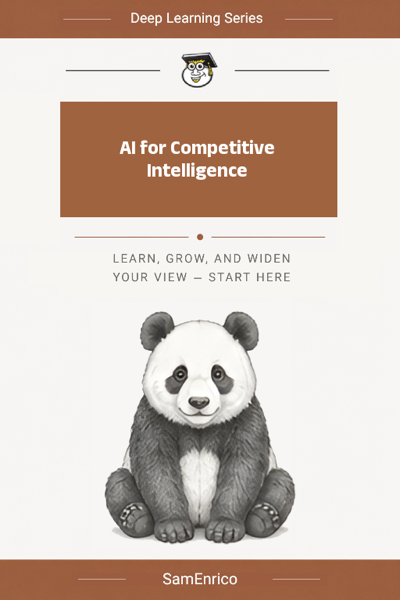 AI for Competitive IntelligenceAndrade Sheron$11.99
You may also like
 Hong Kong Handover 1997Dunn Johnnie$11.99
 Zumba For Postnatal Recovery CourseNeal Christian$11.99
 Zumba for BeginnersLadner Nikia$11.99
 YouTube Comment Mining GuideHumes Pandora$12.99
 Worry Box MeditationCarlin Rudy$11.99
 Workplace Stress MeditationNguyen Lynn$11.99
 Workplace Stress and Sleep RepairHawley Ivory$11.99
 Workplace Perfectionism CureDelaney Jeffry$11.99
 Workplace Injustice Anger GuideWallen Isabelle$11.99
 Work Addiction and Burnout LinkGreenwood Ester$11.99
 Women in Yoga and WellnessBeattie Galina$11.99
 Women in Stand Up ComedyChun Evangeline$11.99