
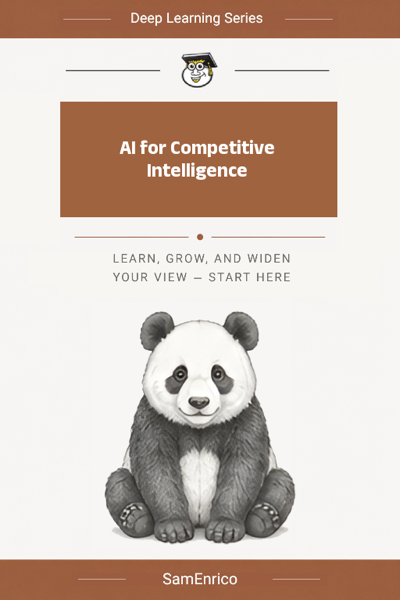
Non-FictionAI OperatorIntelligence GatheringInformative
AI for Competitive Intelligence eBook
A Coursebook on AI for Competitive Intelligence
A Coursebook on AI for Competitive Intelligence
Formats
Free sample
Chapter 1: The Prediction Paradox...--–- Every Monday morning, in thousands of conference rooms around the world, the same ritual unfolds. A well-intentioned competitive intelligence analyst stands before a leadership team and clicks through forty-seven slides of market data, competitor press releases, and SWOT analyses that took three weeks to assemble. The CEO nods, the CFO asks one question about margin assumptions, and by Tuesday afternoon, the deck is forgotten. Three months later, a competitor launches a product that blindsides the entire industry—and someone says, “How did we not see that coming?”This scene is not the failure of effort. It is the failure of a fundamentally broken model.
Traditional competitive intelligence, as it has been practiced for the past forty years, was designed for a world that no longer exists. That world moved at the speed of quarterly earnings reports, annual strategy offsites, and printed market research binders. Today’s world moves at the speed of a tweet, a Git Hub commit, or a single job posting for a role that didn’t exist last week.This chapter dismantles the assumptions that have kept most CI teams trapped in what we will call the data hoarding paradox: the more information they collect, the less insight they actually produce. And it introduces a new economic framework—the collapse in the cost of prediction—that fundamentally rewrites the rules of competitive strategy. By the end of this chapter, you will understand why your current CI process is obsolete, what “forecasting latency” means for your survival, and how shifting from data hoarding to strategic foresight transforms intelligence from a cost center into a competitive weapon.The Four Deadly Sins of Traditional CIBefore we can build something better, we must name what is broken.
Traditional competitive intelligence, whether conducted by a dedicated team of two or a department of fifty, typically commits four fatal errors. These are not occasional mistakes; they are structural features of the analog-era model.Sin One: The Quarterly Time Horizon Most CI is produced on a quarterly or annual cycle, timed to coincide with strategic planning reviews. This rhythm made sense when competitors also moved quarterly. But consider the velocity of modern competition. A software company can launch a new feature every day.
A retailer can adjust prices algorithmically every hour. A logistics firm can reroute its entire network in response to weather patterns in real time.When your intelligence arrives on a quarterly cadence, you are not analyzing the competition; you are analyzing their history. By the time your SWOT analysis reaches the CEO’s desk, the competitor has already pivoted twice. The half-life of competitive advantage in most industries is now measured in months, not years. Quarterly intelligence means you are always reacting to yesterday’s war.Sin Two: The Fallacy of Completeness Traditional CI operates under an unspoken assumption: if we just collect enough data, the answer will reveal itself.
Teams subscribe to ten news feeds, monitor fifty competitors, track two hundred keywords, and produce reports that grow thicker every quarter. This is the data hoarding paradox in action—the belief that volume equals value.It does not. In fact, the opposite is often true. When you collect everything, you see nothing. Signal drowns in noise.
Analysts spend 80% of their time cleaning, organizing, and formatting data, leaving only 20% for actual analysis. The result is not insight; it is exhaustion. The most common phrase heard in CI teams is not “We found something,” but “We don’t have time to look.”Sin Three: The Static Snapshot The traditional CI report is a snapshot—a single point in time captured in a Power Point deck or a PDF. But competition is not a photograph; it is a film. Competitors learn.
Markets shift. Strategies evolve. A snapshot of your competitor’s position last quarter tells you almost nothing about their trajectory this quarter.This is the problem with static tools like the SWOT analysis (Strengths, Weaknesses, Opportunities, Threats) or the 2x2 competitive matrix. They freeze motion. They imply that competitors have fixed attributes rather than dynamic capabilities.
And they give leaders a false sense of certainty—the dangerous belief that they understand the landscape when they are actually looking at an outdated map.Sin Four: The Judgment Bottleneck In traditional CI, every piece of analysis passes through the judgment of a small number of human analysts. They decide what is important. They decide what to include. They decide what to escalate. This creates a brutal bottleneck.
No matter how brilliant your analysts, they cannot read ten thousand documents per day. They cannot monitor every competitor’s job postings. They cannot track every mention of your brand across every language.The result is systematic blindness. You don’t see what you don’t look for. And because your analysts are human, they develop predictable blind spots—favorite competitors they watch too closely, industries they dismiss, signals they have learned to ignore.
These blind spots are not malice; they are the natural consequence of limited attention in an infinite information environment.The Economic Reframe: Prediction as the New Currency To understand why AI changes everything, we need to step back from the technical details and look at the economics of intelligence itself. This framework comes from the work of economists Ajay Agrawal, Joshua Gans, and Avi Goldfarb, whose book Prediction Machines offers the single most useful lens for understanding AI’s role in business.Here is their central insight, stripped to its essence: Artificial intelligence is a dramatic drop in the cost of prediction.That’s it. Not intelligence. Not consciousness. Not creativity.
Prediction.Prediction is the process of using incomplete information to fill in missing pieces. Will this customer pay their bill? Prediction. Will this competitor launch a product next quarter? Prediction.
Will this market grow or contract? Prediction. These are all questions that humans have historically answered using experience, intuition, and limited data. AI can now answer them faster, cheaper, and often more accurately.When the cost of something falls dramatically, the way we organize work changes. Consider electricity.
When electricity became cheap and reliable, factories no longer needed to cluster around water sources for power. They could reorganize production around electric motors, placing them exactly where needed. The entire layout of industrial work changed not because electricity was magic, but because the cost of localized power had fallen.The same logic applies to prediction. When prediction becomes cheap, the scarce resource shifts. You no longer ask, “Can we afford to predict this?” You ask, “What should we do with all this cheap prediction?” And the answer is that judgment—the ability to weigh costs, benefits, and trade-offs—becomes the new bottleneck.The Scarcity Shift: From Prediction to Judgment This is the single most important concept in this book, so let us state it clearly: When prediction becomes cheap, judgment becomes valuable.Most organizations have this backwards.
They treat prediction as the scarce resource—spending weeks or months building forecasts, running analyses, and validating models. Meanwhile, they treat judgment as abundant—assuming that any senior leader can look at a prediction and know what to do.But cheap prediction flips this equation. If you can generate a thousand predictions per second…
This is the end of the free sample. Get the eBook to keep going. Buy now
About this book
Details
- Author
- Andrade Sheron
- Publisher
- SamEnrico
- Language
- English
- Genre
- Non-Fiction, AI Operator, Intelligence Gathering, Informative, Educational
- Released
- 2026-06-02
- Pages (approx.)
- 156
- Available as
- eBook, Audiobook

Read better in the ZLOADR app
Your eBooks on your phone or tablet. Sign in with your SamEnrico account and start reading.
More by Andrade Sheron
 The Beginner's Nature MeditationAndrade Sheron$11.99
 AI Deck Template LibraryAndrade Sheron$11.99
 Secret Keeping Self Esteem GuideAndrade Sheron$11.99
 Aging Body AcceptanceAndrade Sheron$11.99
 Dietary Supplement Recall LogAndrade Sheron$11.99
 Tuskegee AirmanAndrade Sheron$11.99
 Monsters Under The BedAndrade Sheron$11.99
 Reformation Scandinavian Lutheran Kingdom GuideAndrade Sheron$11.99
 Croatian Tourism Post EU IntegrationAndrade Sheron$11.99
 The Last Flight of the Enola Gay: The Atomic Bomb Mission That Changed the WorldAndrade Sheron$11.99
 Beneath the Skin of the World: The Hungry EarthAndrade Sheron$11.99
 Egypt Factoring GuideAndrade Sheron$12.99
You may also like
 Hong Kong Handover 1997Dunn Johnnie$11.99
 Zumba For Postnatal Recovery CourseNeal Christian$11.99
 Zumba for BeginnersLadner Nikia$11.99
 YouTube Comment Mining GuideHumes Pandora$12.99
 Worry Box MeditationCarlin Rudy$11.99
 Workplace Stress MeditationNguyen Lynn$11.99
 Workplace Stress and Sleep RepairHawley Ivory$11.99
 Workplace Perfectionism CureDelaney Jeffry$11.99
 Workplace Injustice Anger GuideWallen Isabelle$11.99
 Work Addiction and Burnout LinkGreenwood Ester$11.99
 Women in Yoga and WellnessBeattie Galina$11.99
 Women in Stand Up ComedyChun Evangeline$11.99