
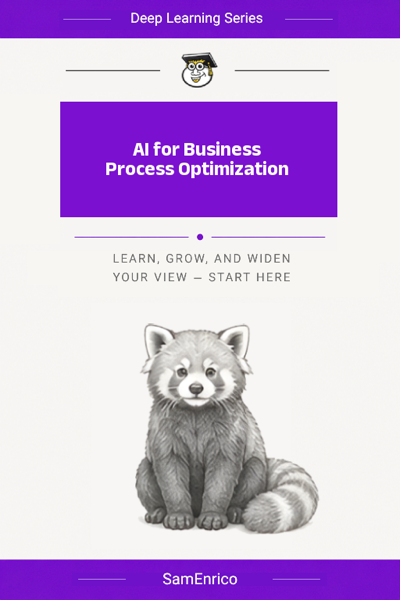
Non-FictionInformativeEducational
AI for Business Process Optimization eBook
A Coursebook on AI for Business Process Optimizati
A Coursebook on AI for Business Process Optimization
Formats
Free sample
Chapter 1: Beyond the Bot...–- In a fluorescent-lit office tower somewhere in North America, a finance manager named Sarah celebrates a small victory. She has just deployed twelve software bots to automate the invoice approval process she used to manage manually. The bots extract data from emailed PDFs, cross-reference purchase orders, and post payments to the general ledger. Within two weeks, processing time drops from seven days to ninety minutes. Error rates fall by eighty percent.
Sarah receives a bonus and a mention in the company newsletter. She is a hero of automation. Six months later, everything falls apart. A supplier changes its invoice format. A new tax regulation requires additional fields.
The procurement system upgrades its API. The bots break, one by one, because they were programmed to follow rules, not to handle change. Sarah spends the next three months patching scripts, hiring consultants, and explaining to leadership why the “automated” process now requires more maintenance than the manual one ever did.Sarah’s story is not a cautionary tale about technology. It is a cautionary tale about a seductive and dangerous illusion. The illusion is this: if you take a process you understand today and encode its steps into software, you have solved the problem of process optimization for the foreseeable future.
You have not. You have merely frozen a single moment in time. The moment the environment changes—and it always changes—your frozen process becomes obsolete. What Sarah needed was not more automation. What Sarah needed was a process that could learn.
What Sarah needed was cognition.This chapter dismantles the most expensive misunderstanding in business process management: the confusion between automation and intelligence. You will learn why traditional process improvement methods, for all their rigor, are increasingly inadequate for a volatile world. You will discover the Cognitive Continuum, a five-stage maturity model that separates mere speed from genuine adaptation. You will see, through concrete examples, how shifting from deterministic rules to probabilistic predictions transforms not just process metrics but the very nature of what a process can be. And you will begin your own transformation from a process analyst who documents workflows into an AI-Ready Process Architect who designs systems that improve themselves.
The first step is to recognize that the bot on your screen is not the destination. It is the starting line.The Automation Fallacy: Why Faster Execution Is Not Better Optimization For decades, the business process improvement community operated on a straightforward theory of value: reduce variation, eliminate waste, and standardize work. Whether you followed Lean, Six Sigma, or Business Process Reengineering, the core assumption was identical. The optimal process could be designed in advance by experts, documented in procedure manuals, and then executed with fidelity by workers or, increasingly, by software. Variation from the ideal was treated as an error to be corrected.
Exceptions were problems to be eliminated through better training or stricter rules. The goal was to make the process run the same way, every time, as fast as possible.This theory worked remarkably well in manufacturing. A car assembly line does not need to adapt to new models every week. A chemical refinery does not need to reconfigure its piping based on daily commodity prices. Physical processes have inertia.
Changing a stamping die requires hours of retooling. Changing a distillation column requires shutting down production. In such environments, stability is a feature, not a bug. The cost of change is so high that you want to change as rarely as possible. Manufacturing-era process improvement was, therefore, correct for manufacturing-era problems.But most of the processes that determine competitive advantage today are not physical.
They are informational. Customer support ticket routing, insurance claims adjudication, loan underwriting, procurement approval, employee onboarding, regulatory compliance monitoring—these processes do not involve stamping metal or mixing chemicals. They involve decisions, documents, and data. And the cost of changing an informational process is asymptotically approaching zero. You can rewrite a business rule in seconds.
You can retrain a machine learning model over a weekend. You can deploy a new workflow in hours, not months.The tragedy is that most organizations have not internalized this shift. They continue to treat informational processes as if they were assembly lines. They invest in RPA to encode static rules. They build workflow engines that execute fixed sequences.
They create centers of excellence dedicated to maintaining brittle automation. And then they wonder why their “optimized” processes break the moment a supplier changes a form, a regulator issues a new guideline, or a customer behaves in an unexpected way. This is the automation fallacy. It is the belief that speed equals optimization. It does not.
In an informational world, the ability to change is more valuable than the ability to execute quickly. Adaptation beats acceleration.The Cognition Alternative: From Rules to Probabilities If automation is about encoding known rules for execution, cognition is about learning unknown patterns for prediction. The difference is not incremental. It is ontological. A rule-based system operates in the domain of logic.
If condition A and condition B are true, then action C occurs. The system is deterministic, transparent, and stable. It is also brittle, limited, and non-learning. Every new scenario that falls outside the pre-encoded rules requires a human to write a new rule. Over time, rule bases become tangled, contradictory, and unmaintainable.A cognitive system, by contrast, operates in the domain of probability.
It does not ask “Is condition A true?” It asks “Given the evidence we have observed, what is the probability that outcome X will occur?” The system is probabilistic, sometimes opaque, and continuously changing. It is also resilient, scalable, and adaptive. When new scenarios arise, the system does not break. It simply produces less confident predictions. Over time, as it encounters more data, its predictions improve without any human rewriting rules.
The cognitive system learns.Consider a concrete example. A traditional fraud detection process might encode rules like: “If transaction amount exceeds $10,000 and the shipping address differs from the billing address and the customer account is less than thirty days old, flag for review.” This rule captures known fraud patterns, but it will miss novel fraud patterns that do not match these specific conditions. Worse, fraudsters quickly learn to evade rules by staying just under thresholds. A cognitive fraud detection process, using a machine learning model, is trained on thousands of past transactions with known outcomes (fraudulent or legitimate). The model learns which combinations of features—amount, address similarity, account age, time of day, device fingerprint, purchase history—are statistically associated with fraud.
When a new transaction arrives, the model outputs a probability, not a binary flag. A transaction with a 92% predicted fraud probability is treated very differently from one with 37% probability. The process can route the 92% case to immediate investigation, auto-approve the 37% case, and send the 67% case to a sampling queue for random audit.The cognitive approach has three profound advantages. First, it handles the long tail of rare scenarios without requiring explicit rules for each scenario. Second, it automatically adapts as fraud patterns evolve, simply by retraining the model on new data.
Third, it provides a continuous risk score that allows fine-grained triage, not just a binary pass-fail decision. These advantages are…
This is the end of the free sample. Get the eBook to keep going. Buy now
About this book
Details
- Author
- Pedersen Shantae
- Publisher
- SamEnrico
- Language
- English
- Genre
- Non-Fiction, Informative, Educational
- Released
- 2026-05-11
- Pages (approx.)
- 160
- Available as
- eBook, Audiobook

Read better in the ZLOADR app
Your eBooks on your phone or tablet. Sign in with your SamEnrico account and start reading.
More by Pedersen Shantae
 Tech Stack Distraction AuditPedersen Shantae$11.99
 Opioid Recovery Acupuncture GuidePedersen Shantae$11.99
 War Death Complicated GriefPedersen Shantae$11.99
 Resume Design Templates GuidePedersen Shantae$11.99
 Property Management For OwnersPedersen Shantae$11.99
 Morning Routine For MinimalistsPedersen Shantae$11.99
 Hot Air Balloon RidePedersen Shantae$11.99
 Elon Musk SpaceXPedersen Shantae$11.99
 F 16 Viper PilotPedersen Shantae$11.99
 The Last Scroll of Hypatia: Alexandria’s Vanished GeniusPedersen Shantae$11.99
 Operation Midnight Sun: The Untold Story of the 1973 Yom Kippur War’s Secret NegotiationsPedersen Shantae$11.99
 Whispers of the Lost Library: The Forgotten Scrolls of HerculaneumPedersen Shantae$11.99
You may also like
 Hong Kong Handover 1997Dunn Johnnie$11.99
 Zumba For Postnatal Recovery CourseNeal Christian$11.99
 Zumba for BeginnersLadner Nikia$11.99
 YouTube Comment Mining GuideHumes Pandora$12.99
 Worry Box MeditationCarlin Rudy$11.99
 Workplace Stress MeditationNguyen Lynn$11.99
 Workplace Stress and Sleep RepairHawley Ivory$11.99
 Workplace Perfectionism CureDelaney Jeffry$11.99
 Workplace Injustice Anger GuideWallen Isabelle$11.99
 Work Addiction and Burnout LinkGreenwood Ester$11.99
 Women in Yoga and WellnessBeattie Galina$11.99
 Women in Stand Up ComedyChun Evangeline$11.99