
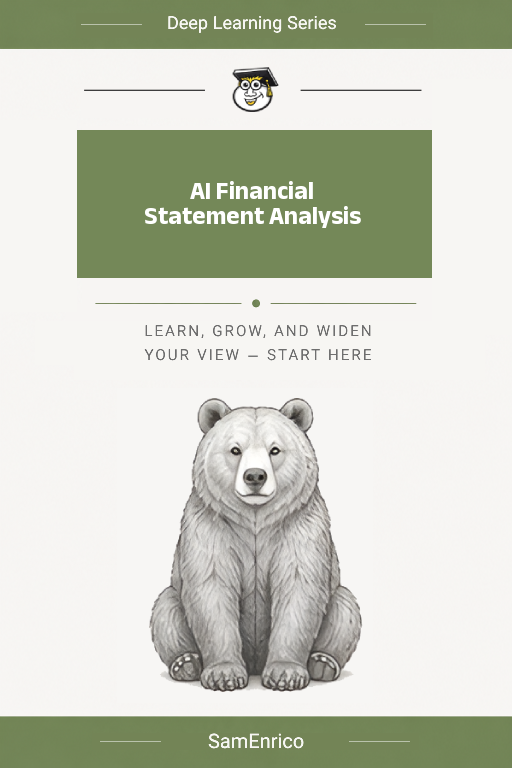
Non-FictionAI OperatorFinancial Analysis
AI Financial Statement Analysis eBook
Generate ratio analysis and trend commentary from
Generate ratio analysis and trend commentary from financial statements using AI.
Formats
Free sample
Chapter 1: The Spreadsheet Cemetery--–- In a windowless conference room on the forty-seventh floor of a Manhattan skyscraper, a senior financial analyst named Sarah had just finished her two-hundredth spreadsheet of the quarter. The file was named Q3_Final_v14_FINAL2_REALLY.xlsx. She had been working eighty-hour weeks for three years, and her annual bonus—the one she had been promised would be “life-changing”—barely covered her student loan payments. That same week, a junior analyst two desks down had used Chat GPT to replicate one of Sarah’s most complex models in forty-five minutes. The output was not perfect.
But it was close. And it had taken forty-five minutes, not three days.This is not a story about AI replacing financial analysts. It is a story about why Sarah’s job was already broken long before the chatbots arrived—and how a new kind of analyst, one who masters both the art of finance and the craft of prompting, will inherit the future.Welcome to the Spreadsheet Cemetery. It is where old-school financial analysis goes to die. Not because the numbers are wrong, but because the process is too slow, too brittle, and too human for the speed of modern markets.
Every day, millions of analysts around the world manually download financial statements, copy-paste them into Excel, calculate the same twenty ratios their predecessors calculated in 1995, and write commentary that is 80 percent boilerplate. Then they do it again next quarter.The problem is not that these analysts are unskilled. The problem is that they are spending 90 percent of their time on mechanical work and only 10 percent on genuine analysis. Artificial intelligence, properly understood, does not automate the 10 percent. It automates the 90 percent—the data fetching, the ratio calculations, the first-draft commentary, the anomaly flagging.
And in doing so, it forces a fundamental question: What is an analyst actually for?This chapter answers that question by introducing the core premise of this entire book. You will learn why the “augmented analyst”—a human who directs, validates, and governs AI systems—will replace the purely manual analyst. You will discover the Four-Layer AI Approach that structures every subsequent chapter. And you will confront the uncomfortable truth about probabilistic reasoning: that AI is not a calculator, and treating it like one is the fastest path to disaster.Most importantly, you will leave this chapter with a clear understanding of which track you belong to. Because this book is written for two different readers.
The Analyst Track is for finance professionals who want to use AI without writing complex code. The Engineer Track is for data professionals who want to build the systems that analysts use. Both are essential. Neither is obsolete.The Broken Promise of the Spreadsheet Era For forty years, Microsoft Excel has been the undisputed king of financial analysis. It is an extraordinary piece of software—flexible, powerful, and ubiquitous.
But it has also become a cage. The average financial analyst spends more than 50 percent of their time on what industry veterans call “data janitor work”: finding data, cleaning data, moving data from one sheet to another, fixing broken formulas, and chasing down formatting errors.A 2023 survey by the Association for Financial Professionals found that analysts spend only 28 percent of their time on actual analysis—interpreting trends, identifying risks, making recommendations. The other 72 percent is mechanical. That is not a skill problem. It is a tool problem.AI does not solve this problem by being smarter than Excel.
It solves it by being faster at the mechanical parts. Consider a typical quarterly reporting cycle. An analyst needs to pull three years of financial statements from SEC filings, calculate twenty ratios, compare them to industry benchmarks, write a two-page commentary, and present findings to the investment committee. In the traditional model, this takes three to five days. With AI assistance, the mechanical parts shrink to thirty minutes.
The analyst then spends the remaining four and a half days on what actually matters: questioning assumptions, stress-testing conclusions, and understanding the story behind the numbers.This is the core promise of augmented analysis. Not replacement. Reallocation.The Great Fear: Will AI Replace Me?Every financial analyst who has opened Chat GPT in the past two years has felt a chill. The tool can write passable commentary. It can explain valuation concepts.
It can even generate simple Excel formulas. If you ask it to “analyze Apple’s liquidity position,” it will produce something that looks, at first glance, like a real analyst’s work.But here is what the AI will not tell you: it does not actually understand what it is saying. Large Language Models are pattern-matching engines. They have ingested millions of financial documents, SEC filings, earnings call transcripts, and analyst reports. When you ask a question, they generate the most statistically likely sequence of words based on that training data.
This is fundamentally different from how a human analyst thinks.Let us be precise about this distinction. Deterministic calculation is what Excel does. You enter =2+2 and Excel returns 4. Every time. Forever.
There is no ambiguity, no probability, no context. The answer is mathematically certain.Probabilistic reasoning is what LLMs do. When you ask an AI “what is 2+2?”, the model is not performing addition. It is predicting the most likely next token based on billions of examples. The answer is almost always 4.
But if the model’s training data had contained a typo—or if the prompt was subtly ambiguous—the answer could be different. A well-tuned LLM might internally represent this as “there is an 85 percent probability that the correct answer is 4, based on my training distribution.”This is not a flaw. It is a feature. Probabilistic reasoning is exactly what you want for tasks like sentiment analysis, trend identification, and narrative generation. It is catastrophically wrong for tasks like calculating debt covenants or verifying compliance with tax law.The implication is profound: You cannot delegate material financial decisions to pure AI output.
Not because the AI is stupid, but because it is probabilistic. It will make mistakes. It will hallucinate. It will confidently assert falsehoods because they are statistically common in its training data. The role of the augmented analyst is to govern the AI—to check its work, validate its sources, and override its conclusions when they conflict with reality.This is not a weakness of AI.
It is a weakness of treating AI as a calculator. The moment you understand this distinction, you stop fearing replacement and start seeing opportunity.The Four-Layer AI Approach (The Spine of This Book)Every chapter in this book maps to one of four layers. Think of these as a stack, starting with raw data and ending with strategic judgment. You cannot skip layers. If your data is dirty, your AI outputs will be garbage.
If you have no governance, your hallucinations will become liabilities.Layer 1: Data (Chapters 2–3)The foundation of everything. You cannot analyze what you cannot retrieve. This layer covers automated data fetching from sources like the SEC EDGAR database, OCR for scanned PDFs, and data cleaning with tools like Pandas (Engineer Track) or Power Query (Analyst Track). The key insight: AI amplifies existing data quality. Garbage in, garbage out…
This is the end of the free sample. Get the eBook to keep going. Buy now
About this book
Details
- Author
- Coronado Donetta
- Publisher
- SamEnrico
- Language
- English
- Genre
- Non-Fiction, AI Operator, Financial Analysis
- Released
- 2026-05-30
- Pages (approx.)
- 110
- Available as
- eBook, Audiobook

Read better in the ZLOADR app
Your eBooks on your phone or tablet. Sign in with your SamEnrico account and start reading.
More by Coronado Donetta
 TM For PTSD Recovery WorkbookCoronado Donetta$11.99
 Yahoo's Dark Web Monitoring FailureCoronado Donetta$11.99
 Subunit Recombinant VaccinesCoronado Donetta$11.99
 The Gacy Victim Autopsy ReportsCoronado Donetta$11.99
 Perfectionism Self Talk GuideCoronado Donetta$11.99
 The Thunderbird’s Last Flight: A Haida EpicCoronado Donetta$11.99
 Understanding Multiple Endocrine Neoplasia Type 1Coronado Donetta$17.99
 Stay ConnectedCoronado Donetta$11.99
 How to Start a Buildings Painting Business (Beginners Guide)Coronado Donetta$11.99
 Remote Resource Allocation ConflictCoronado Donetta$12.99
You may also like
 Hong Kong Handover 1997Dunn Johnnie$11.99
 Zumba For Postnatal Recovery CourseNeal Christian$11.99
 Zumba for BeginnersLadner Nikia$11.99
 YouTube Comment Mining GuideHumes Pandora$12.99
 Worry Box MeditationCarlin Rudy$11.99
 Workplace Stress MeditationNguyen Lynn$11.99
 Workplace Stress and Sleep RepairHawley Ivory$11.99
 Workplace Perfectionism CureDelaney Jeffry$11.99
 Workplace Injustice Anger GuideWallen Isabelle$11.99
 Work Addiction and Burnout LinkGreenwood Ester$11.99
 Women in Yoga and WellnessBeattie Galina$11.99
 Women in Stand Up ComedyChun Evangeline$11.99