
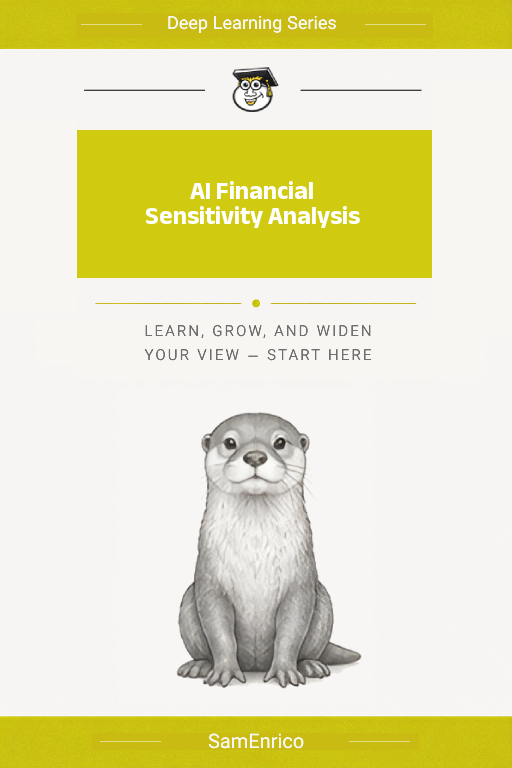
Non-FictionAI OperatorScenario Analysis
AI Financial Sensitivity Analysis
Run sensitivity scenarios on financial models usin
Run sensitivity scenarios on financial models using AI-powered what-if analysis.
Formats
About this book
Free sample
Chapter 1: The Uncertainty Imperative--–- In the summer of 2007, the chief risk officer of a major investment bank presented a single number to the firm's executive committee. The number was 1.2 percent. It was the firm's Value at Risk (Va R) calculation, a statistical measure that supposedly represented the maximum loss the firm could expect to incur on a single day. The number was low. The committee approved the risk limits.
Seven months later, the firm collapsed, losing over $30 billion.The problem was not that the Va R model was poorly constructed. By the standards of the time, it was state-of-the-art. The problem was that the model produced a single number, and the executives treated that number as a truth about the future rather than a projection based on specific assumptions. The model said that daily losses should not exceed 1.2 percent of the portfolio under normal market conditions. But 2008 was not normal.
The assumptions that had gone into the model—about correlations between assets, about the liquidity of markets, about the stability of volatility—all failed simultaneously. The single number became not just wrong, but dangerously misleading.This is not a story about the failure of quantitative finance. It is a story about the failure of single-point estimates. When we reduce the complexity of an uncertain world to a single number, we invite disaster. The future is not a point.
It is a distribution. And the most important questions in finance are not "what will happen?" but "what might happen, and with what probability?"This chapter opens with a provocative challenge to the core assumption underlying most financial practice: that we can predict the future with sufficient accuracy to make single-point decisions. Drawing from Computing Possible Futures (Rouse, 2019), it argues that deterministic forecasting—producing a single number for next quarter's revenue, next year's cash flow, or a project's NPV—is not merely difficult but conceptually flawed in complex systems. The future is not a point to be predicted; it is a distribution of possibilities to be navigated. This chapter dismantles the illusion of "the forecast" as a singular truth, explains why even the…
This is the end of the free sample. Get the eBook to keep going. Buy now
Contents
- Chapter 1
- Chapter 2
- Chapter 3
- Chapter 4
- Chapter 5
- Chapter 6
- Chapter 7
- Chapter 8
- Chapter 9
- Chapter 10
- Chapter 11
- Chapter 12
Details
- Author
- Nieves Dorine
- Publisher
- SamEnrico
- Language
- English
- Genre
- Non-Fiction, AI Operator, Scenario Analysis
- Released
- 2026-06-02
- Pages (approx.)
- 139
- Available as
- eBook, Audiobook

Read better in the ZLOADR app
Your eBooks on your phone or tablet. Sign in with your SamEnrico account and start reading.
More by Nieves Dorine
 Senior Dating Esteem GuideNieves Dorine$11.99
 Vaccine Clinical Trial ProcessNieves Dorine$11.99
 Train Ride CalmNieves Dorine$11.99
 Obsessive Thoughts Self TalkNieves Dorine$11.99
 The Fear of Abandonment Self Esteem FixNieves Dorine$11.99
 The Corsair of the Peninsular War: Luis Mariano Pérez de Padilla's Daring RaidsNieves Dorine$11.99
 Understanding Multiple Synostoses Syndrome 1Nieves Dorine$17.99
 How to Become a Nib InspectorNieves Dorine$11.99
 Google SWOT Analysis GuideNieves Dorine$12.99
 Toy Poodle BreedingNieves Dorine$11.99
You may also like
 Hong Kong Handover 1997Dunn Johnnie$11.99
 Zumba For Postnatal Recovery CourseNeal Christian$11.99
 Zumba for BeginnersLadner Nikia$11.99
 YouTube Comment Mining GuideHumes Pandora$12.99
 Worry Box MeditationCarlin Rudy$11.99
 Workplace Stress MeditationNguyen Lynn$11.99
 Workplace Stress and Sleep RepairHawley Ivory$11.99
 Workplace Perfectionism CureDelaney Jeffry$11.99
 Workplace Injustice Anger GuideWallen Isabelle$11.99
 Work Addiction and Burnout LinkGreenwood Ester$11.99
 Women in Yoga and WellnessBeattie Galina$11.99
 Women in Stand Up ComedyChun Evangeline$11.99