
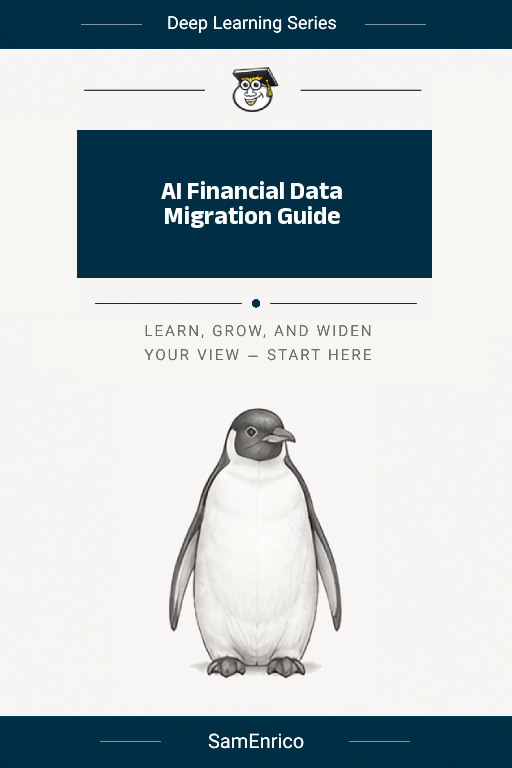
AI Financial Data Migration Guide eBook
Move historical financial data into AI-ready forma
Move historical financial data into AI-ready formats without corruption or loss.
Formats
Free sample
Chapter 1: The Dirty History...–- On a Tuesday morning in March, a Fortune 500 controller named Sarah did something she had never done before: she printed 847 pages of general ledger history, laid them across three conference room tables, and began highlighting with a yellow marker. Her CFO had asked a simple question—“Can we train an AI on our last ten years of data?”—and Sarah had answered yes before looking closely. Now, surrounded by paper, she was discovering that the company’s financial history was not merely messy. It was accidentally fraudulent.The problem was not theft or accounting manipulation. It was something far more common and far more insidious: decades of patches, manual overrides, system migrations, and well-intentioned fixes had left the ledger riddled with “phantom reconciliations”—periods marked as closed but mathematically unbalanced.
Transaction timestamps that had been reset during a software upgrade. GL codes that meant one thing in 2015 and something else entirely by 2020. Sarah found an invoice marked “paid” three months before it was issued. She found a vendor payment recorded twice because a migration job had restarted mid-run. And she found a revenue line that, according to the numbers, originated in 2026—a year that had not yet arrived.Sarah’s discovery is not an edge case.
It is the norm.This book exists because most financial data migrations fail. Not the technical kind of failure where servers crash or pipelines stall—those problems are fixable. The failures that matter are the silent ones: data that moves from one system to another with every byte intact but every meaning lost. A number that lands in the right column but represents the wrong fiscal quarter. A customer ID that points to the wrong entity after a referential integrity check was skipped.
A transaction that exists in the target system but can no longer be reconciled to its source because the provenance chain was broken.When that corrupted data is fed to an AI, the problem compounds. Unlike a human accountant who might spot an anomaly, an AI model has no intuition. It treats every number as equally true. Feed it a ledger where 2019 revenue appears twice, and it will learn that the company’s growth trajectory is twice what it actually was. Feed it a customer database with broken foreign keys, and it will confidently generate forecasts based on relationships that never existed.
Feed it a GL code that changed meaning, and it will produce analyses that are coherent, convincing, and catastrophically wrong.This chapter is about understanding the enemy. Before you write a single line of migration code, before you select a vector database, before you even decide which AI model to use, you must audit your historical financial data for what this book calls “silent corruption”—errors that do not break systems but do break truth. The chapter provides a field guide for that audit, defines the only SLA that matters for AI financial data, and ends with a rubric that will tell you, honestly and without optimism, whether your data is ready to migrate.The Myth of Clean Financial Data Every CFO wants to believe that the general ledger is true. It is, after all, the document that audit firms sign off on, that regulators accept, that investors rely upon. But the ledger’s truth is not absolute.
It is legal truth—a representation of financial reality that conforms to accounting standards and has survived the scrutiny of auditors. Legal truth is not the same as semantic truth, and the difference is where silent corruption lives.Consider a simple transaction: a customer pays $10,000 for an annual software subscription on January 15, 2019. In the source ERP system, that transaction appears as:Field Value Transaction ID44321Date01/15/2019GL Code4100Amount10,000Debit/Credit Credit The auditor confirms that GL Code 4100 maps to “Deferred Revenue,” that the credit is properly offset by a debit to cash, and that the transaction posts to the correct fiscal period. Legal truth: passed.But what happens to that transaction over the next five years? In 2020, the company migrates to a new ERP system.
The migration script drops the Transaction ID column and generates a new surrogate key. Now the 2019 payment has a different identifier. In 2021, a finance analyst manually adjusts the date to 01/16/2019 because “the payment actually cleared on the 16th.” No one documents the adjustment. In 2022, the company is acquired, and the consolidation system maps GL Code 4100 to “Deferred Revenue – Legacy” while a new GL Code 4100 is created for “Deferred Revenue – Current.” The original transaction is now coded to a category that no longer exists. In 2023, a data engineer runs a deduplication script that treats the adjusted record as a duplicate of the original—because the amount and date are similar—and deletes it.By 2024, when Sarah’s team tries to train an AI on ten years of history, that $10,000 payment is either missing entirely, represented twice, or attributed to a fiscal quarter it does not belong to.
The legal truth was preserved at every step—each migration and adjustment was approved, each system change was audited—but the semantic truth evaporated. The data is clean by compliance standards and corrupt by AI standards.This is the dirty history problem. And it is everywhere.Phantom Reconciliations: The Silent Killer The most dangerous form of silent corruption in financial data is what this book calls the “phantom reconciliation.” A reconciliation is the accounting process of matching two sets of records—bank statements to ledgers, invoices to payments, subsidiary ledgers to the general ledger. When a reconciliation is “phantom,” it means the system marks the period as reconciled and balanced when, in fact, it is not.Phantom reconciliations arise from three common scenarios:Scenario 1: The Force-Balance Override An accountant cannot find a 0.37discrepancybetweenthesub−ledgerandthegeneralledger.Ratherthaninvestigate,theypostamanualadjustingentryfor0.37 discrepancy between the sub-ledger and the general ledger. Rather than investigate, they post a manual adjusting entry for 0.37discrepancybetweenthesub−ledgerandthegeneralledger.Ratherthaninvestigate,theypostamanualadjustingentryfor0.37 to “miscellaneous expense” and close the period.
The system now reports debits equal credits, but the 0.37representsrealvaluethathasbeenmisclassified.Ifthat0.37 represents real value that has been misclassified. If that 0.37representsrealvaluethathasbeenmisclassified.Ifthat0.37 is actually a fraction of a larger systematic rounding error across thousands of transactions, the AI will learn a bias that compounds with every prediction.Scenario 2: The Orphaned Transaction A payment is recorded in the accounts payable system but never posted to the general ledger because a workflow was cancelled mid-process. The accounts payable system shows the vendor as paid. The general ledger shows no record of the transaction. Neither system is wrong relative to its own data.
But the reconciliation between them—if anyone runs it—will reveal the orphan. Most companies do not run cross-system reconciliations for historical data. The orphan lives forever.Scenario 3: The Temporal Misalignment Two systems use different definitions of “fiscal quarter.” System A closes on the last day of the calendar month. System B closes on the last Friday of the month. When Sarah’s team migrated data from System A to System B, they mapped dates directly without adjusting for the different closing rules.
The result: transactions that occurred on January 29 appear in January in System A and February in System B. The reconciliation between the two systems shows…
This is the end of the free sample. Get the eBook to keep going. Buy now
About this book
Details
- Author
- Griggs Theron
- Publisher
- SamEnrico
- Language
- English
- Genre
- Non-Fiction, AI Operator
- Released
- 2026-05-30
- Pages (approx.)
- 135
- Available as
- eBook, Audiobook

Read better in the ZLOADR app
Your eBooks on your phone or tablet. Sign in with your SamEnrico account and start reading.
More by Griggs Theron
 Peg System for Dewey DecimalsGriggs Theron$11.99
 EQ For Actors Method GuideGriggs Theron$11.99
 Home Office Deduction Cross BorderGriggs Theron$11.99
 Blaming Spouse Stress CycleGriggs Theron$11.99
 The Withdrawal Grade HealingGriggs Theron$11.99
 Menopause Sleep SolutionsGriggs Theron$11.99
 Palace for ADHDGriggs Theron$11.99
 Self Worth And Grandparents Raising YouGriggs Theron$11.99
 Lithium Therapy Understanding GuideGriggs Theron$11.99
 The Quantum Leap Hypothesis: Did We Just Witness Time Travel in 2023?Griggs Theron$11.99
 The Mozart Paradox: A Symphony of Alternate RealmsGriggs Theron$11.99
 The Lion and the Elephant: Sundiata’s Epic Stand at Kirina (1235 AD)Griggs Theron$11.99
You may also like
 Hong Kong Handover 1997Dunn Johnnie$11.99
 Zumba For Postnatal Recovery CourseNeal Christian$11.99
 Zumba for BeginnersLadner Nikia$11.99
 YouTube Comment Mining GuideHumes Pandora$12.99
 Worry Box MeditationCarlin Rudy$11.99
 Workplace Stress MeditationNguyen Lynn$11.99
 Workplace Stress and Sleep RepairHawley Ivory$11.99
 Workplace Perfectionism CureDelaney Jeffry$11.99
 Workplace Injustice Anger GuideWallen Isabelle$11.99
 Work Addiction and Burnout LinkGreenwood Ester$11.99
 Women in Yoga and WellnessBeattie Galina$11.99
 Women in Stand Up ComedyChun Evangeline$11.99