
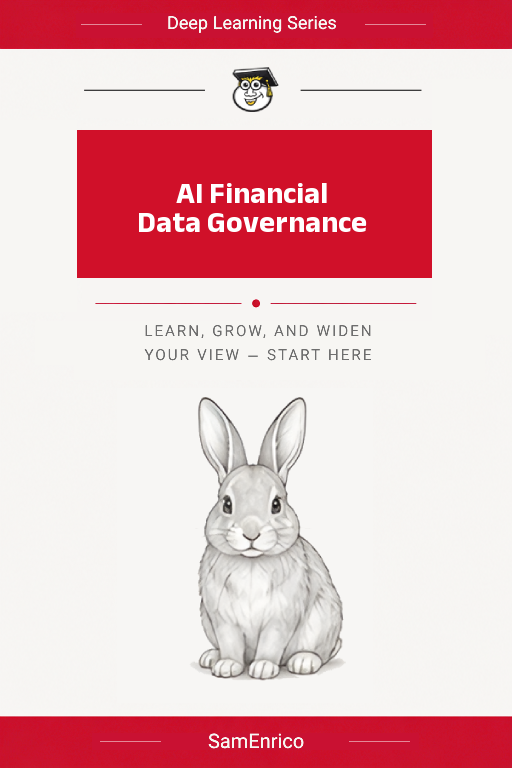
Non-FictionAI OperatorData Governance
AI Financial Data Governance
Establish governance for AI-analyzed financial dat
by Wu Violeta
Establish governance for AI-analyzed financial data including lineage and quality.
Formats
About this book
Free sample
Chapter 1: The Veracity Trap–- On a humid Tuesday afternoon in August 2012, a software deployment that took approximately forty-five seconds to complete destroyed 460millioninmarketvalue.Thefirmwas Knight Capital,arespectedmarketmaker.Thesoftwarecontainedasingleflaw:areusedflagvariablethatfailedtoresetproperly.Butthedeepertruth,theonethatregulatorswouldspendmonthsexcavating,wasthatthe∗data∗feedingthatsoftwarehadnolineage,noqualitycheck,andnoaudittrail.Thealgorithmdidexactlywhatitwastoldtodowiththedataitreceived.Thedatawaswrong.Thealgorithmwasobedient.And460 million in market value. The firm was Knight Capital, a respected market maker. The software contained a single flaw: a reused flag variable that failed to reset properly. But the deeper truth, the one that regulators would spend months excavating, was that the *data* feeding that software had no lineage, no quality check, and no audit trail. The algorithm did exactly what it was told to do with the data it received.
The data was wrong. The algorithm was obedient. And 460millioninmarketvalue.Thefirmwas Knight Capital,arespectedmarketmaker.Thesoftwarecontainedasingleflaw:areusedflagvariablethatfailedtoresetproperly.Butthedeepertruth,theonethatregulatorswouldspendmonthsexcavating,wasthatthe∗data∗feedingthatsoftwarehadnolineage,noqualitycheck,andnoaudittrail.Thealgorithmdidexactlywhatitwastoldtodowiththedataitreceived.Thedatawaswrong.Thealgorithmwasobedient.And460 million vanished.This is the veracity trap.Most executives believe that when an AI system fails, the algorithm is to blame. The math was wrong. The model was overfit.
The data scientist made a coding error. These explanations are comforting because they point to something controllable: code. But the evidence tells a different story. Across financial services—from trading desks to credit underwriting, from fraud detection to regulatory reporting—the majority of AI failures trace back not to flawed mathematics but to poisoned, drifted, or mislabeled data. The model is almost always doing exactly what it was trained to do.
The problem is that what it was trained on is not what it is now seeing. And the governance systems designed to catch these mismatches were built for a world that no longer exists.This chapter introduces the central thesis of this book: traditional data governance is fundamentally broken when applied to artificial intelligence. The manual controls, monthly reconciliations, and static data dictionaries that served banks and asset managers for decades cannot keep pace with the velocity, variety, and veracity demands of modern AI. What is required is a new discipline—AI Financial Data Governance—that treats data not as a static asset to be controlled but as a live, adversarial, constantly shifting…
This is the end of the free sample. Get the eBook to keep going. Buy now
Contents
- Chapter 1
- Chapter 2
- Chapter 3
- Chapter 4
- Chapter 5
- Chapter 6
- Chapter 7
- Chapter 8
- Chapter 9
- Chapter 10
- Chapter 11
- Chapter 12
Details
- Author
- Wu Violeta
- Publisher
- SamEnrico
- Language
- English
- Genre
- Non-Fiction, AI Operator, Data Governance
- Released
- 2026-05-30
- Pages (approx.)
- 160
- Available as
- eBook, Audiobook

Read better in the ZLOADR app
Your eBooks on your phone or tablet. Sign in with your SamEnrico account and start reading.
More by Wu Violeta
 HPV Vaccine for Boys GuideWu Violeta$11.99
 Yahoo's Account Recovery ExploitWu Violeta$11.99
 The Relationship Comparison Trap GuideWu Violeta$11.99
 Senior Divorce Esteem GuideWu Violeta$11.99
 Affirmation Journaling WorkbookWu Violeta$11.99
 Golden Arches & Iron Thrones: The Untold Feud of Fast Food DynastiesWu Violeta$11.99
 Netflix SWOT Analysis GuideWu Violeta$12.99
 Understanding Münchausen Syndrome By ProxyWu Violeta$17.99
 How to Become a Cloth FinisherWu Violeta$11.99
You may also like
 Hong Kong Handover 1997Dunn Johnnie$11.99
 Zumba For Postnatal Recovery CourseNeal Christian$11.99
 Zumba for BeginnersLadner Nikia$11.99
 YouTube Comment Mining GuideHumes Pandora$12.99
 Worry Box MeditationCarlin Rudy$11.99
 Workplace Stress MeditationNguyen Lynn$11.99
 Workplace Stress and Sleep RepairHawley Ivory$11.99
 Workplace Perfectionism CureDelaney Jeffry$11.99
 Workplace Injustice Anger GuideWallen Isabelle$11.99
 Work Addiction and Burnout LinkGreenwood Ester$11.99
 Women in Yoga and WellnessBeattie Galina$11.99
 Women in Stand Up ComedyChun Evangeline$11.99