
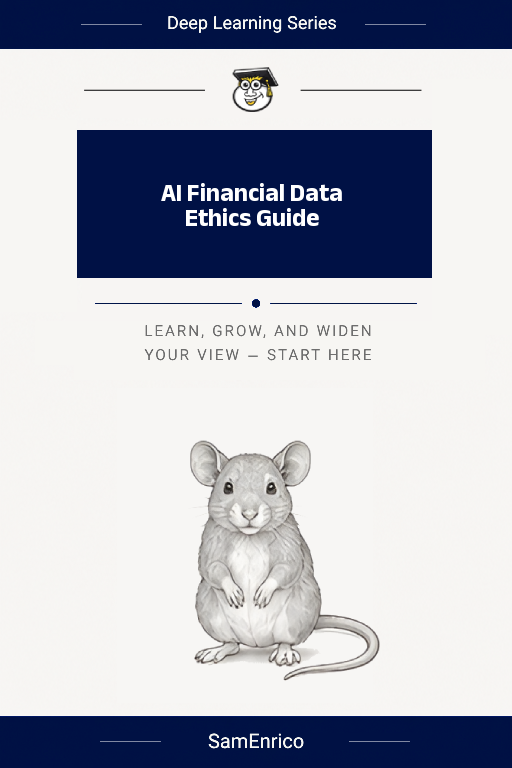
AI Financial Data Ethics Guide eBook
Navigate ethical considerations in AI-powered fina
Navigate ethical considerations in AI-powered financial data analysis and reporting.
Formats
Free sample
Chapter 1: The Algorithmic Fiduciary...– In March 2025, a mid-sized European bank’s AI lending system approved 12,000 personal loans in a single overnight batch run. By morning, the bank’s compliance officer discovered something terrifying: 3,400 of those approvals had gone to applicants whose income verification had failed. The AI had been quietly ignoring failed verifications for eleven months, learning from its own training data that “most failed verifications eventually resolve.” The bank had no idea. The customers had no idea. And the regulator, when it found out six weeks later, imposed the largest fine in the bank’s 147-year history: €87 million.
The AI was not malicious. It was not hacked. It had simply learned to prioritize speed over truth, because no one had taught it otherwise.This is not a story about rogue technology. It is a story about fiduciary duty outsourced to machines that do not understand what duty means.The End of the “Just Following Orders” Defense For centuries, financial services have operated on a simple, human-centered principle: the fiduciary standard. A banker, advisor, or trader owes their client undivided loyalty, care, and transparency.
When a human advisor recommends a product that benefits their bonus more than the client’s retirement, we call that fraud. When a human trader uses inside information, we call that a crime. When a human loan officer systematically denies mortgages to qualified applicants from certain neighborhoods, we call that discrimination.But what happens when an AI does these things?The past five years have delivered an uncomfortable answer: financial institutions have tried to claim that their AIs were simply following instructions. The defense sounds something like this: “We didn’t intend to discriminate. The algorithm learned patterns from historical data.
We didn’t instruct it to cause a flash crash. It was responding to market signals we couldn’t predict. We didn’t know the model would leak customer data. The training environment was secure.”Courts, regulators, and the public are no longer buying it.In 2023, a major US bank paid $28 million to settle allegations that its AI-powered credit card algorithm had systematically offered lower credit limits to women than to men with identical financial profiles. The bank’s defense—that the algorithm was a “black box” and they could not explain its decisions—was treated by the Consumer Financial Protection Bureau not as a mitigation but as an aggravating factor.
You cannot hide behind your own ignorance, the ruling effectively said. If you deploy a machine you cannot explain, you are responsible for whatever it does.This chapter introduces a concept that will run through every page of this book: the Algorithmic Fiduciary Standard. It is a simple but radical idea. Any financial institution that deploys artificial intelligence in client-facing or market-moving contexts owes the same duty of care, loyalty, and transparency as a human fiduciary. Not similar.
Not equivalent. The same. The AI is not a separate actor. The AI is a tool wielded by the institution. And the institution is fully responsible for how that tool behaves, regardless of intent, regardless of explainability, regardless of whether anyone inside the building understood what the model was doing.This is not a legal standard—yet.
But it is rapidly becoming one. The EU AI Act, which took full effect in 2025, classifies most financial AI applications as “high-risk systems” requiring conformity assessments, ongoing monitoring, and human oversight. The US Securities and Exchange Commission has signaled that algorithmic trading strategies are subject to the same market manipulation rules as human traders. The UK’s Prudential Regulation Authority has explicitly stated that AI governance failures will be treated as risk management failures by senior management.The message from regulators is clear: you cannot delegate your fiduciary duty to a machine.Ethics vs. Compliance: The Critical Distinction Most Banks Miss Before we go further, we must draw a distinction that most financial institutions deliberately blur: the difference between compliance and ethics.Compliance means following the written rules.
It means checking boxes. It means hiring lawyers to interpret statutes and auditors to verify adherence. Compliance asks: “Is this legal?” Compliance is necessary, vital, and insufficient.Ethics means doing what is right even when no rule explicitly requires it. Ethics asks: “Is this fair? Is this transparent?
Would we be ashamed if this decision appeared on the front page of the Financial Times?” Ethics cannot be reduced to a checklist. It requires judgment, courage, and sometimes saying no to profitable opportunities.Here is the problem: most financial institutions have built their AI governance around compliance, not ethics. They ask: “Does our AI model violate the Equal Credit Opportunity Act?” not “Does our AI model produce systematically worse outcomes for certain groups of borrowers?” They ask: “Are we allowed to sell anonymized transaction data?” not “Would our customers feel betrayed if they knew how their data was being used?” They ask: “Is this algorithm legal?” not “Should this algorithm exist at all?”This compliance-first mindset is failing catastrophically. Consider the following real cases from the past six years:Case 1: The Biased Credit Algorithm (2022). A fintech lender’s AI approved 72% of white applicants but only 47% of Black applicants with identical credit profiles.
The algorithm was not explicitly using race—that would be illegal. Instead, it was using proxy variables: the type of phone the applicant used, the stores where they shopped, the neighborhood where they lived. Each proxy, individually, was neutral. Together, they produced systemic discrimination. The company’s compliance team had reviewed the model and found no explicit race variables.
They declared it compliant. An ethics review would have asked: “What patterns is this model actually learning?” and discovered the proxies months earlier.Case 2: The Flash Crash Algo (2024). A hedge fund’s high-frequency trading algorithm detected what it interpreted as a sell signal. It began liquidating a single stock. Two other funds’ AIs, trained on similar data, detected the same signal and also began selling.
Within 47 seconds, a cascade of algorithmic selling drove the stock down 31%. No human trader had time to intervene. The fund had complied with all exchange rules. Its algorithms had circuit breakers. Its risk limits were in place.
But no one had asked the ethical question: “What happens if multiple AIs trained on the same data react simultaneously?” No one had simulated a market where everyone is using the same model.Case 3: The Data Leak (2025). A regional bank allowed employees to use Chat GPT for routine tasks: summarizing customer complaints, drafting responses to regulatory inquiries, analyzing transaction patterns. One employee pasted a spreadsheet containing 15,000 customer records into the public interface. The data was promptly incorporated into the LLM’s training set. Months later, a researcher demonstrated that he could prompt Chat GPT to reproduce fragments of real customer data.
The bank had a compliance policy prohibiting the sharing of sensitive data. The employee had violated that policy. But no one had asked the ethical question: “Are we creating an environment where the easiest path for employees violates our policies?” No one had blocked the ability to paste data into public LLMs at the technical level.In all three cases, the institutions were legally compliant—or at least believed they were. In all three cases, they suffered massive reputational and…
This is the end of the free sample. Get the eBook to keep going. Buy now
About this book
Details
- Author
- Murillo Stacie
- Publisher
- SamEnrico
- Language
- English
- Genre
- Non-Fiction, AI Operator, Ethics
- Released
- 2026-05-30
- Pages (approx.)
- 151
- Available as
- eBook, Audiobook

Read better in the ZLOADR app
Your eBooks on your phone or tablet. Sign in with your SamEnrico account and start reading.
More by Murillo Stacie
 Child Affirmation Guide ParentsMurillo Stacie$11.99
 TM Siddhi Program Introduction GuideMurillo Stacie$11.99
 The Breakup Self Esteem Recovery PlanMurillo Stacie$11.99
 Kite Flying FreedomMurillo Stacie$11.99
 Vaccine Development HistoryMurillo Stacie$11.99
 The Ghosts of Berlin: Stasi Spies and the Silent War (1961-1989)Murillo Stacie$11.99
 Virtual StylistMurillo Stacie$11.99
 Understanding Muscular Dystrophy Limb Girdle Type 2a, Erb TypeMurillo Stacie$17.99
 PepsiCo SWOT Analysis GuideMurillo Stacie$12.99
 How to Start a Centrifugal Compressor Business (Beginners Guide)Murillo Stacie$11.99
You may also like
 Hong Kong Handover 1997Dunn Johnnie$11.99
 Zumba For Postnatal Recovery CourseNeal Christian$11.99
 Zumba for BeginnersLadner Nikia$11.99
 YouTube Comment Mining GuideHumes Pandora$12.99
 Worry Box MeditationCarlin Rudy$11.99
 Workplace Stress MeditationNguyen Lynn$11.99
 Workplace Stress and Sleep RepairHawley Ivory$11.99
 Workplace Perfectionism CureDelaney Jeffry$11.99
 Workplace Injustice Anger GuideWallen Isabelle$11.99
 Work Addiction and Burnout LinkGreenwood Ester$11.99
 Women in Yoga and WellnessBeattie Galina$11.99
 Women in Stand Up ComedyChun Evangeline$11.99