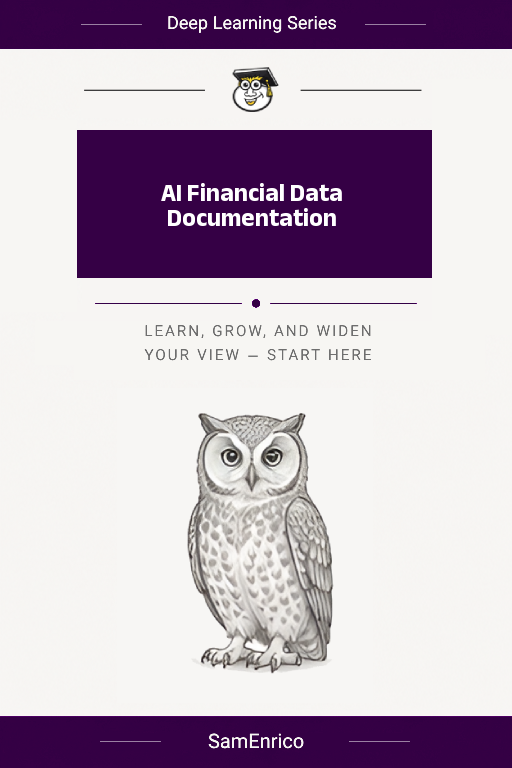
AI Financial Data Documentation Audiobook
Generate documentation for financial data analysis
by Cary Ronda
Generate documentation for financial data analysis workflows using AI.
Formats
Free sample
Chapter 1: The Accountability Gap--–- In the winter of 2023, a mid-sized asset manager with 47billionundersupervisionmadeaseeminglyroutinedecision.Theirnewlydeployed AIsystem,trainedtoparsequarterlyearningsreportsandflagcovenantrisks,recommendedincreasingexposuretoablue−chipmanufacturingclient.Therecommendationwasplausible,well−formatted,andaccompaniedbyaconfidencescoreof94percent.Theportfoliomanagerapprovedthetrade.Ninety−threedayslater,themanufacturingclientfiledfor Chapter11.The AIhadmissedacriticalwarningburiedinafootnoteonpage47ofa10−Kfiling—afootnotethatmentionedapendingpatentlitigationthatwouldrenderthecompany’sprimaryproductunsellableinthreejurisdictions.Wheninternalauditorsdemandedtoknowwhythe AIhadignoredthisinformation,noonecouldanswer.Thedevelopmentteamcouldnotreproducetheexactretrievalpath.Thepromptusedhadbeenoverwritteninaroutineupdate.Theversionoftheembeddingmodelhadchangedwithoutdocumentation.Thefirmpaid47 billion under supervision made a seemingly routine decision. Their newly deployed AI system, trained to parse quarterly earnings reports and flag covenant risks, recommended increasing exposure to a blue-chip manufacturing client. The recommendation was plausible, well-formatted, and accompanied by a confidence score of 94 percent. The portfolio manager approved the trade. Ninety-three days later, the manufacturing client filed for Chapter 11.
The AI had missed a critical warning buried in a footnote on page 47 of a 10-K filing—a footnote that mentioned a pending patent litigation that would render the company’s primary product unsellable in three jurisdictions. When internal auditors demanded to know why the AI had ignored this information, no one could answer. The development team could not reproduce the exact retrieval path. The prompt used had been overwritten in a routine update. The version of the embedding model had changed without documentation.
The firm paid 47billionundersupervisionmadeaseeminglyroutinedecision.Theirnewlydeployed AIsystem,trainedtoparsequarterlyearningsreportsandflagcovenantrisks,recommendedincreasingexposuretoablue−chipmanufacturingclient.Therecommendationwasplausible,well−formatted,andaccompaniedbyaconfidencescoreof94percent.Theportfoliomanagerapprovedthetrade.Ninety−threedayslater,themanufacturingclientfiledfor Chapter11.The AIhadmissedacriticalwarningburiedinafootnoteonpage47ofa10−Kfiling—afootnotethatmentionedapendingpatentlitigationthatwouldrenderthecompany’sprimaryproductunsellableinthreejurisdictions.Wheninternalauditorsdemandedtoknowwhythe AIhadignoredthisinformation,noonecouldanswer.Thedevelopmentteamcouldnotreproducetheexactretrievalpath.Thepromptusedhadbeenoverwritteninaroutineupdate.Theversionoftheembeddingmodelhadchangedwithoutdocumentation.Thefirmpaid12 million in regulatory fines, not for the bad trade, but for its inability to explain how the decision had been made.This is not a cautionary tale about bad AI. It is a cautionary tale about bad documentation.The financial industry stands at an uncomfortable crossroads. On one side lies the extraordinary promise of artificial intelligence—the ability to parse millions of documents, extract structured data from messy PDFs, answer natural language questions across a firm’s entire corpus of filings, and automate complex multi-step analyses that once required armies of analysts. On the other side lies an ugly, unglamorous, and increasingly urgent reality: without rigorous documentation, these AI systems are not assets. They are liabilities waiting to erupt.The Quiet Crisis No One Is Talking About Walk into almost any financial institution today, and you will find a familiar scene.
Data scientists huddled around monitors, fine-tuning retrieval-augmented generation pipelines. Quants experimenting with multi-agent systems to automate earnings call analysis. Compliance officers nervously asking questions no one can answer: “How do we know the model didn’t hallucinate that number?” “Which documents informed…
This is the end of the free sample. Get the Audiobook to keep going. Buy now
About this book
Details
- Author
- Cary Ronda
- Publisher
- SamEnrico
- Language
- English
- Genre
- Non-Fiction, AI Operator, Documentation
- Released
- 2026-06-01
- Pages (approx.)
- 147
- Available as
- eBook, Audiobook

Listen in the VoxFlicks app
Audiobooks and audio dramas wherever you go. Sign in with your SamEnrico account and press play.
More by Cary Ronda
 Senior Medication Esteem GuideCary Ronda$11.99
 Museum QuietCary Ronda$11.99
 The Financial Dependency Self Esteem GuideCary Ronda$11.99
 Sales Confidence AffirmationsCary Ronda$11.99
 The Battle of Cannae: Hannibal's Perfect Trap (216 BC)Cary Ronda$11.99
 Rewire Your Anxious BrainCary Ronda$11.99
 Understanding Muscular Phosphorylase Kinase DeficiencyCary Ronda$17.99
 How to Become a Spool WinderCary Ronda$11.99
 Johnson & Johnson SWOTCary Ronda$12.99